组成图示
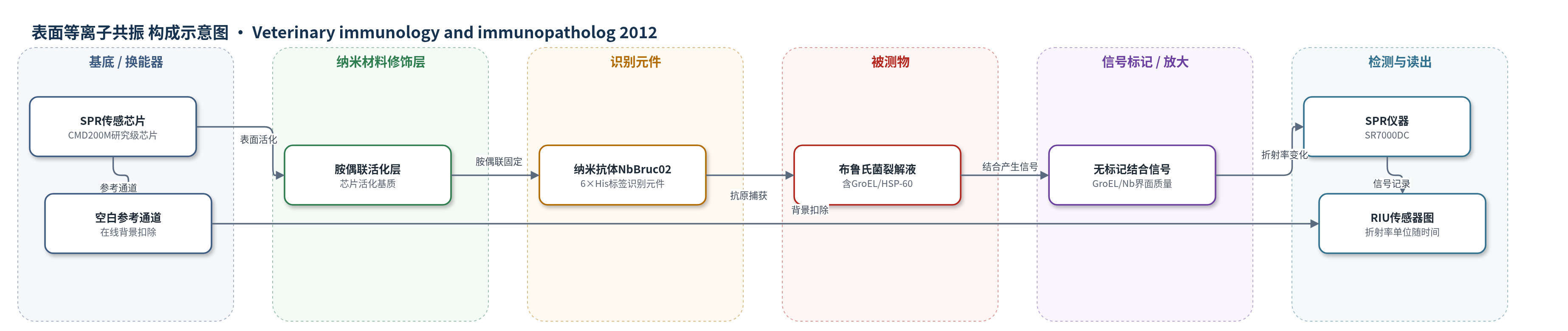
点击图片查看大图 · 依据论文自动绘制
传感器类型
表面等离子共振(SPR)生物传感器
检测对象
布鲁氏菌 GroEL 热休克蛋白(Brucella GroEL/HSP-60);样品基质:布鲁氏菌总裂解液(Brucella total lysate)
检测原理
SPR 检测采用无标记实时界面质量传感。先将 6×His 标签纳米抗体 NbBruc02 以胺偶联方式共价固定于 CMD200M 芯片的一个通道,另一通道留空作参考。布鲁氏菌总裂解液在 HBS-EP 缓冲液中流过芯片时,裂解液中的 GroEL/HSP-60 与固定 NbBruc02 发生特异性结合,使芯片表面局部质量与折射率增加,表面等离子共振条件改变,仪器以折射率单位(RIU)记录结合曲线。裂解液浓度由 0.5、1 到 2 mg/mL 时,结合信号分别约 2200、4700、7000 RIU,表明信号随被测抗原量增加而增强。该过程不依赖酶或荧光标记,无信号放大;识别特异性还受 GroEL 折叠状态影响,天然布鲁氏菌 GroEL 可被识别,而经盐酸胍变性的耶尔森菌 GroEL 也可被识别。
检测灵敏度
原文未报告 LOD、线性范围、灵敏度斜率或相关系数。
效应效果
NbBruc02 对布鲁氏菌属多株(B. abortus NALR、S99、S19、G30;B. melitensis NALR、Riv1、S1;B. ovis S15)阳性,对耶尔森菌 O9 及肠杆菌、假单胞菌、变形杆菌、沙门氏菌、芽孢杆菌、链球菌、葡萄球菌无反应;骆驼血清不能区分布鲁氏菌与耶尔森菌。ELISA 中只识别胞质提取物,不识别完整细胞、OMP、LPS 或周质提取物。SPR 固定 NbBruc02 稳定捕获抗原,洗涤后信号维持,0.5、1、2 mg/mL 裂解液对应约 2200、4700、7000 RIU。Nb-IP 拉下约 60 kDa 蛋白并随裂解液量增加。MALDI-TOF-MS 以 Mowse 92 鉴定为 GroEL。作者认为可用于诊断、治疗及疫苗抗原开发。
传感器的构成
- SPR换能基底:CMD200M研究级传感芯片,提供表面等离子共振检测界面
- 活化修饰层:芯片活化基质,通过胺偶联形成共价固定位点
- 识别元件:6×His标签纳米抗体NbBruc02,0.1 µg/mL于10 mM醋酸缓冲液pH 5.0,共价固定并识别GroEL
- 信号标记物:无标记,SPR直接检测结合引起的折射率变化
- 参考通道:空白通道,用于在线扣除背景折射率变化
- 读出系统:SR7000DC SPR仪器,记录RIU传感器图
中文摘要
当前抗体难以区分布鲁氏菌(Brucella)与耶尔森菌(Yersinia)等近缘病原体,因为二者共享相同的脂多糖(LPS)O-链表位;同时布鲁氏菌病对公共卫生和畜牧业经济影响重大,亟需鉴定新的免疫原性蛋白以开发下一代疫苗。骆驼重链抗体来源的纳米抗体(Nanobody, Nb)具有小分子、高稳定性和强特异性,可用于感染性疾病研究。此前作者从热灭活布鲁氏菌免疫的单峰骆驼中构建了免疫纳米抗体库,并以布鲁氏菌总裂解液进行噬菌体展示筛选,快速富集到 NbBruc02。本研究表征该纳米抗体在明确条件下区分布鲁氏菌与其他细菌(包括耶尔森菌)的能力。SPR 生物传感器显示 NbBruc02 能在粗裂解液中与其抗原发生强而特异的相互作用,并可通过免疫捕获从裂解液中富集同源抗原。MALDI-TOF-MS 将该抗原鉴定为分子伴侣 GroEL,即 60 kDa 热休克蛋白(HSP-60),它是布鲁氏菌免疫优势抗原,参与应激条件下蛋白质折叠。研究还发现 NbBruc02 的识别受 GroEL 折叠状态影响。因此,纳米抗体技术既可获得用于诊断和潜在治疗的特异性结合分子,也可鉴定疫苗候选抗原。
英文摘要
The deployment of today's antibodies that are able to distinguish Brucella from the closely similar pathogens, such as Yersinia, is still considered a great challenge since both pathogens share identical LPS (lipopolysaccharide) O-ring epitopes. In addition, because of the great impact of Brucella on health and economy in many countries including Syria, much effort is going to the development of next generation vaccines, mainly on the identification of new immunogenic proteins of this pathogen. In this context, Brucella-specific nanobodies (Nbs), camel genetic engineered heavy-chain antibody fragments, could be of great value. Previously, a large Nb library was constructed from a camel immunized with heat-killed Brucella. Phage display panning of this 'immune' library with Brucella total lysate resulted in a remarkable fast enrichment for a Nb referred to as NbBruc02. In the present work, we investigated the main characteristics of this Nb that can efficiently distinguish under well-defined conditions the Brucella from other bacteria including Yersinia. NbBruc02 showed a strong and specific interaction with its antigen within the crude lysate as tested by a surface plasmon resonance (SPR) biosensor and it was also able to pull down its cognate antigen from such lysate by immuno-capturing. Using matrix assisted laser desorption ionization time-of-flight mass spectrometry (MALDI-TOF-MS), NbBruc02 specific antigen was identified as chaperonin GroEL, also known as heat shock protein of 60 kDa (HSP-60), which represents a Brucella immunodominant antigen responsible of maintaining proteins folding during stress conditions. Interestingly, the antigen recognition by NbBruc02 was found to be affected by the state of GroEL folding. Thus, the Nb technology applied in the field of infectious diseases, e.g. brucellosis, yields two outcomes: (1) it generates specific binders that can be used for diagnosis, and perhaps treatment, and (2) it identifies the immunogenic candidate antigens for developing vaccines.