组成图示
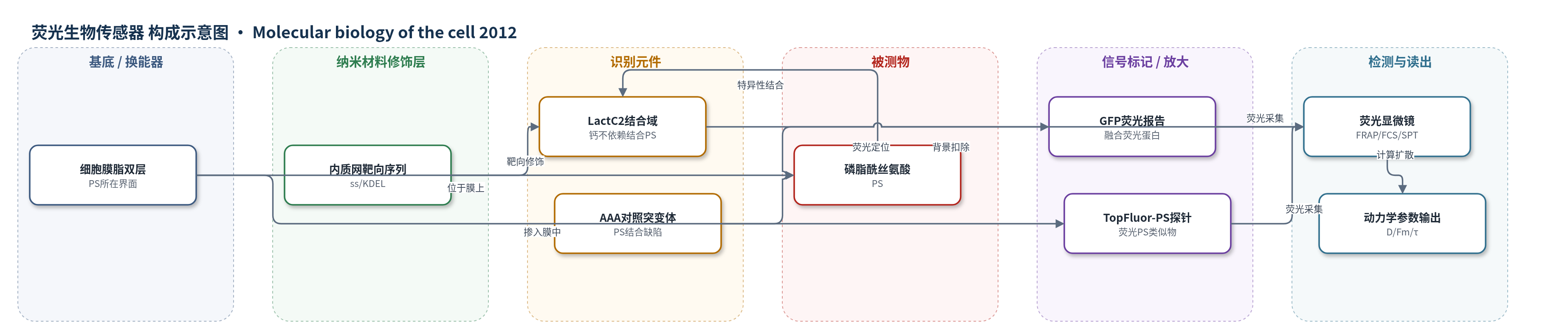
点击图片查看大图 · 依据论文自动绘制
传感器类型
荧光生物传感器
检测对象
磷脂酰丝氨酸(phosphatidylserine, PS);样品基质:活细胞(HeLa、RAW264.7)质膜、吞噬体膜、内质网腔面膜,以及支持脂双层/脂质体模型膜
检测原理
GFP-LactC2中的LactC2域与膜上PS头部基团发生钙离子不依赖的特异性结合,使原本在胞质中自由扩散的GFP-LactC2转变为膜结合态,荧光空间分布和侧向迁移性随PS浓度与分布改变。FRAP通过光漂白后荧光恢复,结合高斯拟合分离侧向扩散与结合/解离,得到扩散系数D和表观解离时间τ;FCS通过荧光强度自相关曲线区分膜结合慢扩散与胞质快扩散,并结合Kd估算PS浓度;SPT/TIRFM追踪单分子轨迹,区分自由扩散与受限扩散。TopFluor-PS作为荧光PS类似物掺入脂双层,其荧光自淬灭/去淬灭随膜翻转、内吞稀释而变化。整体无外源酶或核酸放大,信号来自荧光探针与PS结合/掺入后的光学变化。
检测灵敏度
—
效应效果
TopFluor-PS比NBD-PS稳定:BSA回洗后NBD-PS去除>75%,TopFluor-PS大部分保留;37°C约30 min内完整,磷脂酶抑制剂不改变其消失。GFP-LactC2选择性结合PS,AAA突变体不结合;Kd为329±69、351±72、288±42 nM。HeLa质膜TopFluor-PS FRAP D=0.49 μm2/s、Fm=0.43,SPT 71%受限(111±4 nm);GFP-LactC2 D=0.33 μm2/s、τ=12.5 s。胆固醇增加使D降至0.10 μm2/s,耗竭降至0.15 μm2/s。ER腔面PS浓度估计2–30 μM,支持PS不对称分布与皮层肌动蛋白限制。
传感器的构成
- 传感界面:细胞质膜、内体/吞噬体膜或内质网膜脂双层,提供磷脂酰丝氨酸(PS)结合位点
- 识别元件:LactC2(lactadherin discoidin-type C2 domain),钙离子不依赖地特异性结合PS头部基团
- 荧光报告元件:GFP(green fluorescent protein),与LactC2融合,PS结合后产生膜定位荧光信号
- 靶向/保留元件:preprolactin signal sequence(ss)与KDEL motif,将ss-LactC2-GFP-KDEL靶向并保留于内质网腔
- 对照元件:GFP-LactC2(AAA)或ss-LactC2(AAA)-GFP-KDEL,PS结合缺陷,用于扣除游离/非特异结合背景
- 辅助探针:TopFluor-PS(1-palmitoyl-2-(dipyrrometheneboron difluoride)undecanoyl-sn-glycero-3-phospho-l-serine),合成荧光PS类似物,掺入膜中报告PS分布与翻转
中文摘要
既往利用膜联蛋白V研究外翻磷脂酰丝氨酸(PS)在凋亡和凝血中的作用,但膜联蛋白不能进入细胞,且在低钙下不能结合PS,因此正常细胞内膜系统PS的拓扑分布与动力学知之甚少。本研究采用两种新探针:绿色荧光蛋白(GFP)-LactC2,一种遗传编码的荧光PS生物传感器;以及1-棕榈酰-2-(二吡咯甲烷硼二氟)十一酰-sn-甘油-3-磷酸-L-丝氨酸(TopFluor-PS),一种合成荧光PS类似物,检测活细胞内PS分布与动力学。通过单粒子追踪、荧光相关光谱、荧光漂白恢复和全内反射荧光显微镜等光学方法评估PS迁移性。结果显示,质膜中存在相当比例迁移受限的PS,皮层肌动蛋白参与限制PS运动;将GFP-LactC2靶向分泌途径后,可检测到内质网腔面叶存在PS。数据为理解细胞内PS性质、亚细胞分布与功能提供了新见解。
英文摘要
Much has been learned about the role of exofacial phosphatidylserine (PS) in apoptosis and blood clotting using annexin V. However, because annexins are impermeant and unable to bind PS at low calcium concentration, they are unsuitable for intracellular use. Thus little is known about the topology and dynamics of PS in the endomembranes of normal cells. We used two new probes-green fluorescent protein (GFP)-LactC2, a genetically encoded fluorescent PS biosensor, and 1-palmitoyl-2-(dipyrrometheneboron difluoride)undecanoyl-sn-glycero-3-phospho-L-serine (TopFluor-PS), a synthetic fluorescent PS analogue-to examine PS distribution and dynamics inside live cells. The mobility of PS was assessed by a combination of advanced optical methods, including single-particle tracking and fluorescence correlation spectroscopy. Our results reveal the existence of a sizable fraction of PS with limited mobility, with cortical actin contributing to the confinement of PS in the plasma membrane. We were also able to measure the dynamics of PS in endomembrane organelles. By targeting GFP-LactC2 to the secretory pathway, we detected the presence of PS in the luminal leaflet of the endoplasmic reticulum. Our data provide new insights into properties of PS inside cells and suggest mechanisms to account for the subcellular distribution and function of this phospholipid.