组成图示
点击图片查看大图 · 依据论文自动绘制
传感器类型
综述或非传感器论文
检测对象
葡萄糖(glucose)、乳酸(lactate);样品基质:组织间液、血液、体内植入组织
检测原理
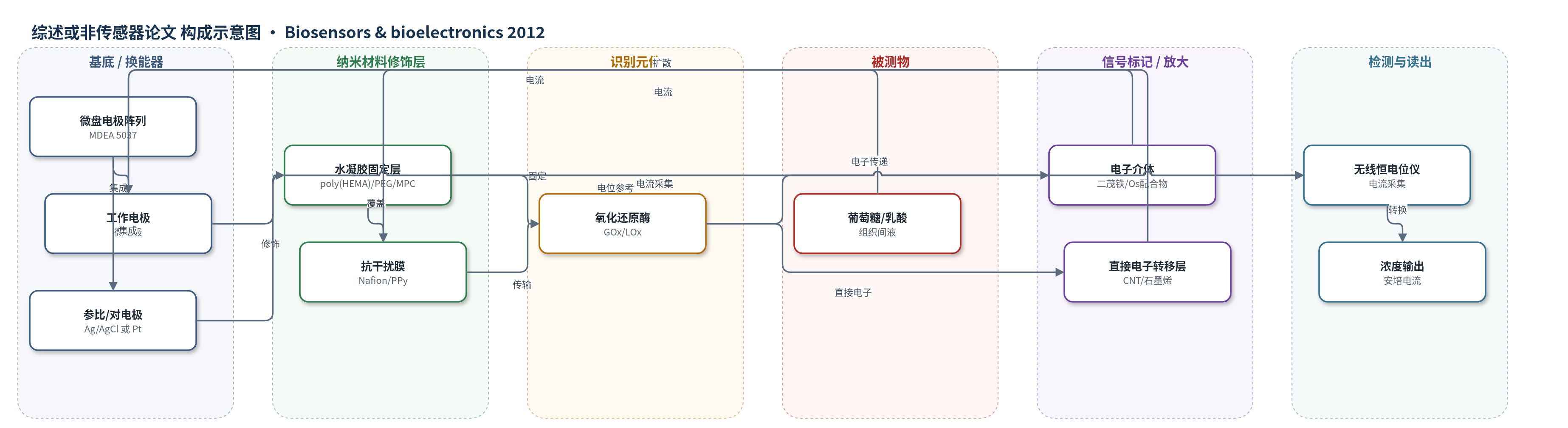
植入式酶安培生物传感器以微电极作为换能器,在工作电极上施加固定电位。识别元件通常为葡萄糖氧化酶(GOx)或乳酸氧化酶(LOx),其催化底物发生氧化还原反应。第一代器件中,GOx/LOx 在分子氧存在下产生过氧化氢(H2O2),H2O2 在工作电极上被阳极氧化或阴极还原,产生与底物浓度相关的稳态电流。第二代器件引入二茂铁、Os(II/III)联吡啶配合物或导电聚合物等电子介体,在酶辅因子与电极间传递电子,降低工作电位并减少尿酸、抗坏血酸等干扰。第三代器件利用碳纳米管(CNT)或石墨烯实现酶 FAD 与电极间的直接电子转移,可摆脱对氧和介体的依赖。微电极的稳态扩散使电流趋于稳定,酶催化和介体/直接电子转移构成信号放大与低电位检测策略。
检测灵敏度
原文未报告具体 LOD、线性范围、灵敏度斜率或相关系数。
效应效果
聚合物抗干扰膜可将尿酸、抗坏血酸、对乙酰氨基酚等干扰限制至总响应的约1–6%;含0.5 mol% PEG和10 mol% MPC的poly(HEMA)水凝胶较纯poly(HEMA)降低64%蛋白吸附。Dexcom STS/STS-7已获FDA批准;乳酸MDEA 5037在大鼠失血性休克模型中显示组织间液与血液乳酸不一致。植入生物传感器在鼠中连续工作最长4个月、猪中1年。无线UWB发射器实现1 ns脉冲、90–270 MHz、14 Mbps,功耗10–21 mW,距离3.2–4.0 m;Bio-Nano-Sensor体积约2477 mm3。作者认为长期植入与无线集成具临床价值。
传感器的构成
- 换能器电极:微盘电极阵列(MDEA 5037)或针状微电极,含工作、对和参比电极,Ag/AgCl 或 Pt 伪参比,用于施加电位并采集安培电流
- 识别元件:葡萄糖氧化酶(GOx)或乳酸氧化酶(LOx),固定于工作电极,催化葡萄糖或乳酸氧化还原
- 酶固定/仿生膜:poly(HEMA) 水凝胶,可含 PEG、MPC、葡聚糖、海藻酸盐或透明质酸,用于固定酶并降低蛋白吸附与异物反应
- 抗干扰膜:Nafion、聚吡咯(PPy)、聚邻苯二胺(PPD)等聚合物膜,限制尿酸、抗坏血酸、对乙酰氨基酚等干扰物传输
- 电子介体/直接电子转移层:二茂铁、聚二茂铁、Os(II/III)联吡啶配合物、导电聚合物(PPy/聚噻吩/聚苯胺)或碳纳米管(CNT)/石墨烯,用于酶-电极电子传递
- 信号读出:无线恒电位仪/ASIC 前端,采集稳态电流并转换为分析物浓度
中文摘要
植入式酶安培生物传感器仍是体内检测、监测和报告与多种病理相关的生化分析物的主要形式。它已广泛用于动物研究,并日益被强调用于糖尿病管理、创伤相关出血管理和重症监护。这些前沿应用要求器件连续留置性能长达数年,远超当前已批准的7天。本综述概述了长期植入式安培酶生物传感器成功部署所面临的诸多挑战,并强调其持续发展中的新兴技术路线。异物反应在植入式生物换能器失效中起突出作用。文章综述了减轻炎症反应、使用仿生化学、纳米结构形貌、药物释放结构以及组织-器件界面模量匹配等方法。同时,文章讨论了影响生物换能器性能的因素,包括酶稳定性、底物干扰、介体选择和校准。对于生物传感器系统,受足迹要求、混合信号电子局限和功率需求驱动,形成了三种系统方法。其潜力巨大,但解决基本问题所需的多尺度集成,以及实现这些高集成系统成功所需的跨学科集成,仍是植入式安培酶生物传感器系统开发与部署中的挑战。
英文摘要
The implantable enzyme amperometric biosensor continues as the dominant in vivo format for the detection, monitoring and reporting of biochemical analytes related to a wide range of pathologies. Widely used in animal studies, there is increasing emphasis on their use in diabetes care and management, the management of trauma-associated hemorrhage and in critical care monitoring by intensivists in the ICU. These frontier opportunities demand continuous indwelling performance for up to several years, well in excess of the currently approved seven days. This review outlines the many challenges to successful deployment of chronically implantable amperometric enzyme biosensors and emphasizes the emerging technological approaches in their continued development. The foreign body response plays a prominent role in implantable biotransducer failure. Topics considering the approaches to mitigate the inflammatory response, use of biomimetic chemistries, nanostructured topographies, drug eluting constructs, and tissue-to-device interface modulus matching are reviewed. Similarly, factors that influence biotransducer performance such as enzyme stability, substrate interference, mediator selection and calibration are reviewed. For the biosensor system, the opportunities and challenges of integration, guided by footprint requirements, the limitations of mixed signal electronics, and power requirements, has produced three systems approaches. The potential is great. However, integration along the multiple length scales needed to address fundamental issues and integration across the diverse disciplines needed to achieve success of these highly integrated systems, continues to be a challenge in the development and deployment of implantable amperometric enzyme biosensor systems.