组成图示
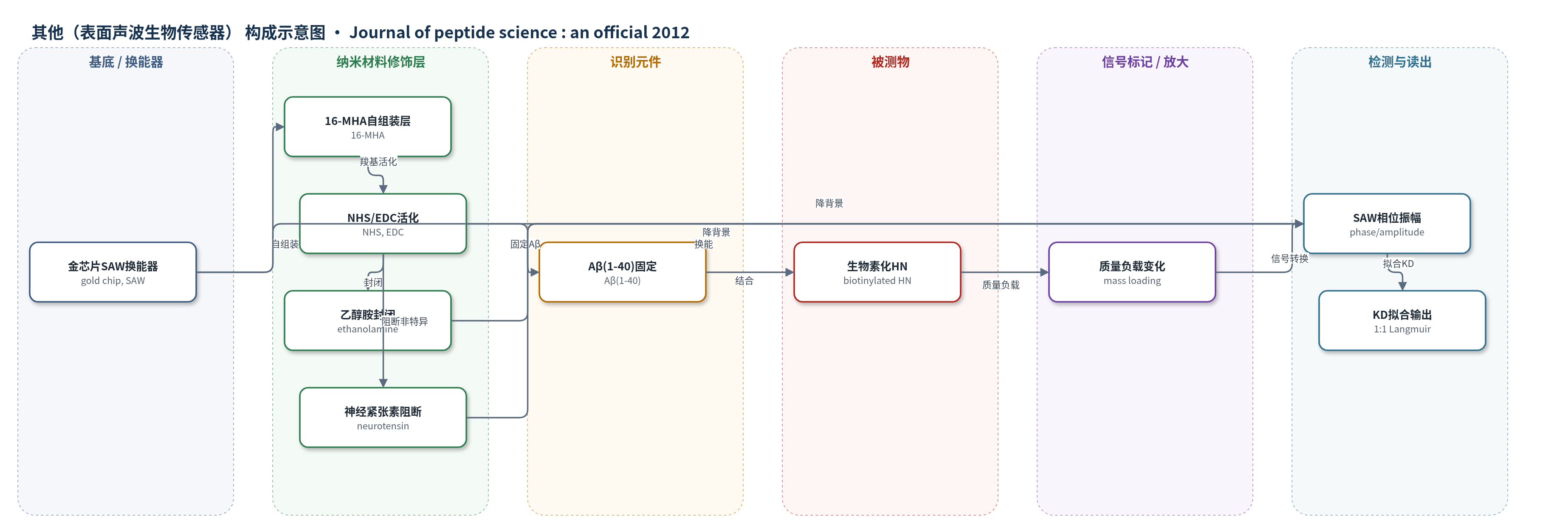
点击图片查看大图 · 依据论文自动绘制
传感器类型
其他(表面声波生物传感器)
检测对象
人神经保护肽 humanin(HN)、生物素化 HN 变体(biotinylated HN, BG5HN/BG5HNG),样品基质:PBS
检测原理
SAW 传感器以金芯片为基底,16-巯基十六烷酸自组装形成羧基单分子层,经 EDC/NHS 活化后共价固定 Aβ(1–40) 作为识别配体;乙醇胺封闭未反应基团,神经紧张素阻断非特异位点。注入不同浓度生物素化 HN 后,HN 的 HN(5–15) 表位与 Aβ(17–28) 结合,使界面质量负载和局部粘度增加,改变表面声波传播速度,表现为相位和振幅变化。信号随 HN 浓度升高而增大并趋于饱和。结合/解离曲线按 1:1 Langmuir 模型拟合,由 kon 和 koff 计算 KD。该方法无酶或核酸放大,依赖直接质量响应。
检测灵敏度
—
效应效果
SAW 生物亲和分析显示 HN 与 Aβ(1–40) 发生特异性结合,阴性对照神经紧张素不结合;MALDI-MS 也仅洗脱 HN,支持选择性。SAW 测得 BG5HN 与 Aβ(1–40) 复合物 KD 为 0.61 μM(610 nM),Ser14Gly 突变体 BG5HNG 为 0.53 μM,结果与 ELISA 定量一致。ELISA 中 Cys8Ala 变体 BG5HNA 对 Aβ(1–40) 亲和最高,野生型 BG5HN 与 BG5HNG 在低浓度时结合相似,浓度高于 0.33 μM 后饱和;Cys8 被 Acm 烷基化或替换为 Ser 时亲和明显降低,提示 Cys-8 参与结合。论文未报告 RSD、长期稳定性或实际样品回收率。作者认为该结果阐明 HN 神经保护作用的分子基础,支持其作为 AD 治疗先导结构。
传感器的构成
- 换能器基底:金芯片(gold chip)与表面声波(SAW)换能器,将高频电信号逆压电转换为表面声波。
- 自组装单分子层:16-巯基十六烷酸(16-mercaptohexadecanoic acid, MCH)在金表面形成羧基功能化 SAM。
- 活化层:N-羟基琥珀酰亚胺(NHS)与 1-乙基-3-(3-二甲基氨基丙基)碳二亚胺(EDC)活化羧基,用于共价固定肽。
- 识别/捕获元件:Aβ(1–40) 固定于芯片表面,作为配体特异性捕获 HN。
- 封闭剂:乙醇胺(ethanolamine)灭活未反应活化基团;神经紧张素(neurotensin)阻断非特异结合位点。
- 分析物/信号标记:生物素化 HN(biotinylated HN, BG5HN/BG5HNG)作为检测对象,结合后改变表面质量负载。
- 读出层:S-sens K5 SAW 仪器检测相位与振幅变化,并用 OriginPro/FitMaster 拟合 KD。
中文摘要
人神经保护肽 humanin(HN)是一种近期在阿尔茨海默病(AD)人脑中检出的线性 24 氨基酸肽。HN 在体外可特异性抑制由 β-淀粉样蛋白(Aβ)肽以及家族性 AD 相关淀粉样前体蛋白(APP)及其基因突变诱导的神经元死亡,因而被视为 AD 潜在治疗先导结构,但其分子机制尚不清楚。本研究通过亲和质谱和分子建模鉴定 HN 与 Aβ(1–40) 的结合表位并表征相互作用结构。野生型 HN 及序列突变体经固相肽合成(SPPS)合成,HPLC 纯化后以 MALDI-MS 表征。利用蛋白酶表位切除与提取的亲和质谱鉴定结合表位:HN 的表位为 HN(5–15),Aβ 的相互作用表位为 Aβ(17–28)。ELISA 进一步确认表位和结合位点。直接 ESI-MS 表征 HN–Aβ(1–40) 复合物的特异性与亲和,表面声波(SAW)生物传感器生物亲和分析给出复合物 KD 为 610 nM。分子动力学模拟与结合特异性及表位屏蔽效应一致。结果表明 HN 与 Aβ(1–40) 存在特异性强结合,为理解 HN 神经保护功能提供分子基础。
英文摘要
Humanin (HN) is a linear 24-aa peptide recently detected in human Alzheimer's disease (AD) brain. HN specifically inhibits neuronal cell death in vitro induced by ß-amyloid (Aß) peptides and by amyloid precursor protein and its gene mutations in familial AD, thereby representing a potential therapeutic lead structure for AD; however, its molecular mechanism of action is not well understood. We report here the identification of the binding epitopes between HN and Aß(1-40) and characterization of the interaction structure through a molecular modeling study. Wild-type HN and HN-sequence mutations were synthesized by SPPS and the HPLC-purified peptides characterized by MALDI-MS. The interaction epitopes between HN and Aß(1-40) were identified by affinity-MS using proteolytic epitope excision and extraction, followed by elution and mass spectrometric characterization of the affinity-bound peptides. The affinity-MS analyses revealed HN(5-15) as the epitope sequence of HN, whereas Aß(17-28) was identified as the Aß interaction epitope. The epitopes and binding sites were ascertained by ELISA of the complex of HN peptides with immobilized Aß(1-40) and by ELISA with Aß(1-40) and Aß-partial sequences as ligands to immobilized HN. The specificity and affinity of the HN-Aß interaction were characterized by direct ESI-MS of the HN-Aß(1-40) complex and by bioaffinity analysis using a surface acoustic wave biosensor, providing a K(D) of the complex of 610 nm. A molecular dynamics simulation of the HN-Aß(1-40) complex was consistent with the binding specificity and shielding effects of the HN and Aß interaction epitopes. These results indicate a specific strong association of HN and Aß(1-40) polypeptide and provide a molecular basis for understanding the neuroprotective function of HN.