组成图示
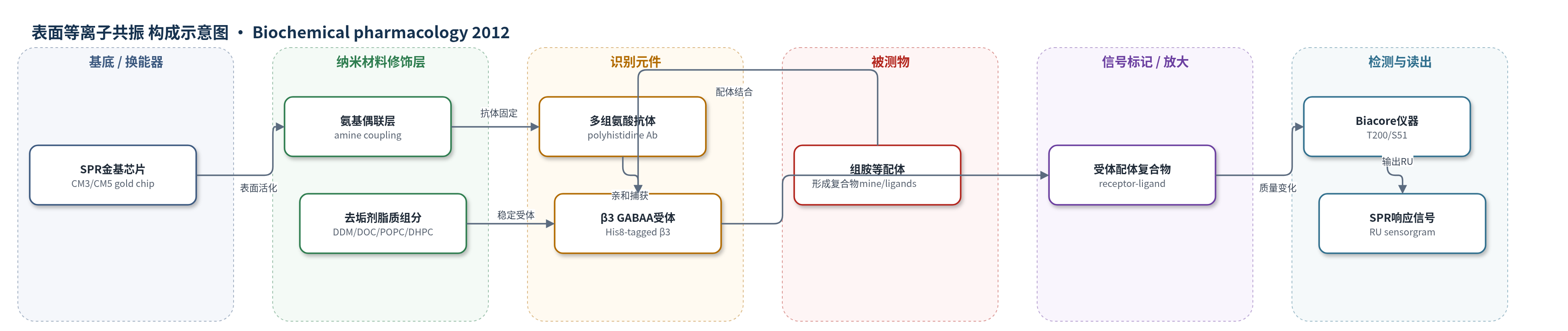
点击图片查看大图 · 依据论文自动绘制
传感器类型
表面等离子共振(SPR)生物传感器
检测对象
组胺(histamine)、组胺能配体(histaminergic ligands)、GABA能配体(GABAergic ligands);样品基质:Sf9 细胞溶解膜/去垢剂溶解受体运行缓冲液(detergent-solubilized membrane in running buffer)
检测原理
该传感器以金基 SPR 芯片为换能器,通过氨基偶联固定多组氨酸抗体,再亲和捕获 His8 标签同源寡聚 β3 GABAA 受体。去垢剂/脂质体系维持受体可溶和结合活性。当组胺或 GABA 能配体注入时,配体与受体结合,使传感器界面质量/折射率增加,改变表面等离子共振条件,产生响应单位(RU)信号。由于结合动力学很快,采用稳态 Langmuir 等温线 R=Rmax[L]/(KD+[L])+m 拟合浓度-信号曲线获得 KD。竞争实验中,组胺与配体混合注入的信号低于二者单独信号之和,表明竞争结合。方法无酶放大,依靠直接质量传感,可检测组胺等小分子(Rmax<3 RU)。
检测灵敏度
原文未报告 LOD、线性范围、灵敏度斜率或相关系数。
效应效果
固定后的 β3 受体表面基线稳定,可在同一传感器表面完成超过 200 次配体注入(约 15–20 h),满足片段库筛选约 10^3 化合物的通量需求。Biacore T200 信噪比低于 S51,但两者均可用于本研究。方法能检测组胺等小分子直接结合(Rmax<3 RU),51 种组胺能配体中 17 种 KD<300 μM,其中 13 种与组胺竞争;5 种 GABA 能配体结合,而 GABA 至 100 μM 不结合。竞争验证显示 famotidine 表观 pKD 由 4.1±0.2 降至 3.6,tiotidine 由 4.5±0.1 降至 4.0。结果与放射配体结合和电生理数据一致,支持用于全长膜蛋白药物识别和片段药物发现。
传感器的构成
- 基底/换能器:CM3/CM5 金基 SPR 芯片(gold-based SPR chip),提供表面等离子共振检测界面。
- 亲和捕获层:多组氨酸抗体(polyhistidine antibody),经氨基偶联化学固定,特异性识别 His8 标签。
- 受体识别层:His8 标签同源寡聚 β3 GABAA 受体(His8-tagged homo-oligomeric β3 GABAA receptor),去垢剂溶解后捕获,提供配体结合位点。
- 受体稳定组分:DDM、DOC、POPC、DHPC 混合去垢剂/脂质体系,维持受体五聚体构象与结合活性。
- 运行缓冲液:25 mM Tris–HCl、150 mM NaCl、2 mM CaCl2、5 mM KCl、5 mM MgCl2、4 mM EDTA、0.15% DDM、0.2% DMSO,pH 7.4,维持受体稳定并校正溶剂效应。
- 信号读出:Biacore T200/S51 仪器,监测结合引起的响应单位(RU)变化。
中文摘要
本研究建立了一种表面等离子共振(SPR)生物传感器方法,用于研究51种组胺能和15种GABA能配体与同源寡聚β3 GABAA受体的相互作用。去垢剂溶解的受体通过亲和捕获固定在生物传感器表面。组胺能和GABA能配体的相互作用动力学很快,但可通过稳态分析确定亲和力。多个GABA能配体结合结果与既往数据一致。组胺和16种组胺能配体被检测到直接结合β3 GABAA受体,亲和力为微摩尔级(KD<300 μM),进一步支持β3 GABAA受体可与组胺能配体相互作用。组胺对这些受体的亲和力与人类组胺H1或H2受体相当,且其中13种组胺能配体与组胺竞争结合。H2、H3和H4受体配体与β3受体的相互作用表明这些受体具有独特的组胺药理学特征。由于对同源五聚体β3受体亲和力较低,这些组胺药物在临床相关浓度下不太可能调节该受体。结果支持将该SPR生物传感器用于全长受体药物识别和基于片段的药物发现,高亲和、选择性化合物有助于阐明β3受体是否存在于脑内,并为靶向该新型组胺结合位点的药物开发提供新途径。
英文摘要
A surface plasmon resonance biosensor assay was established for studying the interactions of 51 histaminergic and 15 GABAergic ligands with homo-oligomeric β3 GABA(A) receptors. Detergent solubilized receptors were successfully immobilized via affinity-capture on biosensor surfaces. The interaction kinetics of both histaminergic and GABAergic ligands were very rapid but affinities could be determined by steady-state analysis. Binding of several GABAergic ligands was observed, in agreement with previous data. Histamine and 16 histaminergic ligands were detected to directly bind to β3 GABA(A) receptors with micromolar affinity (K(D)<300 μM), thus extending previous evidence that β3 GABA(A) receptors can interact with histaminergic ligands. Histamine exhibited an affinity for these receptors comparable to that for human histamine type 1 (H1) or type 2 (H2) receptors. Furthermore, 13 of these histaminergic ligands appeared to compete with histamine. The discovery that H2, H3 and H4 receptor ligands interact with β3 receptors indicates a unique histaminergic pharmacology of these receptors. Due to their low affinity for the homo-pentameric β3 receptors these histaminergic drugs are not expected to modulate these receptors at clinically relevant concentrations. The results support the use of the new biosensor assay for the identification of drugs interacting with full length receptors and for fragment-based drug discovery of high affinity ligands for β3 receptors. Drugs with high affinity and selectivity for these receptors can be used to clarify the question whether β3 receptors do exist in the brain, and provide new avenues for the development of therapeutically active compounds targeting this novel histamine binding site.