组成图示
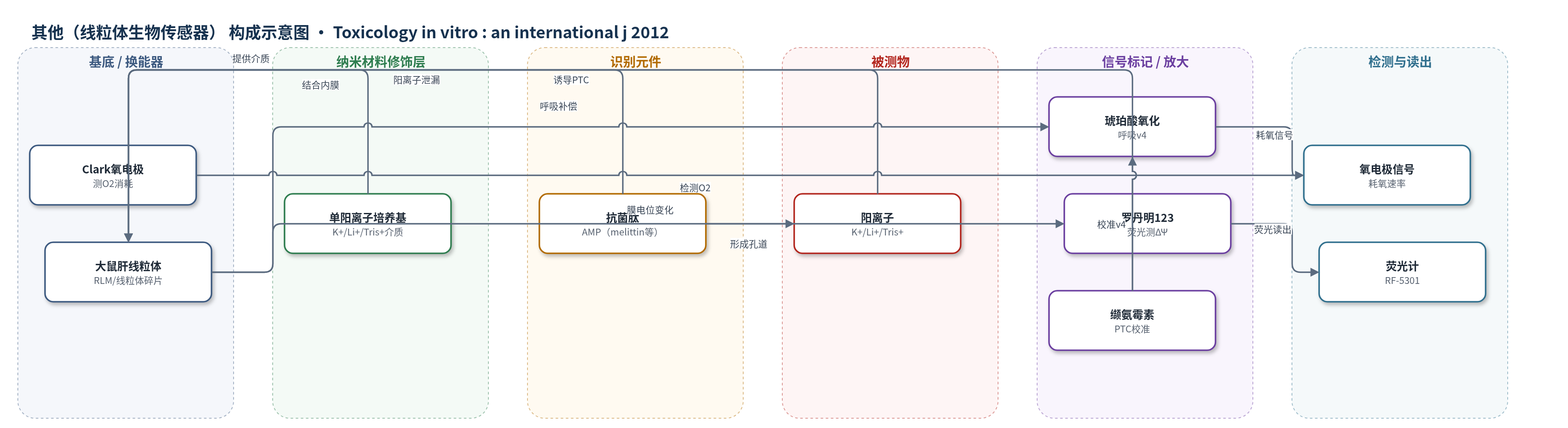
点击图片查看大图 · 依据论文自动绘制
传感器类型
其他(线粒体生物传感器)
检测对象
蜂毒肽(melittin)、黄蜂毒肽(mastoparan)、短杆菌肽(alamethicin);样品基质:大鼠肝线粒体(RLM)/线粒体碎片(mitoplasts)悬浮液(单阳离子培养基)
检测原理
抗菌肽在跨膜电位(ΔΨ)驱动下插入大鼠肝线粒体内膜,形成低寡聚孔或预孔,使K+、Li+或Tris+等阳离子跨膜,产生钾跨膜电流(PTC)。阳离子泄漏由琥珀酸驱动的电子传递链质子泵入补偿,导致稳态耗氧速率v4升高;v4激活程度与PTC成比例,可用缬氨霉素诱导的线性PTC校准。在双对数坐标中,v4激活对肽浓度的斜率即限速反应级数,melittin、mastoparan和alamethicin第一相分别约为2.01、1.83和1.92,提示限速步骤接近二聚/预孔形成。罗丹明123荧光同步监测ΔΨ,Clark氧电极读出耗氧信号。
检测灵敏度
相关系数: >0.95(valinomycin 滴定线性);双对数斜率(反应级数): melittin 2.01 ± 0.15,mastoparan 1.83 ± 0.23,alamethicin 1.92 ± 0.07
效应效果
该线粒体传感器在16 h内呼吸速率变化<4%,单条曲线30 min内变化2–3%;最高肽浓度下v4激活可稳定20 min,数据为3次独立生物学重复。缬氨霉素滴定线性相关系数>0.95。有效膜浓度Cm覆盖40–4600 μM,肽/脂比约1/6250–1/54;CLC/A200为7.5–44.6,表明低浓度下未破坏线粒体。相比脂体/BLM,RLM可维持ΔΨ数分钟,避免渗透压和膜张力干扰,并能时间分辨alamethicin低/高寡聚通道。作者认为可用于比较评价潜在药物的线粒体/肝毒性。
传感器的构成
- 换能器电极:Clark型氧电极(Clark-type electrode),响应时间20 s,检测O2消耗/呼吸速率
- 生物传感元件:紧密偶联大鼠肝线粒体(RLM)/线粒体碎片(mitoplasts/SMP),维持ΔΨ并作为PTC传感器
- 识别/作用元件:抗菌肽(melittin、mastoparan、alamethicin、TAM),插入内膜形成孔/预孔
- 信号转换底物:琥珀酸钠(sodium succinate),驱动电子传递链泵质子,使耗氧v4与PTC成比例
- 膜电位探针:罗丹明123(rhodamine 123),荧光变化监测ΔΨ(503/527 nm)
- 校准离子载体:缬氨霉素(valinomycin),诱导简单PTC,用于v4激活与PTC线性校准
- 介质/缓冲层:单阳离子培养基(IMKP/IMLiP/IMT等),含K+、Li+、Tris+、Mg2+、EDTA、Hepes/Tris、蔗糖
- 解偶联/验证试剂:FCCP或SF,用于测定ΔΨ变化并验证内膜完整性
中文摘要
来自蜂毒、黄蜂毒和真菌的毒性物质蜂毒肽(melittin)、黄蜂毒肽(mastoparan)和短杆菌肽(alamethicin)可通透生物膜。本研究以能产生跨膜电位(ΔΨ)的大鼠肝线粒体(RLM)为钾跨膜电流(PTC)传感器,考察这些肽在RLM中形成孔的初始步骤。在含6 mM Mg2+的“钾”孵育介质中,melittin诱导的RLM呼吸稳态激活对肽浓度的反应级数为2.01±0.15;mastoparan为1.83±0.23。alamethicin在“Tris”介质中未出现第一稳态激活相,加入KCl后才出现,其限速反应级数为1.92±0.07。结果表明该相PTC主要由由“二聚体”形成的最低寡聚度通道决定。等活性膜浓度之比反映相应“二聚体”平均寿命(ALT)之比(alamethicin/melittin为38.5,mastoparan/melittin为0.32)。结论认为该结果可用于比较评价潜在药物的线粒体毒性。
英文摘要
Toxic agents, derived from bee or hornet venoms and from fungi - melittin, mastoparan, and alamethicin are able to permeabilize biological membranes. We studied the initial steps of pore formation by these peptides in rat liver mitochondria preparations (RLM) generating transmembrane potential (ΔΨ). RLM has been used as a potassium transmembrane current (PTC) sensor. The PTC induced in RLM depends linearly on the degree of steady-state activation of RLM respiration. The concentration order of such activation by melittin in a "potassium" incubation medium containing 6mM Mg(2+) was 2.01±0.15. In the case of mastoparan, the reaction order was 1.83±0.23. The first steady-state phase of activation of RLM respiration by alamethicin was not detected in "Tris" incubation medium; it appeared only after addition of KCl. The order of the reaction limiting such activation was 1.92±0.07. It is suggested that PTC in this phase is determined by the channels with the lowest degree of oligomerization formed by "dimers". The ratio of equally active membrane concentrations of peptides obviously reflects the ratio of average lifetimes (ALT) for corresponding "dimers" (alamethicin and melittin, 38.5; mastoparan and melittin, 0.32). It is concluded that the results of this investigation may be useful for comparative testing of perspective pharmaceuticals.