组成图示
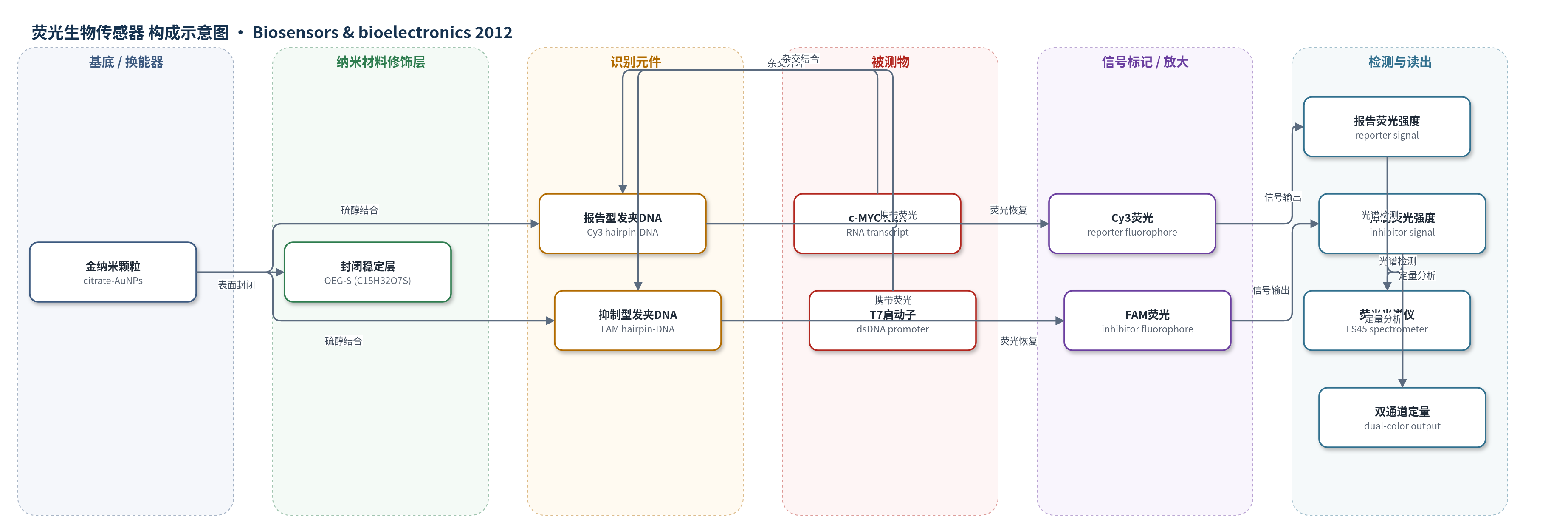
点击图片查看大图 · 依据论文自动绘制
传感器类型
荧光生物传感器
检测对象
c-MYC RNA转录本(c-MYC RNA transcript)、T7启动子区(T7 promoter region);样品基质:体外转录反应液(in vitro transcription reaction mixture)
检测原理
Au-nanobeacon由AuNP表面通过硫醇-C6连接发夹DNA,3'端带Cy3或FAM。无靶标时发夹茎环闭合,荧光基团靠近AuNP并被猝灭,荧光弱。当c-MYC RNA转录本生成并与报告型发夹loop杂交时,茎环打开,Cy3远离AuNP,荧光恢复;荧光强度随RNA浓度/合成量增加而增加。抑制型FAM发夹与T7启动子区杂交后,FAM远离AuNP发出荧光,指示被结合/阻断的启动子数量;同时占据T7启动子,阻止T7 RNA polymerase起始转录,降低RNA产量。双通道荧光(490/530 nm激发)实时读出,实现RNA合成速率与抑制程度定量。
检测灵敏度
灵敏度斜率: y=0.8482x+0.0719; y=1.2634x+0.1614; y=0.0618x+0.0018; y=0.1076x+0.0539;相关系数: R2=0.9948
效应效果
该传感器具序列特异性:报告型信标与互补靶标杂交后荧光较非相关靶标提高10倍;抑制型信标与互补启动子区杂交后荧光提高4.3倍,不与非互补序列杂交。抑制型AuNP平均负载4.95±0.66条寡核苷酸。实时监测RNA合成速率约10.3 fmol/min;加入1 nM抑制型信标后,60 min转录产物由约618 fmol降至约43.9 fmol,降低14.1倍。不同模板浓度下启动子阻断比例为17.63%、13.79%、10.79%、6.91%、7.64%,转录抑制率为96.14%、90.69%、66.49%、62.00%、56.39%。结果与实时qPCR和凝胶电泳定量一致,可快速评估RNA表达与基因沉默潜力。
传感器的构成
- 纳米基底/猝灭载体:柠檬酸金纳米颗粒(citrate-AuNPs,约14 nm),提供支撑并猝灭邻近荧光。
- 识别元件:5'-Thiol-C6修饰发夹DNA(thiolated hairpin-DNA),loop序列互补c-MYC RNA或T7启动子区,实现序列识别。
- 信号标记物:3'-Cy3(reporter)或3'-FAM(inhibitor)荧光基团,杂交后远离AuNP恢复荧光。
- 表面封闭剂:O-(2-巯基乙基)-O'-甲基-六(乙二醇)(O-(2-Mercaptoethyl)-O'-methyl-hexa(ethylene glycol)),封闭AuNP表面并稳定纳米信标。
- 靶标/反应体系:T7-MYC双链DNA模板、NTPs和T7 RNA polymerase体外转录体系,生成c-MYC RNA靶标。
- 读出装置:PerkinElmer LS45荧光光谱仪,490/530 nm激发监测FAM/Cy3荧光强度。
中文摘要
测量RNA合成及抑制水平对评估基因沉默策略至关重要。本文开发了一种基于金纳米颗粒(AuNPs)功能化荧光标记发夹DNA的直接实时RNA合成监测方法,即金纳米信标(Au-nanobeacon)。在发夹构型下,荧光基团靠近金纳米颗粒而发生荧光猝灭;与互补靶标杂交后,Au-nanobeacon构象重组,使荧光基团与AuNP分离,荧光发射恢复,产生定量响应。利用报告型Au-nanobeacon,作者测定了体外RNA合成速率(约10.3 fmol RNA/min)。随后设计靶向启动子序列的抑制型Au-nanobeacon,在抑制转录的同时监测被沉默启动子数量。两种Au-nanobeacon在同一反应体系中,可实时定量评估RNA合成水平及抑制程度。该生物传感器概念易于扩展,可用于实时定量评估RNA合成和抑制水平,并有助于体外评价特定序列的沉默潜力,为体内基因沉默应用提供参考。
英文摘要
Measuring RNA synthesis and, when required, the level of inhibition, is crucial towards the development of practical strategies to evaluate silencing efficiency of gene silencing approaches. We developed a direct method to follow RNA synthesis in real time based on gold nanoparticles (AuNPs) functionalized with a fluorophore labeled hairpin-DNA, i.e. gold-nanobeacon (Au-nanobeacon). Under hairpin configuration, proximity to gold nanoparticles leads to fluorescence quenching; hybridization to a complementary target restores fluorescence emission due to the Au-nanobeacons' conformational reorganization that causes the fluorophore and the AuNP to part from each other, yielding a quantitative response. With this reporter Au-nanobeacon we were able to measure the rate of in vitro RNA synthesis (~10.3 fmol of RNA per minute). Then, we designed a second Au-nanobeacon targeting the promoter sequence (inhibitor) so as to inhibit transcription whilst simultaneously monitor the number of promoters being silenced. Using the two Au-nanobeacons in the same reaction mixture, we are capable of quantitatively assess in real time the synthesis of RNA and the level of inhibition. The biosensor concept can easily be extended and adapted to situations when real-time quantitative assessment of RNA synthesis and determination of the level of inhibition are required. In fact, this biosensor may assist the in vitro evaluation of silencing potential of a given sequence to be later used for in vivo gene silencing.