组成图示
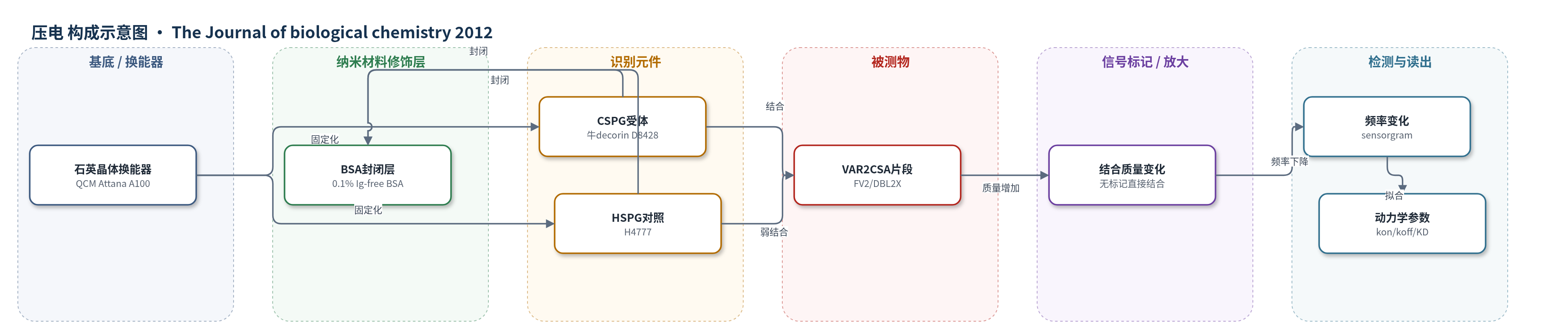
点击图片查看大图 · 依据论文自动绘制
传感器类型
压电(QCM)生物传感器
检测对象
重组恶性疟原虫 VAR2CSA 蛋白(Plasmodium falciparum VAR2CSA, PfEMP1)及其截短片段(FV2、DBL1X-ID2a、ID1-DBL4Δ、ID1-DBL2Xb 等),样品基质为重组蛋白溶液(Tris/NaCl 缓冲液)
检测原理
QCM 传感器表面先固定化硫酸软骨素蛋白聚糖(CSPG),再用无免疫球蛋白 BSA 封闭。当重组 VAR2CSA 或其截短片段注入流动池时,蛋白的 DBL2X 及邻近 ID1/ID2a 区与 CSPG 上的 CSA 发生特异性结合,使晶体表面质量增加。石英晶体共振频率随表面质量增加而下降,结合与解离过程形成随时间变化的 sensorgram。按 1:1 结合模型拟合可得到 kon、koff 和 KD,从而反映 VAR2CSA 与 CSA 的亲和力和动力学。该体系无酶或荧光放大,信号直接来自结合质量;HSPG 表面不结合或仅弱结合,用于验证 CSA 选择性。
检测灵敏度
原文未报告 LOD、线性范围、灵敏度斜率或相关系数。报告数值:ID1-DBL2Xb 结合亲和力 21.8 nM;盐滴定 log KD,observed 对 log[Na+] 的斜率 m(1-f) 为 2.7(ID1-ID2a)至 3.4(FV2),线性区间 150–300 mM NaCl。
效应效果
QCM 与 ELISA 一致,显示 ID1-DBL2Xb 为最小 CSPG 结合片段,KD 21.8 nM,与全长相当;片段特异性结合 CSPG 而不结合 HSPG,提示 CSA 选择性。经典硫酸结合基序突变和 DSM 删除未降低结合,说明不依赖经典离子位点。盐滴定在 150–300 mM NaCl 内线性,估计最多 2–3 个离子相互作用,约 25–35% 结合能归因离子作用。免疫实验中,含 CSA 结合位点片段诱导的抗血清几乎完全(接近 100%)抑制感染红细胞黏附 CSPG;DBL1X-DBL2Xa 和 ID1-DBL2Xa 抑制差。作者认为 ID1-DBL2X 等小片段可诱导强效抗黏附抗体,是胎盘疟疾疫苗候选。
传感器的构成
- 换能器基底:石英晶体微天平(QCM,Attana A100),以晶体共振频率变化监测表面结合质量。
- 识别配体层:硫酸软骨素蛋白聚糖(CSPG,牛 decorin,D8428,Sigma)或硫酸肝素蛋白聚糖(HSPG,H4777,Sigma),固定于晶体表面作为 CSA 受体。
- 封闭层:PBS 含 0.1% 无免疫球蛋白牛血清白蛋白(Ig-free BSA,BSA-50,Rockland),用于减少非特异结合。
- 分析物:重组 VAR2CSA 全长外域(FV2)及截短片段(DBL1X-ID2a、ID1-DBL4Δ、ID1-DBL2Xb 等),以 1:3 稀释系列注入。
- 信号读出:QCM 频率变化(sensorgram),按 1:1 结合模型拟合 kon、koff 和 KD。
中文摘要
表达 VAR2CSA 的恶性疟原虫通过结合胎盘合体滋养层上的硫酸软骨素 A(CSA)引起胎盘疟疾。为设计阻断黏附的疫苗,本研究通过截短重组 VAR2CSA 蛋白,并采用 ELISA 与石英晶体微天平(QCM)生物传感器技术鉴定其最小 CSA 结合区。结果显示,核心 CSA 结合位点位于 N 端 DBL2X 结构域及邻近的 ID1 和 ID2a 区,最小结合片段 ID1-DBL2Xb 的结合亲和力(KD 约 21.8 nM)与全长蛋白相当,且特异性结合硫酸软骨素蛋白聚糖(CSPG)而不结合硫酸肝素蛋白聚糖(HSPG)。小角 X 射线散射(SAXS)建模表明 DBL2X 位于紧凑 VAR2CSA 结构中心。经典硫酸结合基序突变和盐滴定实验提示 CSA 结合不完全依赖离子相互作用。基于该区域构建的小片段可诱导强效抗黏附抗体,是胎盘疟疾疫苗候选。
英文摘要
Malaria is a major global health problem. Pregnant women are susceptible to infection regardless of previously acquired immunity. Placental malaria is caused by parasites capable of sequestering in the placenta. This is mediated by VAR2CSA, a parasite antigen that interacts with chondroitin sulfate A (CSA). One vaccine strategy is to block this interaction with VAR2CSA-specific antibodies. It is a priority to define a small VAR2CSA fragment that can be used in an adhesion blocking vaccine. In this, the obvious approach is to define regions of VAR2CSA involved in receptor binding. It has been shown that full-length recombinant VAR2CSA binds specifically to CSA with nanomolar affinity, and that the CSA-binding site lies in the N-terminal part of the protein. In this study we define the minimal binding region by truncating VAR2CSA and analyzing CSA binding using biosensor technology. We show that the core CSA-binding site lies within the DBL2X domain and parts of the flanking interdomain regions. This is in contrast to the idea that single domains do not possess the structural requirements for specific CSA binding. Small-angle x-ray scattering measurements enabled modeling of VAR2CSA and showed that the CSA-binding DBL2X domain is situated in the center of the structure. Mutating classic sulfate-binding sites in VAR2CSA, along with testing dependence of ionic interactions, suggest that the CSA binding is not solely dependent on the sulfated CSA structure. Based on these novel PfEMP1 structure-function studies, we have constructed a small VAR2CSA antigen that has the capacity to induce highly adhesion-blocking antibodies.