组成图示
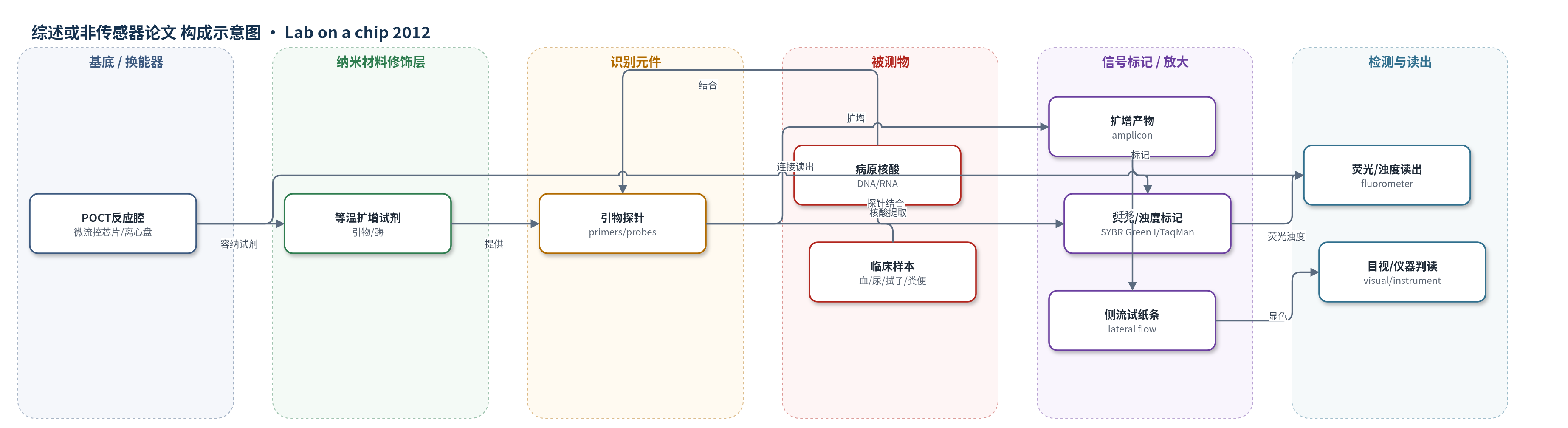
点击图片查看大图 · 依据论文自动绘制
传感器类型
综述或非传感器论文
检测对象
病原微生物核酸(DNA/RNA,包括细菌、病毒、真菌、寄生虫核酸);样品基质:血液、尿液、拭子、粪便、脑脊液、食品/环境样本等
检测原理
本文综述的等温核酸扩增POCT检测通常以临床样本中的病原DNA/RNA为靶标。引物或探针首先与目标序列特异性结合,随后在恒温条件下由解旋酶、重组酶、逆转录酶、RNA聚合酶、DNA聚合酶或限制性内切酶等驱动链分离、延伸、置换或转录,产生大量扩增子。LAMP/RCA/SMAP2可形成串联或超支产物,RPA/HDA/SDA/NEAR/ICAN产生离散或修饰末端产物。信号通过嵌入染料(SYBR Green I、EvaGreen)、TaqMan/分子信标、浊度、侧流层析或化学发光探针读出;目标浓度越高,扩增子积累越快,荧光/浊度/显色信号越强或出现时间越早。部分方法利用多引物、MutS错配抑制、链置换和滚环复制实现放大与特异性控制。
检测灵敏度
综述未给出统一LOD;文中报告LOD/灵敏度:NASBA 1 copy;HDA 1 copy;ICAN ~10–100 copies;LAMP ~5 copy;NEAR 10 copy LOD;RCA 10 copies;RPA 1 copy;SDA 10 copies;SMAP2 3 copy;SPIA WGA from as little as 500 pg;RPA digital 300 copies/mL sensitivity and dynamic range of 1400–1 000 000 copies/mL;HDA E. coli O157:H7 10^2 copy limit of detection;NEAR N. gonorrhoeae 10 copy LOD, C. trachomatis 10 copy LOD;EnviroLogix 50 copy LOD in 10 min;ICAN 25 times greater than equivalent PCR
效应效果
综述指出多种等温扩增方法在速度、灵敏度和特异性上可媲美甚至优于实时PCR/qPCR。LAMP研究最充分,检测限可低至约5 copies,能区分病毒变异、SNP和拷贝数,并耐受血清、脑脊液、拭子等粗样本;HDA对粗细菌样本仅约1倍灵敏度下降;NASBA在呼吸道感染诊断中优于ELISA和RT-PCR;RPA可在37–42 °C、20–40 min内完成;NEAR报告5 min、10 copy LOD并支持5-plex;ICAN灵敏度可比等效PCR高约25倍。商业产品包括Twista、Genie II、Illumigene、OligoC-TesT、NucliSENSEasyQ、APTIMA/Tigris、BESt Cassette和ProbeTec。瓶颈在于样本处理、扩增与检测的自动化集成、知识产权和监管。
传感器的构成
- 基底/换能器:微流控芯片、离心盘、侧流试纸条、荧光仪(microfluidic chip/centrifugal disc/lateral flow strip/fluorometer),用于容纳反应与信号读出
- 等温扩增试剂:引物、酶(primers/enzymes),用于恒温核酸扩增
- 识别元件:引物与探针(primers/probes),包括TaqMan、分子信标(molecular beacons),用于序列特异性识别
- 信号标记物:嵌入染料(SYBR Green I、EvaGreen)、荧光探针、化学发光探针(acridinium ester),用于产生可读出信号
- 读出方式:荧光、浊度、侧流层析、化学发光(fluorescence/turbidimetry/lateral flow/chemiluminescence),用于信号转换
中文摘要
核酸检测(NAT)有望实现对感染性、遗传性和遗传疾病的快速、灵敏和特异性诊断。下一代诊断设备将在即时检测(POCT)场景下检测这些疾病的遗传决定因素,使临床医生获得及时可靠的诊断,以指导更有效治疗。临床样本生化性质复杂,大多数临床样本中核酸靶标丰度低,且现有生物传感器技术有限,因此从小体积POCT样本中获得具有临床相关性的灵敏度,通常需要某种形式的核酸扩增。本文对现有核酸扩增技术进行概述和系统综述,比较不同方法并讨论其适配POCT的适用性,同时考察采用等温扩增策略的现有商业产品。最后,作者指出阻碍这些方法整合到全自动、样本进结果出POCT设备中的关键因素。
英文摘要
Nucleic Acid Testing (NAT) promises rapid, sensitive and specific diagnosis of infectious, inherited and genetic disease. The next generation of diagnostic devices will interrogate the genetic determinants of such conditions at the point-of-care, affording clinicians prompt reliable diagnosis from which to guide more effective treatment. The complex biochemical nature of clinical samples, the low abundance of nucleic acid targets in the majority of clinical samples and existing biosensor technology indicate that some form of nucleic acid amplification will be required to obtain clinically relevant sensitivities from the small samples used in point-of-care testing (POCT). This publication provides an overview and thorough review of existing technologies for nucleic acid amplification. The different methods are compared and their suitability for POCT adaptation are discussed. Current commercial products employing isothermal amplification strategies are also investigated. In conclusion we identify the factors impeding the integration of the methods discussed in fully automated, sample-to-answer POCT devices.