组成图示
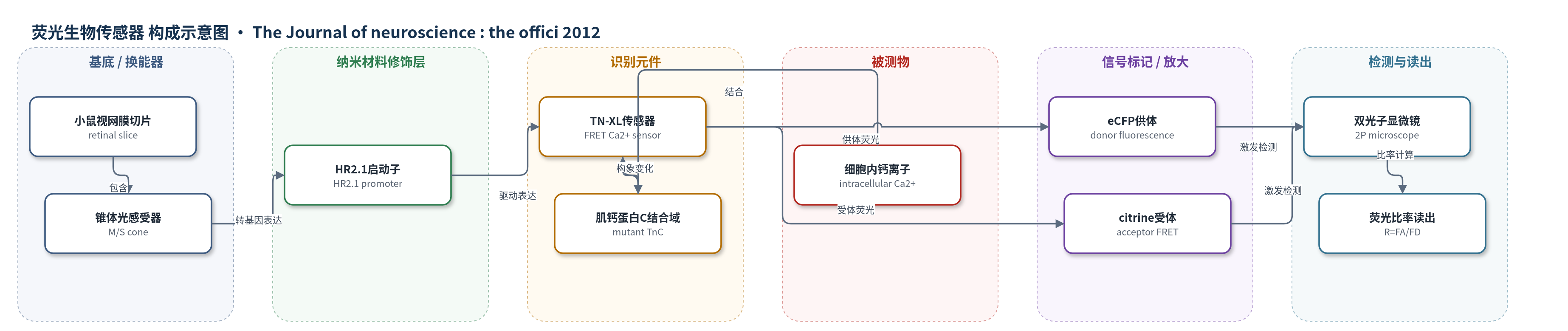
点击图片查看大图 · 依据论文自动绘制
传感器类型
荧光生物传感器
检测对象
细胞内钙离子(intracellular Ca2+,[Ca2+]);样品基质:小鼠视网膜急性切片中的锥体光感受器(M/S 锥体)胞质、内节和突触终末
检测原理
TN-XL 为 FRET 比率型基因编码钙传感器,由 eCFP 供体、citrine 受体和突变鸡骨骼肌肌钙蛋白 C(TnC)钙结合域组成。细胞内 Ca2+ 结合 TnC 后引起传感器构象变化,改变 eCFP 与 citrine 之间的 FRET 效率,使供体/受体荧光比率 R=FA/FD 随 [Ca2+] 变化。双光子或共聚焦显微镜激发 eCFP,分别采集 eCFP 与 citrine 发射并计算比率。光刺激使锥体超极化,电压门控钙通道关闭,突触终末 Ca2+ 下降,R 下降;KCl 去极化、咖啡因或 cGMP 类似物使 Ca2+ 升高,R 升高。TN-XL 的 KD 约 0.7–2.2 μM,适合锥体生理钙范围。
检测灵敏度
—
效应效果
HR2.1:TN-XL 小鼠锥体表达 TN-XL,ERG 与野生型无显著差异(明视 b 波 p=0.13–0.67;闪烁 p=0.31/0.39;暗视 a 波 p=0.093–1.00、b 波 p=0.39–0.94),表达稳定至至少 8 个月。光响应约 1 h、最多约 120 次试验重复性好且无明显漂白。KCl 使终末 ΔR/R=0.94±0.29,胞体/内节 0.11±0.10;咖啡因 0.77±0.35 vs 0.08±0.08;8-pCPT-cGMP 0.73±0.32 vs 0.07±0.07。光响应 Rbase=0.93±0.14,上升 219±131 ms、衰减 550±504 ms。SNAP 降低静息钙和响应幅度。
传感器的构成
- 表达调控层:人红色视蛋白启动子 HR2.1,驱动 TN-XL 在小鼠 M/S 锥体光感受器中表达
- 识别传感层:基因编码比率型钙传感器 TN-XL,由 eCFP 供体、citrine 受体和突变鸡骨骼肌肌钙蛋白 C 钙结合域组成,结合 Ca2+ 后改变 FRET 效率
- 换能读出层:双光子显微镜(2P)或共聚焦显微镜,激发 eCFP 并分别检测 eCFP 与 citrine 荧光,计算比率 R=FA/FD
- 样品基质层:小鼠视网膜急性切片中的锥体光感受器胞质、内节和突触终末,作为传感器表达与钙信号检测的细胞环境
- 刺激/分析物层:细胞内 Ca2+ 浓度变化,由光刺激、KCl 去极化、咖啡因、8-pCPT-cGMP、SNAP 等诱导
中文摘要
钙离子介导多种神经元功能,视网膜锥体光感受器因区室化明显,是研究钙信号多样性的理想模型。在生理条件下测量锥体亚细胞钙信号对理解锥体功能及视网膜神经退行性病变具有重要意义,但光敏外节邻近其他区室,使光诱导钙响应的光学测量困难。作者构建了转基因小鼠 HR2.1:TN-XL,使短波和中波敏感锥体选择性表达基因编码比率型钙传感器 TN-XL。该小鼠可利用双光子成像在单个锥体突触终末记录光诱导钙响应,并以亚细胞分辨率结合药理学研究光转导及其调控机制。进一步检测发现,一氧化氮可降低小鼠锥体静息钙水平,且无直接可溶性鸟苷酸环化酶参与证据。总之,HR2.1:TN-XL 小鼠为阐明锥体光驱动钙动力学及其调控异常提供了前所未有的工具。
英文摘要
Calcium mediates various neuronal functions. The complexity of neuronal Ca²⁺ signaling is well exemplified by retinal cone photoreceptors, which, with their distinct compartmentalization, offer unique possibilities for studying the diversity of Ca²⁺ functions in a single cell. Measuring subcellular Ca²⁺ signals in cones under physiological conditions is not only fundamental for understanding cone function, it also bears important insights into pathophysiological processes governing retinal neurodegeneration. However, due to the proximity of light-sensitive outer segments to other cellular compartments, optical measurements of light-evoked Ca²⁺ responses in cones are challenging. We addressed this problem by generating a transgenic mouse (HR2.1:TN-XL) in which both short- and middle-wavelength-sensitive cones selectively express the genetically encoded ratiometric Ca²⁺ biosensor TN-XL. We show that HR2.1:TN-XL allows recording of light-evoked Ca²⁺ responses using two-photon imaging in individual cone photoreceptor terminals and to probe phototransduction and its diverse regulatory mechanisms with pharmacology at subcellular resolution. To further test this system, we asked whether the classical, nitric oxide (NO)-soluble guanylyl-cyclase (sGC)-cGMP pathway could modulate Ca²⁺ in cone terminals. Surprisingly, NO reduced Ca²⁺ resting levels in mouse cones, without evidence for direct sGC involvement. In conclusion, HR2.1:TN-XL mice offer unprecedented opportunities to elucidate light-driven Ca²⁺ dynamics and their (dys)regulation in cone photoreceptors.