组成图示
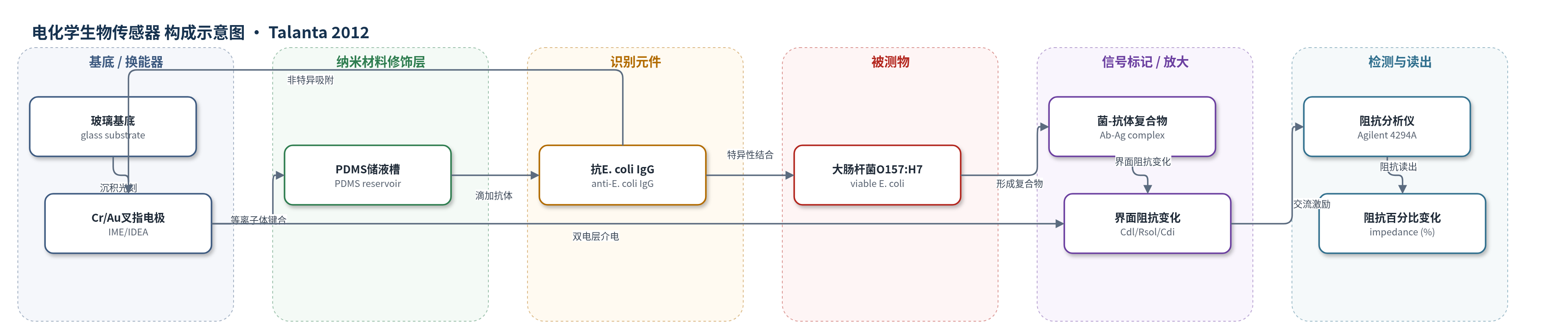
点击图片查看大图 · 依据论文自动绘制
传感器类型
电化学生物传感器
检测对象
活大肠杆菌O157:H7(viable Escherichia coli O157:H7);样品基质:PBS菌悬液(由mTSB培养、离心后用PBS重悬)
检测原理
传感器以金叉指微电极(IME/IDEA)为换能器,表面非特异性吸附固定山羊抗E. coli O157:H7 IgG抗体。活菌加入后,抗原与抗体特异性结合,在电极表面形成菌-抗体复合物。细菌细胞壁、胞质等组分具有一定导电性,并改变电极-溶液界面双电层电容(Cdl)、溶液电阻(Rsol)及介质介电电容(Cdi)。在100 Hz–10 MHz交流激励下,低频区主要由Cdl和Rsol决定,高频区由Cdi决定;被测菌浓度升高时,界面阻抗幅值增大,以阻抗百分比变化实现定量。该法无标签、无酶催化放大,依赖抗体捕获和阻抗谱变化。
检测灵敏度
剂量响应工作范围: 2.5 × 10^4 CFU ml−1–2.5 × 10^7 CFU ml−1
效应效果
该传感器可在约3 h内对活E. coli O157:H7进行定性和定量检测,而作者指出其他阻抗传感器可能需要24 h,若需富集则需3–4 d。选择性来自固定抗E. coli O157:H7 IgG抗体,但荧光成像显示部分标记菌也吸附在电极间玻璃空隙,提示非特异吸附仍存在。器件可重复使用:经丙酮30 min、异丙醇、去离子水及48 W等离子体2 min清洗后,每个器件至少复用5次,研究中共成功使用至少20个器件。作者认为其制备简单、无需微流控泵和酶,适合作为食品/水样中病原菌快速检测的替代平台。
传感器的构成
- 基底:玻璃基底(glass substrate),承载叉指微电极并提供绝缘支撑
- 换能器电极:铬/金叉指微电极(Cr/Au interdigitated microelectrode, IME/IDEA),Cr 50 nm粘附层、Au 200 nm电极,100指对,用于交流阻抗换能
- 储液结构:聚二甲基硅氧烷(PDMS)储液槽,经氧等离子体键合于玻璃,容纳抗体和样品溶液
- 识别元件:山羊抗E. coli O157:H7 IgG抗体(goat anti-E. coli O157:H7 IgG),50 μg/mL PBS,非特异性吸附固定于金表面,捕获目标菌
- 被测物:活大肠杆菌O157:H7(viable E. coli O157:H7),PBS重悬菌悬液,与抗体特异性结合
- 清洗再生介质:丙酮、异丙醇、去离子水及等离子体(48 W,2 min),用于器件重复使用
- 读出仪器:Agilent 4294A阻抗分析仪,500 mV正弦激励,100 Hz–10 MHz测量阻抗
中文摘要
本文报道了一种用于检测活大肠杆菌O157:H7的金叉指微电极(IME)阻抗生物传感器。该传感器采用光刻技术制备,电极表面固定抗E. coli IgG抗体,通过抗体/抗原结合而非细菌生长来监测阻抗变化。在100 Hz–10 MHz频率范围内记录阻抗,剂量响应工作范围为2.5×10^4–2.5×10^7 CFU/mL。时间响应研究表明,抗体/抗原结合并非随时间持续增强,过长的结合时间反而可能使阻抗降低;60 min结合时的阻抗高于120 min。该装置可在3 h内实现定性和定量检测,而以往阻抗传感器可能需要24 h,若需富集则需3–4 d。通过更换抗原特异性抗体,该传感器可用于检测其他细菌。与依赖酶或富集步骤的传感器相比,本器件可通过简单清洗协议重复使用,每个器件至少使用5次,是微流控和酶基阻抗传感器的简便替代方案。
英文摘要
A gold interdigitated microelectrode (IME) impedance biosensor was fabricated for the detection of viable Escherichia coli O157:H7. This sensor was fabricated using lithography techniques. The surface of the electrode was immobilized with anti-E. coli IgG antibodies. This approach is different from other studies where the change in impedance is measured in terms of growth of bacteria on the electrode, rather then the antibody/antigen bonding. The impedance values were recorded for frequency ranges between 100 Hz and 10 MHz. The working range of the dose response for this device was found to be between 2.5×10(4) CFU ml(-1) and 2.5×10(7) CFU ml(-1). The time response studies indicated that antibody/antigen binding is not a function of time, but can decrease if excess times are allowed for binding. It was observed that the impedance values for 60 min antibody/antigen binding were higher than the impedance values for 120 min binding time. The main advantages of the reported device are that, it provides for both qualitative and quantitative detection in 3h while other impedance sensors reported earlier may take up to 24h for detection. If enrichment steps are required then it may take 3-4 days to infer the results. This sensor can be used to detect different types of bacteria by immobilizing the antigen specific antibody. Most of the sensors are not reusable since they either use enzymes or enrichment steps for detection but this device can be reused, following a cleaning protocol which is easy to follow. Each device was used at least five times. The simplicity of this sensor and the ease of fabrication make this sensor a useful alternate to the microfluidics and enzyme based impedance sensors, which are relatively more difficult to fabricate, need programmable fluidic injection pumps to push the sample through the channel, suffer from limitation of coagulation and are difficult to clean.