组成图示
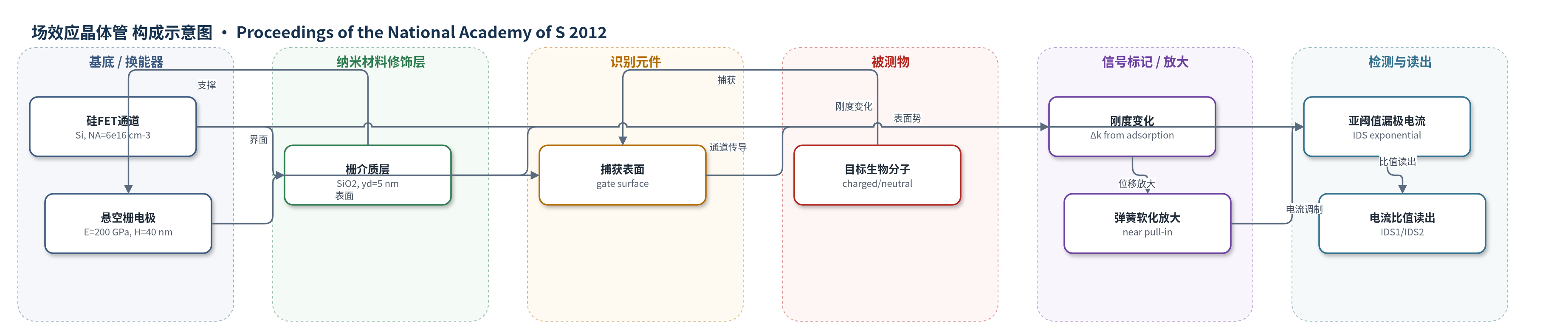
点击图片查看大图 · 依据论文自动绘制
传感器类型
场效应晶体管(FET)生物传感器
检测对象
目标生物分子(target biomolecules,如蛋白 proteins、病毒 viruses、DNA),样品基质:电解质溶液/生物流体(未具体限定)
检测原理
目标生物分子被捕获到悬空栅表面后,栅的有效厚度、杨氏模量或表面应力改变,使刚度由 k 变为 k+Δk,其中 Δk/k≈3NsAtHt/H。器件将栅偏置在接近 pull-in 不稳定点,弹簧软化效应使刚度微小变化引起栅位移 Δy 的非线性放大,Δy∝√Ns。栅位移改变栅-介质电容和表面势 ψs,FET 通道处于亚阈值区,漏极电流 IDS 随表面势呈指数变化。捕获前后电流比 IDS1/IDS2≈exp(γ1√Ns−γ2Ns),因此信号随被测物表面密度指数增强。该机制无需标记,可检测带电与中性分子,并避免溶液离子静电屏蔽。
检测灵敏度
原文未报告具体 LOD、线性范围、灵敏度斜率或相关系数;仅给出灵敏度标度关系 SFlexure≈exp(γ1√Ns−γ2Ns)。
效应效果
该文为理论与数值模拟工作,未报告选择性、稳定性、重现性、实际样品加标回收率或 RSD。作者将 Flexure-FET 与 Si-NW FET 和纳米悬臂梁比较:经典电学传感器受静电屏蔽限制,灵敏度多为线性或对数;机械传感器也多为线性或对数,而 Flexure-FET 因弹簧软化与亚阈值传导耦合呈指数灵敏度。数值模拟显示,在典型表面密度 Ns=5×10^12 cm^-2、Rt=1 nm、Ht=5.1 nm 下,等效 Δk≈6% 即可使漏极电流变化数个量级;补充材料指出 5–10% 刚度变化可带来 2–3 个数量级 IDS 变化。作者主张其可用于低成本即时检测、无 PCR 基因组测序及气体/化学/压力传感。
传感器的构成
- 基底/换能器:掺杂硅 FET 通道/衬底(εs=11.7,NA=6×10^16 cm^-3),形成亚阈值反型通道并输出漏极电流 IDS
- 栅介质层:SiO2 介电层(εd=3.9,厚度 yd=5 nm),隔离悬空栅与通道并传递表面势
- 悬空栅电极:薄膜悬空栅(L=4 μm,W=1 μm,H=40 nm,E=200 GPa),作为机械换能器,刚度随捕获分子改变
- 识别元件:目标生物分子直接捕获/吸附表面(未指定抗体、适配体或 DNA 探针),通过改变栅有效厚度实现识别
- 信号标记物:无标记(label-free),不引入荧光、酶或电化学标记物
- 读出接口:漏极-源极偏置与电流测量(VDS、IDS),通过捕获前后电流比值 IDS1/IDS2 读出
中文摘要
本文提出一种 Flexure-FET(柔性敏感场效应晶体管)超灵敏生物传感器,利用非线性机电耦合突破经典电学或机械纳米生物传感器的基本灵敏度极限。该器件由纳米板通道和薄膜悬空栅构成;目标生物分子被捕获后,悬空栅的刚度发生变化,栅的形状或偏转随之改变,并反映在场效应晶体管的漏极电流中。器件被设计为将栅偏置在接近 pull-in 不稳定点,同时 FET 通道工作于亚阈值区。在这种耦合非线性工作模式下,Flexure-FET 对捕获分子密度 Ns 的灵敏度呈指数增长,SFlexure≈exp(γ1√Ns−γ2Ns),而经典电学或机械生物传感器通常受限于线性 S≈γ3Ns 或对数 S≈γ4ln(Ns) 响应。此外,该传感器可检测带电和电中性生物分子,无需参比电极或复杂仪器,有望用于低成本即时检测。
英文摘要
In this article, we propose a Flexure-FET (flexure sensitive field effect transistor) ultrasensitive biosensor that utilizes the nonlinear electromechanical coupling to overcome the fundamental sensitivity limits of classical electrical or mechanical nanoscale biosensors. The stiffness of the suspended gate of Flexure-FET changes with the capture of the target biomolecules, and the corresponding change in the gate shape or deflection is reflected in the drain current of FET. The Flexure-FET is configured to operate such that the gate is biased near pull-in instability, and the FET-channel is biased in the subthreshold regime. In this coupled nonlinear operating mode, the sensitivity (S) of Flexure-FET with respect to the captured molecule density (N(s)) is shown to be exponentially higher than that of any other electrical or mechanical biosensor. In other words, while S(Flexure) ~ e(γ1 [square root]Ns-γ2Ns), classical electrical or mechanical biosensors are limited to S(classical) ~ γ(3)N(S) or γ(4) ln(N(S)), where γ(i) are sensor-specific constants. In addition, the proposed sensor can detect both charged and charge-neutral biomolecules, without requiring a reference electrode or any sophisticated instrumentation, making it a potential candidate for various low-cost, point-of-care applications.