组成图示
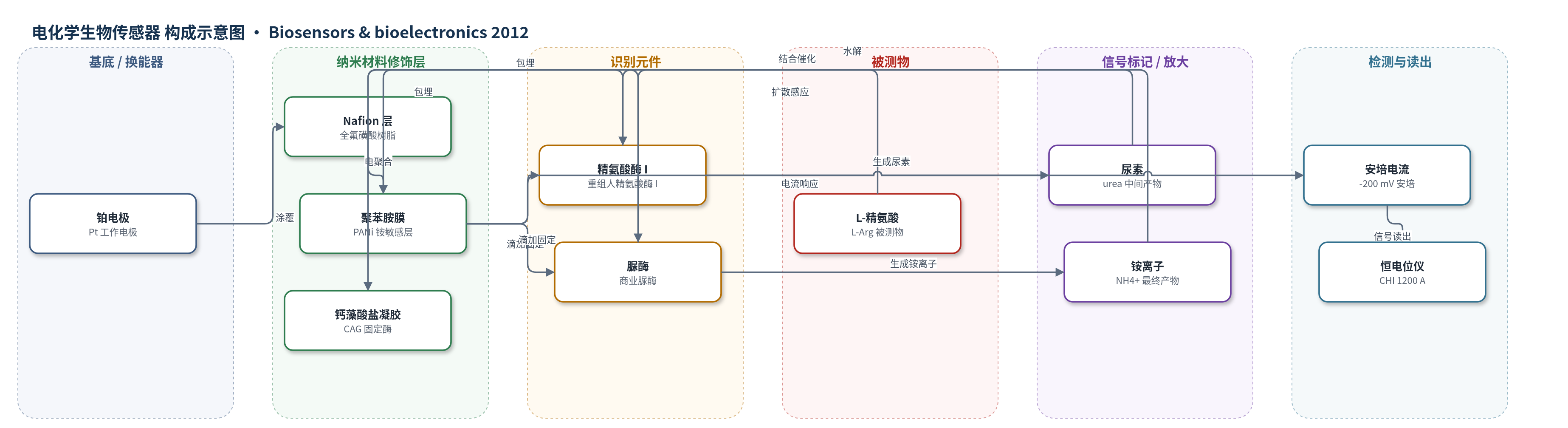
点击图片查看大图 · 依据论文自动绘制
传感器类型
电化学生物传感器
检测对象
L-精氨酸(L-arginine, L-Arg);样品基质:含 L-Arg 商业药物样品(Tivortin、Citrarginine、Aminoplazmal 10% E)及磷酸盐缓冲液标准溶液
检测原理
L-精氨酸在精氨酸酶 I 催化下水解为 L-鸟氨酸和尿素;尿素进一步被脲酶水解生成铵离子(NH4+)和碳酸氢根。生成的 NH4+ 扩散进入 PANi–Nafion 膜,改变聚苯胺的掺杂/去掺杂状态或触发 PANi 在铂电极表面的还原,使导电聚合物界面发生电荷转移,从而在固定电位 -200 mV 下产生安培电流。电流大小与 NH4+ 浓度相关,进而与 L-Arg 浓度呈正相关。Nafion 提供磺酸基团电荷补偿并促进铵离子传输,PANi 作为铵敏感导电聚合物实现信号放大;双酶级联将非电活性 L-Arg 转化为可电化学生物传感的 NH4+,提高选择性。
检测灵敏度
LOD: 0.038 mM;线性范围: 0.07–0.6 mM;灵敏度: 110±71.3 nA/(mM mm2);R² = 0.977
效应效果
该传感器对 L-精氨酸选择性良好,对 Ile、Lys、Thr、Orn、Ser、Val、Cys 和 citrulline 基本无响应;仅 canavanine 产生略高信号,但生物流体中罕见。稳定性方面,72 h 监测显示 24 h 活性下降约 80%,半衰期约 72 h,作者归因于 CAG 固定较弱。实际样品用标准加入法测定三种药物,与声明值差异 0.5–2.5%,CV 为 0.8%、1.4%、2.2%;Citrarginine 斜率干扰 24.7%,Aminoplazmal 10% E 约 10%。与已有 L-Arg 传感器相比,响应时间 10 s,快于 0.7–12 min,LOD 0.038 mM、线性 0.07–0.6 mM,适合临床与食品质控。
传感器的构成
- 基底/换能器电极:铂(Pt)棒电极,直径 3.0 mm,作为工作电极与电子传导基底
- 离子交换/电荷补偿层:Nafion 全氟磺酸树脂,涂覆于 Pt 表面,提供磺酸基团并辅助铵离子传感
- 导电聚合物铵敏感层:聚苯胺(PANi),循环伏安电聚合形成约 367 nm 膜,感应 NH4+ 并产生电流
- 识别/催化元件:重组人精氨酸酶 I(arginase I)与商业脲酶(urease),催化 L-Arg 转化为尿素并水解为 NH4+
- 固定/保护凝胶层:钙藻酸盐凝胶(CAG,海藻酸钠与 CaCl2 交联),物理固定双酶层
- 工作介质:30 mM 磷酸盐缓冲液(PB),pH 7.5,维持酶活性与电化学测量环境
- 信号读出:CHI 1200 A 恒电位仪,在 -200 mV vs Ag/AgCl 下安培检测
中文摘要
本文报道了一种新型 L-精氨酸选择性双酶安培生物传感器。该传感器以从基因工程甲基营养酵母 Hansenula polymorpha 中分离的重组人精氨酸酶 I 和商业脲酶为识别/催化元件,传感层构建于聚苯胺(PANi)–Nafion 复合修饰的铂电极表面,并以钙藻酸盐凝胶(CAG)覆盖固定。L-精氨酸在精氨酸酶 I 催化下生成鸟氨酸和尿素,尿素再经脲酶水解产生铵离子;铵离子扩散至 PANi–Nafion 膜并引起 PANi 在铂电极上的还原,从而产生安培电流。传感器对 L-精氨酸具有良好选择性,灵敏度为 110±71.3 nA/(mM·mm²),表观 Michaelis–Menten 常数为 1.27±0.29 mM,线性范围为 0.07–0.6 mM,检出限为 0.038 mM,响应时间约 10 s,并表现出良好的储存稳定性。实验室原型采用标准加入法测定三种含 L-精氨酸商业药物样品,所得含量与生产商声明值吻合良好。
英文摘要
A novel L-arginine-selective amperometric bi-enzyme biosensor based on recombinant human arginase I isolated from the gene-engineered strain of methylotrophic yeast Hansenula polymorpha and commercial urease is described. The biosensing layer was placed onto a polyaniline-Nafion composite platinum electrode and covered with a calcium alginate gel. The developed sensor revealed a good selectivity to L-arginine. The sensitivity of the biosensor was 110 ± 1.3 nA/(mM mm(2)) with the apparent Michaelis-Menten constant (K(M)(app)) derived from an L-arginine (L-Arg) calibration curve of 1.27 ± 0.29 mM. A linear concentration range was observed from 0.07 to 0.6mM, a limit of detection being 0.038 mM and a response time - 10s. The developed biosensor demonstrated good storage stability. A laboratory prototype of the proposed amperometric biosensor was applied to the samples of three commercial pharmaceuticals ("Tivortin", "Cytrarginine", "Aminoplazmal 10% E") for L-Arg testing. The obtained L-Arg-content values correlated well with those declared by producers.