组成图示
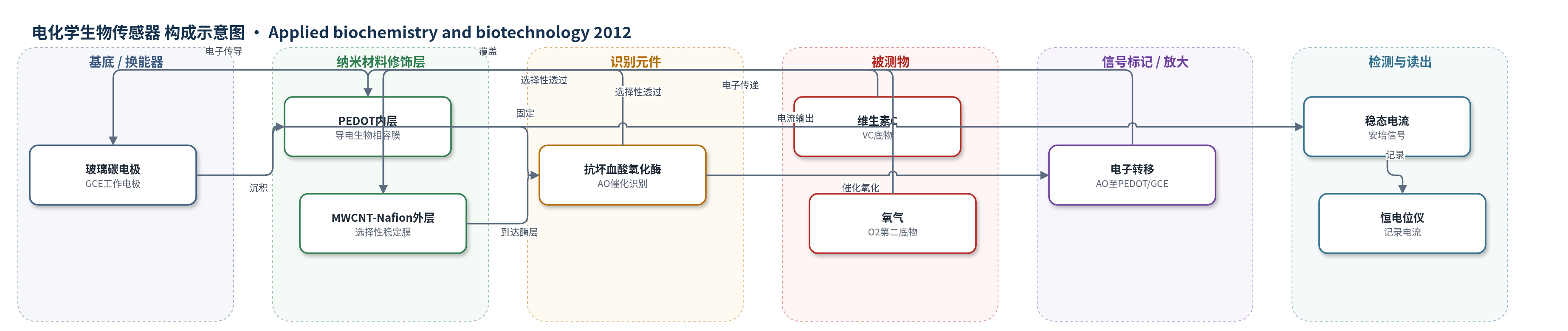
点击图片查看大图 · 依据论文自动绘制
传感器类型
电化学生物传感器
检测对象
维生素C(Vitamin C, VC/ascorbic acid);样品基质:商业果汁(commercial juices)
检测原理
该传感器以AO为识别与催化元件,采用双底物乒乓机制检测VC。VC首先与氧化型AO结合并被氧化为脱氢抗坏血酸(DHA),AO被还原;随后O2与还原型AO结合并被还原为H2O,使AO再生。酶铜中心的电子变化通过PEDOT导电膜和MWCNT网络快速传递至GCE,在0.05 V安培电位下产生稳态电流。低浓度VC时电流与浓度呈线性关系;高浓度时因溶解O2消耗和酶饱和,电流趋于最大稳态值Imax。MWCNT-Nafion外层提高选择性和稳定性,PEDOT/EMIES/SLS内层维持酶活性并促进电子转移。
检测灵敏度
LOD: 0.087 μM (S/N=3);线性范围: 4.0×10⁻⁷–1×10⁻³ M;灵敏度: 187 mA M−1 cm−2;R^2 = 0.9995
效应效果
传感器在0.05 V低电位下响应时间约10 s,工作电位低于多数报道,有利于减少还原性干扰物干扰。对1 mM葡萄糖、果糖、蔗糖、L-天冬氨酸、DL-丙氨酸、DL-苹果酸、烟酸、尿素、甘露醇、草酸、柠檬酸、山梨醇、肌醇、甘氨酸等干扰物无明显干扰,特异性良好。重复性RSD为1.2%(40次连续测定0.1 mM VC),重现性RSD为2.17%(10个独立电极0.5 mM VC)。商业果汁中VC测定与厂家标示值一致,五次重复RSD为2.3%–5.4%,如果汁9.3±0.5 mg/100 mL对标示10 mg/100 mL,橙汁12.51±0.3 mg/100 mL对13 mg/100 mL,柠檬汁21.7±0.5 mg/100 mL对22.5 mg/100 mL。作者认为其可用于农产品中VC的电化学检测。
传感器的构成
- 基底/换能器电极:裸玻璃碳电极(GCE),直径3 mm,作为工作电极和电子传导基底。
- 内层导电膜:聚(3,4-乙烯二氧噻吩)(PEDOT)复合膜,在含20 mM EDOT、0.1 M EMIES、0.1 M SLS的离子液体微乳液中恒电位1.1 V沉积90 s,提供导电、生物相容微环境并促进电子转移。
- 识别/催化元件:抗坏血酸氧化酶(AO,0.3 g L−1,5 μL)滴涂于PEDOT膜上,催化VC氧化并实现酶识别。
- 外层选择性膜:多壁碳纳米管-Nafion(MWCNT-Nafion)复合膜,由5% Nafion与4% MWCNT按体积比1:1混合滴涂,增强稳定性、选择性、界面粘附并防止酶泄漏。
中文摘要
抗坏血酸氧化酶(AO)作为生物活性大分子被成功固定到生物相容的三明治型复合膜中,用于开发维生素C(VC)生物传感器,并对商业果汁中的VC含量进行安培法测定。生物相容且导电的聚(3,4-乙烯二氧噻吩)(PEDOT)复合膜,以及高稳定性、高选择性的多壁碳纳米管-Nafion(MWCNT-Nafion)复合膜,分别作为传感器的内层膜和外层膜,AO分子被固定于两层复合膜之间。所制备的传感器对VC氧化表现出优异的生物电催化性能、快速电流响应、低工作电位、高灵敏度、宽线性范围和低检出限。文中还提出了该传感器的工作机理并讨论了反应动力学,同时评价了其特异性、重现性和实际可行性。商业果汁中VC的测定结果良好,表明该传感器可作为农产品中VC电化学测定的潜在候选;内外复合膜也为固定生物活性物质提供了有前景的平台。
英文摘要
Ascorbate oxidase (AO), a biologically active macromolecule, was successfully immobilized into a biocompatible sandwich-type composite film for developing the vitamin C (VC) biosensor, and the content of VC in commercial juices was amperometrically determined. The biocompatible and conducting poly(3,4-ethylenedioxythiophene) composite film and highly stable and selective multiwalled carbon nanotubes -Nafion composite film were prepared as inner and outer films of biosensor. AO molecules were immobilized between these two composite films. The as-fabricated biosensor displayed an excellent bioelectrocatalytic performance towards the oxidation of VC, a fast current response, a low working potential, a high sensitivity, a wide linear range, and a low detection limit. Moreover, the working mechanism of the biosensor was proposed, and its kinetics was also discussed. In addition, the specificity, reproducibility, and feasibility of the as-fabricated biosensor were also evaluated. Good results of the VC determination in commercial juices indicated that the as-fabricated biosensor was a potential candidate for the electrochemical determination of VC in agricultural crops. Inner and outer films provided a promising platform for the immobilization of biologically active species.