组成图示
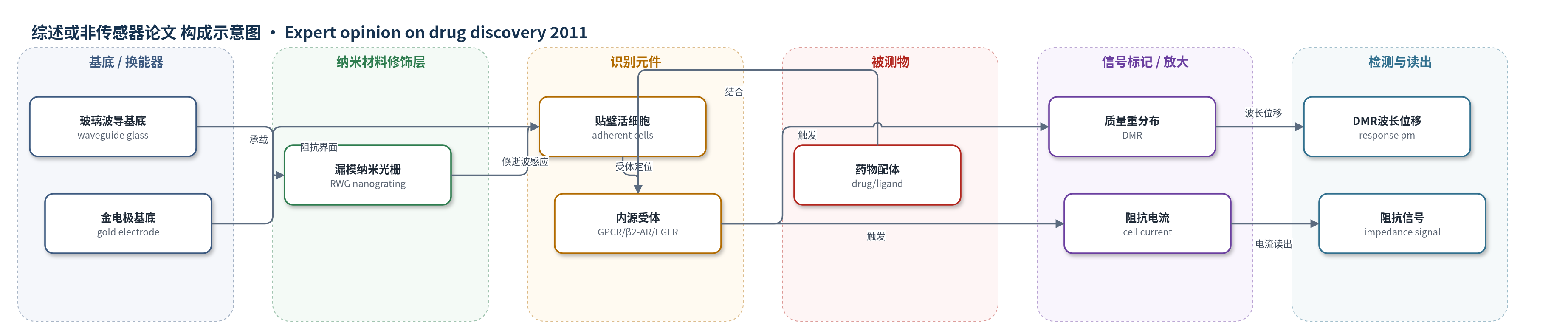
点击图片查看大图 · 依据论文自动绘制
传感器类型
综述或非传感器论文
检测对象
药物/配体(drug/ligand,如 tyrphostin-51、salmeterol、tyramine、EGF、β-AR 配体);样品基质:贴壁活细胞培养物(A431、HT29、HEK293、CHO、H1993 等)
检测原理
无标记细胞检测中,药物/配体与贴壁活细胞膜上的内源受体结合,激活 G 蛋白、激酶或离子通道等下游通路,引起蛋白转运、细胞骨架重排、细胞黏附与形态改变。光学 DMR 平台利用玻璃波导上的漏模纳米光栅产生倏逝波,传感体积约 200 nm 内局部质量密度和折射率变化使共振波长发生位移,以 pm 为单位的实时曲线反映受体-药物相互作用;电学阻抗平台则通过金电极低电解质阻抗界面采集细胞外与跨细胞电流,细胞形态和离子重分布改变阻抗。信号随配体浓度呈剂量依赖,可出现单相、双相或功能选择性谱,无需外源标记或酶放大。
检测灵敏度
原文未报告 LOD、线性范围、灵敏度斜率或 R^2;报告 tyrphostin-51 的 EC50: 0.11 ± 0.03 µM。
效应效果
综述指出无标记细胞检测具有高通量、高时间分辨率和宽通路覆盖,可在天然细胞及疾病相关原代细胞中筛选内源受体配体,并解析分子作用机制。其可区分激动剂、部分激动剂、拮抗剂及偏向性激动:β2-AR 配体产生四类 DMR;salmeterol 呈双相剂量响应;tyramine 提示多药理学。iPOT 将 β-AR 药物 DMR 聚类与临床适应症相关,如 carvedilol 与 propranolol 异构体同簇,terbutaline 与 ritodrine、phenylephrine 同簇。119,595 化合物筛选得到 1149 个命中,A549 反筛确认 239 个,其中 125 个与 paclitaxel 同簇,16 个进一步确认为抗有丝分裂剂。挑战包括机制解卷积、数据分析和新传感器开发。
传感器的构成
- 光学基底:玻璃波导(waveguide glass),承载漏模纳米光栅并产生倏逝波(E.W.)
- 纳米光栅层:漏模纳米光栅波导结构(leaky-mode nanograting waveguide),将细胞响应转换为 DMR 波长位移
- 电学基底:金电极基底(gold electrode substrate),提供低电解质阻抗界面并采集细胞电流
- 识别元件:贴壁活细胞及内源受体(endogenous receptors,如 GPCR、β2-AR、EGFR),识别药物/配体
- 信号标记物:无外源标记(label-free),依赖细胞自身 DMR 或阻抗变化
- 读出接口:实时 DMR(pm)或阻抗电流(extracellular/transcellular current)
中文摘要
提高药物研发生产力的需求持续推动药理检测技术创新。能够兼具体系分子检测与表型检测优势的技术,有望用于新药发现。本文简要综述当前用于细胞检测的无标记平台,并以动态质量重分布(DMR)技术为例,重点讨论这些检测的基本原理,同时提出将无标记检测谱与药物分子作用机制相关联的策略。现有证据表明,无标记细胞检测本质上属于表型检测,但允许进行分子机制解卷积。凭借其高通量、高敏感性和宽通路覆盖能力,无标记细胞检测可在天然细胞(包括疾病相关原代细胞)中针对内源受体筛选药物,并确定药物分子的分子作用机制。然而,无标记技术在基础研究和药物发现中仍面临挑战:受体-药物相互作用生物传感器信号背后的细胞与分子机制解卷积、新的数据分析方法以及新生物传感器技术的开发。只有解决这些挑战,才能推动该类检测在药物发现中的广泛应用。
英文摘要
INTRODUCTION: The need to improve drug research and development productivity continues to drive innovation in pharmacological assays. Technologies that can leverage the advantages of both molecular and phenotypic assays would hold great promise for discovery of new medicines.
AREAS COVERED: This article briefly reviews current label-free platforms for cell-based assays and is primarily focused on fundamental aspects of these assays using dynamic mass redistribution technology as an example. The article also presents strategies for relating label-free profiles to molecular modes of actions of drugs.
EXPERT OPINION: Emerging evidence suggests that label-free cellular assays are phenotypic in nature, yet permit molecular mechanistic deconvolution. Together with unique competency in throughput, sensitivity and pathway coverages, label-free cellular assays allow users to screen drugs against endogenous receptors in native cells (including disease relevant primary cells) and determine the molecular modes of action of drug molecules. However, there are challenges for label-free in both basic research and drug discovery: the deconvolution of the cellular and molecular mechanisms for the biosensor signatures of receptor-drug interactions, new methodologies for data analysis and the development of new biosensor technologies. These challenges will need to be met for the wide adoption of these assays in drug discovery.