组成图示
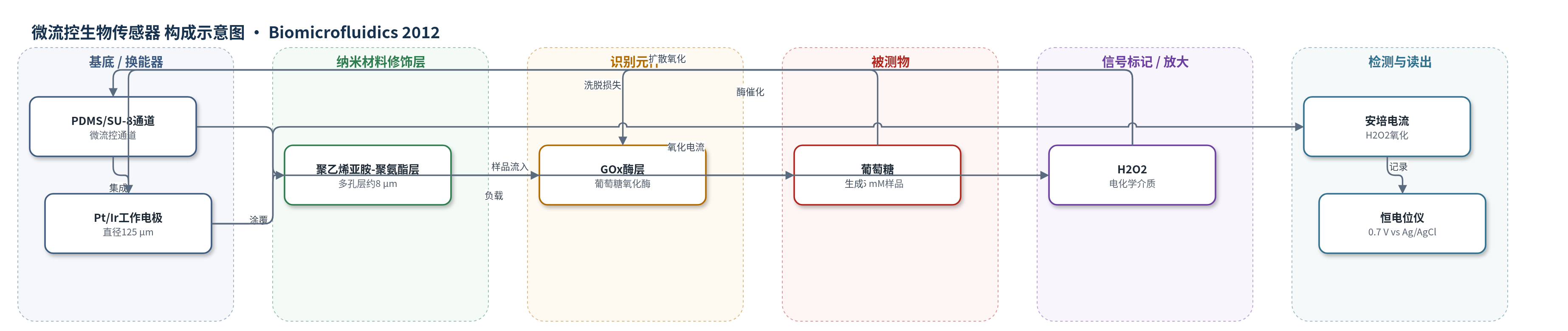
点击图片查看大图 · 依据论文自动绘制
传感器类型
微流控生物传感器
检测对象
葡萄糖(glucose);样品基质:PBS 1×、DMEM 高糖/无糖培养基流动溶液
检测原理
葡萄糖样品在微流控通道中流动并扩散进入电极表面的GOx多孔层。GOx催化葡萄糖与O2反应生成葡萄糖酸和H2O2,这是识别与信号介导步骤。生成的H2O2一部分扩散到Pt/Ir工作电极,在+0.7 V下发生两电子氧化:H2O2→O2+2H++2e−,形成安培电流;另一部分被流动相洗脱而损失。因此电流同时受葡萄糖向酶层扩散和H2O2向电极扩散/对流洗脱控制。低流速时外部扩散层较厚、H2O2洗脱少,效率高但响应慢;高流速时葡萄糖接触时间短且H2O2被快速带走,效率下降但时间分辨率提高。采样环路可解耦采样与测量流速,使峰电流随葡萄糖浓度线性变化。
检测灵敏度
LOD: 0.18 mM;线性范围: 1–5 mM;灵敏度: 6.22 nA/mM
效应效果
直接H2O2检测中,流速10–400 μL/min变化时电流仅变化约10%,浓度10–100 mM影响很小。葡萄糖间接检测中,流速1–50 μL/min增加时电流下降约60%,1和5 mM浓度影响可忽略。效率随流速升高下降,响应时间随流速升高缩短。解耦系统在10 μL/min下响应时间小于1 min;17和28 nL环路呈峰形响应,28 nL灵敏度6.22 nA/mM,峰电流在1–5 mM线性,响应约100 s,重复性好且线性不依赖环路体积。28 nL检出限0.18 mM,作者认为低于文献其他电化学传感器,适合在线流动监测。
传感器的构成
- 换能器电极:Pt/Ir 90/10% 微丝工作电极,直径125 μm、长1 mm,用于H2O2氧化并输出安培电流
- 识别/催化层:聚乙烯亚胺-聚氨酯多孔聚合物层,厚约8 μm,负载黑曲霉葡萄糖氧化酶(GOx),催化葡萄糖生成H2O2
- 参比电极:Ag/AgCl 伪参比电极,提供0.7 V恒电位基准
- 对电极:Pt 丝对电极,完成电化学回路
- 微流控通道:SU-8/PDMS 软刻蚀通道,高300 μm、侧向入口400 μm,引导样品流过电极
- 采样-传感解耦单元:双层PDMS/SU-8微阀与环路,独立控制采样流速和测量流速
中文摘要
生物分析微型化可显著降低样品体积并加快响应。将微型生物传感器集成到芯片级流动检测平台中,不仅简化操作,还能提高测量的稳健性和独立性。本文研究在间接测量分析物浓度时,将流动安培生物传感器集成到微流控平台中的行为。以铂基微型葡萄糖生物传感器为案例,葡萄糖在葡萄糖氧化酶催化下转化为过氧化氢,过氧化氢在工作电极上被氧化产生电流。实验结果与流体动力学理论分析紧密结合,证明入口流速是影响流动生物传感器性能的关键参数,因为它同时改变葡萄糖和过氧化氢向电极的传质及从电极的洗脱。作者识别出兼顾准确传感与高时间分辨率的最优流速条件,并通过无量纲理论分析将结果推广至其他传感系统。此外,论文提出一种连接采样单元与生物传感器的微流控设计,使采样流速与测量流速解耦,便于在线流动监测。
英文摘要
Miniaturization in biological analyses has several advantages, such as sample volume reduction and fast response time. The integration of miniaturized biosensors within lab-on-a-chip setups under flow conditions is highly desirable, not only because it simplifies process handling but also because measurements become more robust and operator-independent. In this work, we study the integration of flow amperometric biosensors within a microfluidic platform when analyte concentration is indirectly measured. As a case study, we used a platinum miniaturized glucose biosensor, where glucose is enzymatically converted to [Formula: see text] that is oxidized at the electrode. The experimental results produced are strongly coupled to a theoretical analysis of fluid dynamic conditions affecting the electrochemical response of the sensor. We verified that the choice of the inlet flow rate is a critical parameter in flow biosensors, because it affects both glucose and [Formula: see text] transport, to and from the electrode. We identify optimal flow rate conditions for accurate sensing at high time resolution. A dimensionless theoretical analysis allows the extension of the results to other sensing systems according to fluid dynamic similarity principles. Furthermore, we developed a microfluidic design that connects a sampling unit to the biosensor, in order to decouple the sampling flow rate from that of the actual measurement.