组成图示
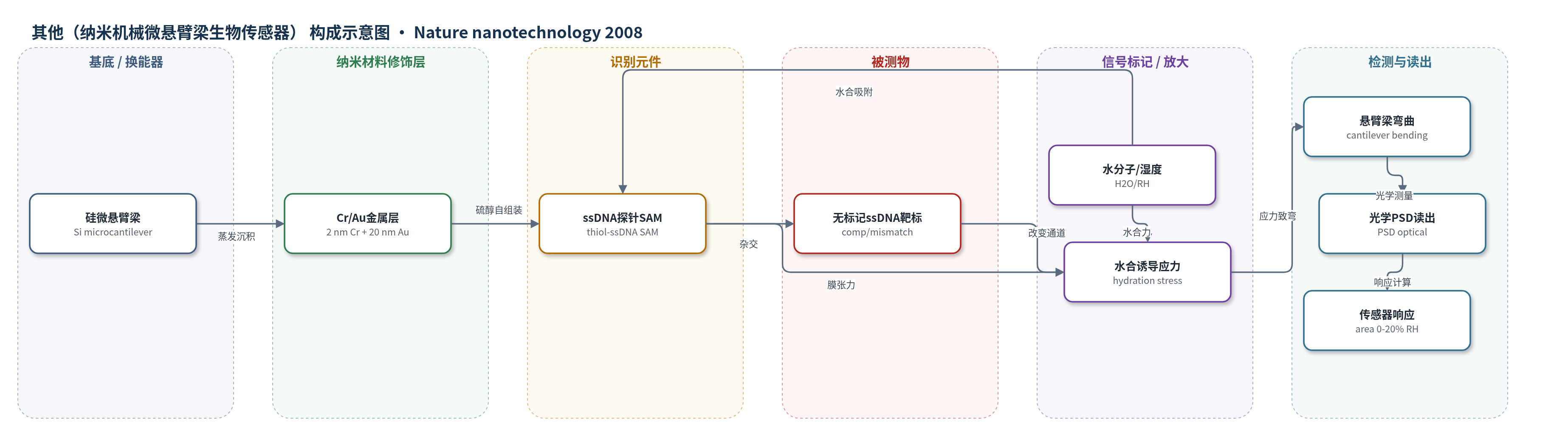
点击图片查看大图 · 依据论文自动绘制
传感器类型
其他(纳米机械微悬臂梁生物传感器)
检测对象
单链DNA靶标(single-stranded DNA, ssDNA;BRCA1基因序列互补靶标、单错配靶标),样品基质:PBS缓冲液(杂交后冲洗干燥,在湿度腔中检测)
检测原理
硫醇修饰ssDNA探针通过Au-S键在硅微悬臂梁金表面形成致密单分子层,分子间形成约0.8 nm亚纳米通道。在可控相对湿度下,水分子先形成DNA水合壳,再进入通道,产生水合排斥/吸引力和毛细样力,使单分子层表面应力改变,并通过Stoney方程转化为悬臂梁弯曲。当互补ssDNA杂交后,双链形成使通道变窄,低湿度下水合诱导应力由拉伸转为压缩,且滞后减小;单错配靶标因双链构象不同给出中间响应。通过比较杂交前后0-20%相对湿度区间表面应力曲线围成的归一化面积作为传感器响应,响应随靶标浓度升高而增大,约0.5 nM以上趋于饱和,1 fM仍高于阴性对照。无酶促或核酸扩增,灵敏度来自高密度探针与通道水合应力放大。
检测灵敏度
检测灵敏度: 飞摩尔范围;可检测浓度: 1 fM(约为阴性对照2倍);响应平台: >0.5 nM;浓度范围: 1 fM–10^-6 M(图5c)
效应效果
该传感器具有良好特异性:1 μM单中心T/T错配靶标杂交3 h后,低湿度区响应介于未杂交与完全互补之间,可区分单碱基突变;在1 μM非互补DNA背景中加入1 nM互补靶标(0.1%少数基因组),响应与1 μM纯互补靶标相近,显著不同于非互补对照。灵敏度达飞摩尔范围,1 fM响应约为阴性对照2倍,>0.5 nM响应近似恒定。作者称其较此前无标记纳米机械传感器和标记微阵列至少提高两个数量级,较类似尺寸纳米机械方法提高三个数量级。方法需1–3 h杂交,不能实时监测,但无需参考悬臂梁,有望用于基因分型和无需扩增/标记的早期诊断。
传感器的构成
- 基底/换能器:单晶硅微悬臂梁(silicon microcantilever,400 μm×100 μm×0.6 μm),承载表面应力并产生可测弯曲。
- 金属修饰层:2 nm Cr粘附层与20 nm Au蒸发层,提供Au-S自组装界面。
- 识别元件:硫醇修饰16-mer ssDNA探针(5'-HS-CTACCTTTTTTTTCTG-3'),经Au-S键形成致密SAM,密度约4×10^13 cm^-2。
- 替代识别元件:Cys终止11-mer ssPNA探针(cys-O-O-AATCCCCGCAT),用于验证静电作用非必需。
- 信号调制剂:水分子(H2O),在可控相对湿度下吸附于DNA分子间亚纳米通道,产生水合诱导表面应力。
- 样品/靶标:无标记ssDNA靶标(互补或单错配),在PBS中杂交。
- 读出系统:湿度腔与光学位置敏感探测器(position-sensitive detector, PSD),测量悬臂梁位移并用Stoney方程换算表面应力。
中文摘要
本文报道了一种基于核酸薄膜水合诱导张力的无标记DNA杂交检测方法。作者将硫醇修饰的单链DNA探针自组装到硅微悬臂梁金表面,形成致密单分子层,并在可控湿度环境中测量水分子吸附引起单分子层张力变化所导致的悬臂梁弯曲。结果表明,水合过程可显著改变DNA单分子层的表面应力,且当探针与互补或含单个错配碱基的单链DNA靶标杂交后,水合诱导的张力响应发生明显定量和定性变化。该张力主要受DNA分子间亚纳米通道中水合力支配,因此可用于识别DNA杂交事件并区分单碱基突变。该方法在飞摩尔浓度范围内具有检测灵敏度,比此前无标记纳米机械传感器和依赖标记的微阵列至少提高两个数量级。
英文摘要
The properties of water at the nanoscale are crucial in many areas of biology, but the confinement of water molecules in sub-nanometre channels in biological systems has received relatively little attention. Advances in nanotechnology make it possible to explore the role played by water molecules in living systems, potentially leading to the development of ultrasensitive biosensors. Here we show that the adsorption of water by a self-assembled monolayer of single-stranded DNA on a silicon microcantilever can be detected by measuring how the tension in the monolayer changes as a result of hydration. Our approach relies on the microcantilever bending by an amount that depends on the tension in the monolayer. In particular, we find that the tension changes dramatically when the monolayer interacts with either complementary or single mismatched single-stranded DNA targets. Our results suggest that the tension is mainly governed by hydration forces in the channels between the DNA molecules and could lead to the development of a label-free DNA biosensor that can detect single mutations. The technique provides sensitivity in the femtomolar range that is at least two orders of magnitude better than that obtained previously with label-free nanomechanical biosensors and with label-dependent microarrays.