组成图示
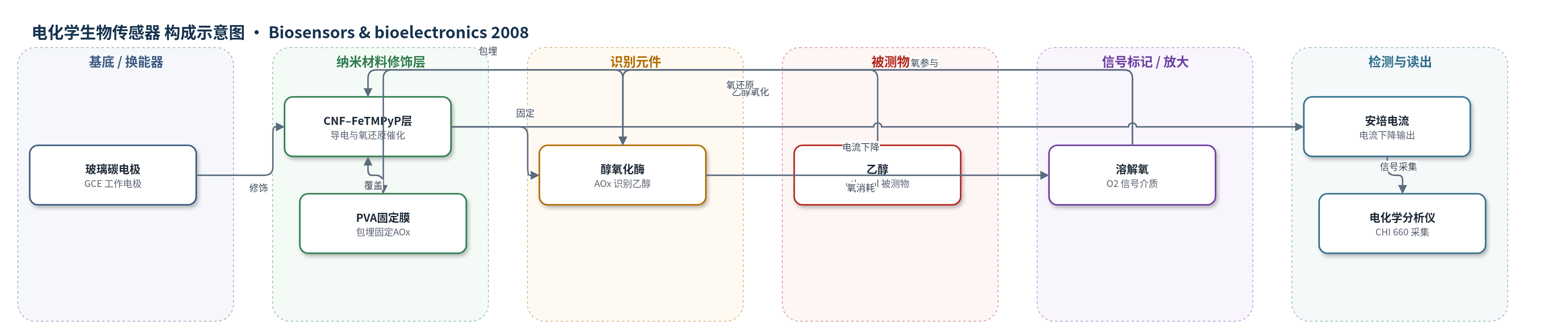
点击图片查看大图 · 依据论文自动绘制
传感器类型
电化学生物传感器
检测对象
乙醇(ethanol, EtOH);样品基质:空气饱和 PBS 缓冲液、啤酒
检测原理
该传感器基于醇氧化酶(AOx)催化乙醇氧化并消耗溶解氧(O2)的反应。乙醇在 AOx 作用下被选择性氧化,同时 O2 作为辅底物被消耗,使电极附近 O2 浓度降低。CNF–FeTMPyP 纳米复合层中,CNF 提供快速电子传导通道,FeTMPyP 作为类血红素电催化剂促进 O2 在低过电位下还原,二者协同增强氧还原电流。在 -0.20 V 恒电位安培检测中,乙醇浓度增加导致 O2 消耗增多,氧还原电流相应下降,电流下降值与乙醇浓度在一定范围内呈线性关系。CNF 微环境还促进 AOx 直接电子转移,提高响应速度和灵敏度。
检测灵敏度
LOD: 1.2 μM;线性范围: 2.0 μM–112 μM;灵敏度: 1.93 nA μM−1
效应效果
传感器响应迅速,达到稳态 95% 的时间小于 10 s,明显快于 AOx/明胶(120 s)和 AOx/聚乙烯基铁氰化铵(30–50 s)修饰电极。在 200 μM 干扰物条件下,抗坏血酸、乳酸、柠檬酸、乙酸和蔗糖的等效乙醇干扰分别为 4.1、1.5、2.9、1.1 和 1.7 μM,干扰较小。啤酒样品仅需稀释即可检测,测得乙醇浓度为 0.70 M(4.14% v/v),与标称 ≥4.0% 一致;加标 20 和 80 μM 的回收率为 110±1.7% 和 106±2.0%。批内 CV 为 4.5%(10 μM)和 3.6%(80 μM),批间 RSD 为 7.9%(20 μM)。4 °C PBS 中保存 20 d 无明显下降,30 d 后保留 91% 初始响应。
传感器的构成
- 基底/换能器电极:玻璃碳电极(GCE),经氧化铝抛光和酸/有机溶剂清洗,提供导电基底与电子转导界面
- 纳米材料修饰层:碳纳米纤维(CNF)与水溶性铁(III)卟啉 FeTMPyP 经 π–π 非共价组装形成 CNF–FeTMPyP 纳米复合层,兼具导电与氧还原电催化功能
- 识别元件:醇氧化酶(AOx,Hansenula polymorpha),催化乙醇氧化并消耗溶解氧
- 固定/封闭膜:聚乙烯醇(PVA)膜,包埋固定 AOx 并防止酶泄漏
- 信号介质:溶解氧(O2),作为 AOx 催化辅底物并在 CNF–FeTMPyP 表面发生电化学还原,产生安培电流变化
- 检测仪器:CHI 660 电化学分析仪,三电极体系(铂丝辅助电极、饱和甘汞电极 SCE、GCE 工作电极),在 -0.20 V 恒电位下安培检测
中文摘要
本文通过非共价相互作用设计了碳纳米纤维(CNF)与水溶性铁(III)中四(N-甲基吡啶鎓-4-基)卟啉(FeTMPyP)的生物功能杂化纳米复合材料,用于制备高灵敏度乙醇生物传感器。该纳米复合材料在水中分散性良好,并经稳态电子吸收光谱和扫描电子显微镜表征。复合材料兼具 CNF 的良好导电性和 CNF 与 FeTMPyP 对溶解氧还原的优异催化活性,实现了在低过电位下对 6.5 nM 至 6.4 μM 范围内溶解氧的安培检测。进一步将醇氧化酶(AOx)固定于该纳米复合材料修饰电极上,构建了乙醇安培生物传感器。该传感器对乙醇响应迅速且灵敏,线性范围为 2.0 μM 至 112 μM。固定化 AOx 还表现出直接电化学行为。该生物功能纳米复合材料不仅为构建高灵敏度生物传感器提供了新途径,也可用于模拟生命过程中酶的催化活性。
英文摘要
A biofunctional hybrid nanocomposite of carbon nanofiber (CNF) with water-soluble iron(III) meso-tetrakis(N-methylpyridinum-4-yl) porphyrin (FeTMPyP) was designed via non-covalent interaction for preparation of highly sensitive ethanol biosensor. The prepared nanocomposite showed good dispersion in water and was characterized with steady-state electronic absorption spectroscopy and scanning electron microscope. The nanocomposite combined the good conductivity of CNF and the excellent catalytic activity of both CNF and FeTMPyP toward the reduction of dissolved oxygen, producing a method for amperometric detection of oxygen ranging from 6.5 nM to 6.4 microM at a low overpotential. The nanocomposite modified electrode was further used for assembly of alcohol oxidase to construct an amperometric biosensor for ethanol. The biosensor showed rapid and highly sensitive response to ethanol with a linear range from 2.0 microM to 112 microM. The immobilized alcohol oxidase also showed its direct electrochemistry. The biofunctional nanocomposite provides a new way to not only construct the highly sensitive biosensors but also mimic the catalytic activity of enzyme in the life process.