组成图示
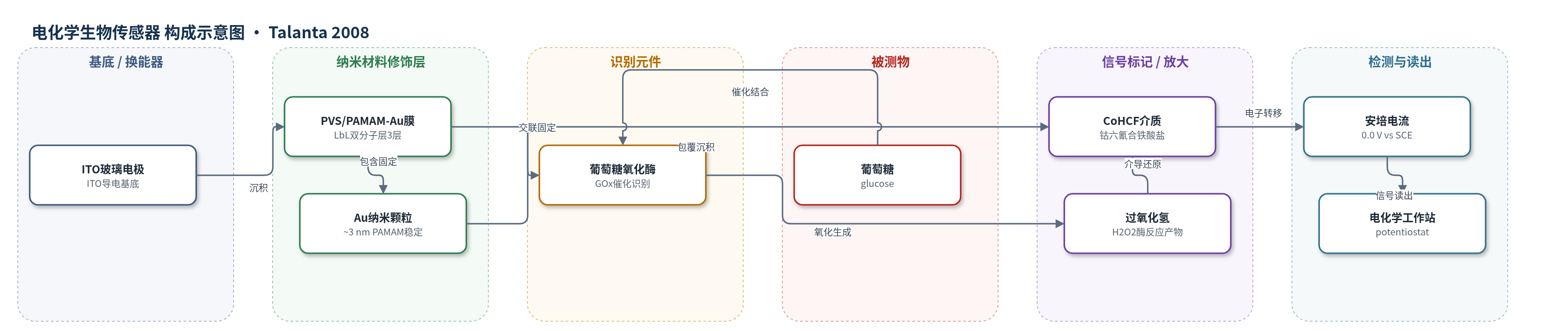
点击图片查看大图 · 依据论文自动绘制
传感器类型
电化学生物传感器
检测对象
葡萄糖(glucose),样品基质:磷酸盐缓冲液(NaPBS)、葡萄酒等自然样品
检测原理
该传感器基于酶催化与氧化还原介质介导的电化学检测。葡萄糖氧化酶(GOx)固定在 ITO-(PVS/PAMAM-Au)3@CoHCF 电极表面,催化葡萄糖氧化生成过氧化氢(H2O2)。H2O2 扩散至包覆在金纳米颗粒表面的钴六氰合铁酸盐(CoHCF)介质层,在 0.0 V vs SCE 发生电催化还原,产生与 H2O2 浓度成正比的阴极电流。由于 H2O2 生成速率受葡萄糖浓度控制,安培电流随葡萄糖浓度增加而增大。PAMAM-Au/PVS 层层膜提供导电纳米通道和固定位点,戊二醛交联 GOx/BSA 以稳定酶层;Au 纳米颗粒与 CoHCF 共同促进电子转移,使检测在低电位进行并降低干扰。
检测灵敏度
LOD: 6.1 μM;线性范围: up to 250 μM;灵敏度: 111 nA mM−1;R = 0.9998;KMapp: 0.20 mM
效应效果
优化传感器对葡萄糖线性至 250 μM,灵敏度 111 nA mM−1,R=0.9998,LOD 6.1 μM,KMapp 0.20 mM。对葡萄酒中果糖、乙醇、乙酸、柠檬酸、乳酸、苹果酸、草酸、酒石酸无干扰,仅抗坏血酸在 0.0 V 有响应;−0.180 V 时其信号降至 8.6%,葡萄糖响应为 78.3%。连续 20 次 0.74 mM 测量后电流下降 30%;4°C 保存 1 个月保持 65% 初始响应。与碳膜 CoHCF 传感器相比,LOD 较高(6.1 vs 1.9 μM),但线性范围更大(250 vs 30 μM),适合甜葡萄酒等自然样品。drop-coating 比 dip-coating 响应高约 30%。
传感器的构成
- 基底/工作电极:ITO 玻璃电极(indium tin oxide, ITO),提供导电基底与电子转导
- 层状修饰层:PVS/PAMAM-Au 双分子层(poly(vinylsulfonate, PVS) 与含 Au 纳米颗粒的 PAMAM 交替,3 层),构建纳米结构膜并固定 Au NPs
- 纳米材料修饰层:Au 纳米颗粒(~3 nm,PAMAM 稳定),提供导电/电催化位点并作为 CoHCF 沉积核
- 氧化还原介质层:CoHCF(cobalt hexacyanoferrate)包覆 Au NPs,介导 H2O2 在 0.0 V vs SCE 的电化学还原
- 识别元件:GOx(glucose oxidase),催化葡萄糖氧化生成 H2O2
- 交联固定层:GA(glutaraldehyde)交联 GOx/BSA 与 PAMAM 氨基,固定酶
- 保护蛋白层:BSA(bovine serum albumin),与 GOx 共固定,提供友好微环境保持酶活性
中文摘要
采用层层自组装(LbL)技术制备了电活性纳米结构膜,并通过修饰钴六氰合铁酸盐氧化还原介质和固定葡萄糖氧化酶,构建了用于葡萄糖检测的电化学酶生物传感器。氧化铟锡(ITO)玻璃电极被修饰至多三层含金纳米颗粒的聚酰胺胺(PAMAM)树状分子与聚磺化乙烯(PVS)双分子层。金纳米颗粒表面包覆钴六氰合铁酸盐,作为氧化还原介质,使修饰电极能在 0.0 V(vs. SCE)检测氧化酶反应产物过氧化氢。随后用戊二醛交联固定酶。研究优化了葡萄糖生物传感器的多个参数,包括沉积双分子层数、酶固定方法以及固定酶和与 PAMAM 交联蛋白的浓度;该蛋白用于为葡萄糖氧化酶提供友好微环境以保持生物活性。优化后的三层双分子层传感器具有高灵敏度和操作稳定性,检出限为 6.1 μM,表观 Michaelis–Menten 常数为 0.20 mM。其对干扰物具有良好的选择性,适用于自然样品中葡萄糖的测定。
英文摘要
Electroactive nanostructured membranes have been produced by the layer-by-layer (LbL) technique, and used to make electrochemical enzyme biosensors for glucose by modification with cobalt hexacyanoferrate redox mediator and immobilisation of glucose oxidase enzyme. Indium tin oxide (ITO) glass electrodes were modified with up to three bilayers of polyamidoamine (PAMAM) dendrimers containing gold nanoparticles and poly(vinylsulfonate) (PVS). The gold nanoparticles were covered with cobalt hexacyanoferrate that functioned as a redox mediator, allowing the modified electrode to be used to detect H(2)O(2), the product of the oxidase enzymatic reaction, at 0.0 V vs. SCE. Enzyme was then immobilised by cross-linking with glutaraldehyde. Several parameters for optimisation of the glucose biosensor were investigated, including the number of deposited bilayers, the enzyme immobilisation protocol and the concentrations of immobilised enzyme and of the protein that was crosslinked with PAMAM. The latter was used to provide glucose oxidase with a friendly environment, in order to preserve its bioactivity. The optimised biosensor, with three bilayers, has high sensitivity and operational stability, with a detection limit of 6.1 microM and an apparent Michaelis-Menten constant of 0.20mM. It showed good selectivity against interferents and is suitable for glucose measurements in natural samples.