组成图示
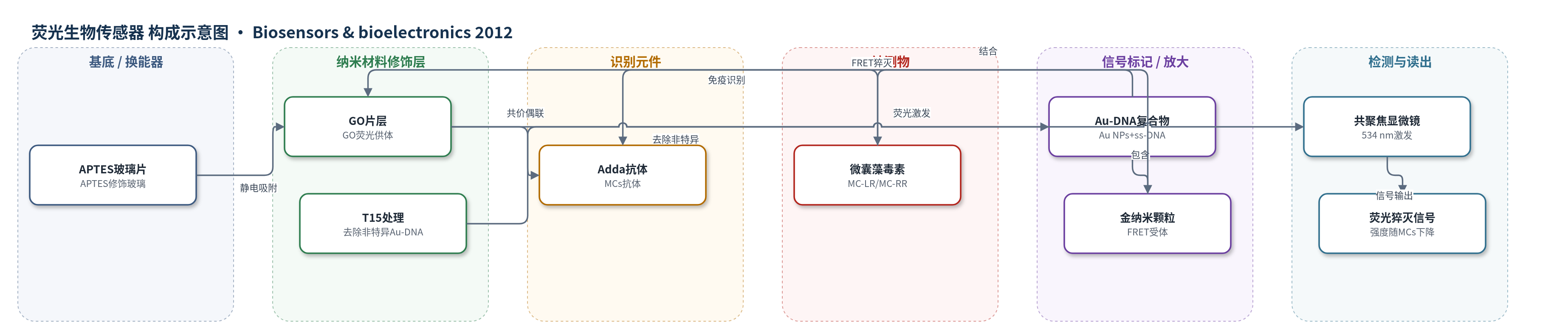
点击图片查看大图 · 依据论文自动绘制
传感器类型
荧光生物传感器
检测对象
微囊藻毒素(microcystins, MCs;MC-LR、MC-RR);样品基质:超纯水、天然湖水
检测原理
该传感器以GO的本征光致发光为信号源。GO片层通过静电作用固定在APTES修饰玻璃片上,其羧基经EDC/NHS活化后与MCs Adda基团抗体共价偶联。MCs可与Au NPs表面的ss-DNA结合,形成Au–DNA–MCs复合物;当复合物被GO表面抗体捕获后,Au NPs被拉近至GO表面10 nm以内,作为FRET受体接受GO激发态能量,导致GO荧光猝灭。MCs浓度越高,结合到GO表面的Au NPs越多,FRET效率越高,荧光强度越低。T15寡核苷酸通过互补结合剥离非特异吸附的Au–DNA,降低背景。最终通过共聚焦显微镜测量534 nm激发下GO荧光强度变化实现定量检测。
检测灵敏度
LOD: 0.5 mg/L (MC-LR);LOD: 0.3 mg/L (MC-RR);检测浓度范围: 10^-4–2.5 mg/L
效应效果
该传感器对MC-LR和MC-RR均产生明确荧光猝灭信号,在超纯水和天然湖水中结果一致,湖水中猝灭效率略高约4%。特异性实验中,1 mg/L的河豚毒素(STX)和新河豚毒素(NEO)未引起明显猝灭,荧光强度接近阴性对照,说明抗体对Adda基团识别具有较高选择性。AFM显示各功能化步骤形貌变化:GO单层/双层高度差约1 nm,抗体修饰后约2 nm,MC-LR结合后约4 nm,最终Au NPs复合物总高约17 nm,证实Au NPs足够接近GO。T15处理后荧光强度恢复至92±0.9%,有效降低非特异吸附。LOD满足WHO饮用水MC-LR限值1 mg/L,作者认为该方法可推广至其他水污染有害毒素检测。
传感器的构成
- 基底/换能器:APTES修饰的正电荷玻璃载玻片(APTES-modified glass slide),提供正电荷表面以静电吸附GO。
- 纳米材料修饰层:氧化石墨烯(GO)片层,具有本征光致发光,作为FRET能量供体。
- 识别元件:微囊藻毒素Adda基团抗体(MCs antibody, Ab),经EDC/NHS活化后共价偶联到GO羧基,特异性识别MCs。
- 信号标记物:巯基单链DNA修饰的13 nm金纳米颗粒(HS-A15/Au NPs),与MCs结合形成Au–DNA–MCs复合物,Au NPs作为FRET受体猝灭GO荧光。
- 抗非特异处理:胸腺嘧啶寡核苷酸(T15),通过互补结合去除非特异吸附的Au–DNA,降低背景猝灭。
- 读出装置:激光共聚焦显微镜(Leica TCS SP2 Confocal Microscope),534 nm激发、PMT检测GO荧光强度变化。
中文摘要
水安全是全球普遍问题。微囊藻毒素(MCs)是蓝藻产生的肝毒素,对饮用水安全构成严重威胁。世界卫生组织规定饮用水中微囊藻毒素-LR(MC-LR)限值低至1 mg/L,因此需要灵敏的痕量检测方法。本文基于金纳米颗粒(Au NPs)诱导氧化石墨烯(GO)荧光猝灭现象,建立了一种用于微囊藻毒素检测的可靠生物传感器。MCs可通过与修饰在Au NPs上的单链DNA(ss-DNA)相互作用而结合到Au NPs上,形成Au–DNA–MCs复合物。复合物中的MCs可被吸附在GO片层上的抗体免疫识别,使Au NPs足够接近GO表面,通过荧光共振能量转移(FRET)猝灭GO光致发光。随着MCs浓度增加,更多Au NPs连接至GO表面,荧光强度下降。MC-LR和MC-RR的检出限分别为0.5和0.3 mg/L,满足WHO最严格标准。在天然湖水和特异性实验中均获得明确结果。所用抗体识别MCs保守的Adda基团,使传感器既能检测单一毒素,也能检测水样中MCs总含量。
英文摘要
Water safety is one of the most pervasive problems afflicting people throughout the world. Microcystin, a hepatotoxin produced by cyanobacteria, poses a growing and serious threat of water safety. According to World Health Organization (WHO), the limit of content of microcystin-LR (MC-LR) in drinking water is as low as 1 μg/L; it is thus necessary to explore a sensitive method for the trace detection of microcystins (MCs). Based on the observation of gold nanoparticles (Au NPs) induced graphene oxide (GO) fluorescence quenching, a reliable biosensor was developed here for microcystins detection. MCs could be attached on Au NPs through the interaction with single strand-DNA (ss-DNA) modified on Au NPs, which formed Au-DNA-MCs complexes. These MCs in the complexes could be immunologically recognized by the antibodies adsorbed on GO sheets, as a result, Au NPs were close enough to quench the photoluminescence of GO by the fluorescence resonance energy transfer (FRET). The fluorescence intensity decreased with the increase of MCs as more Au NPs linked onto GO surface. The limit of detection was 0.5 and 0.3 μg/L for microcystin-LR and microcystin-RR (MC-RR), respectively, which satisfies the strictest standard of WHO. Well defined results were also obtained in natural lake water and the specificity experiment. The antibody used here could recognize Adda group, the conservative part of MCs, which allowed the biosensor to detect both single toxin and the total content of MCs existing in the water sample.