组成图示
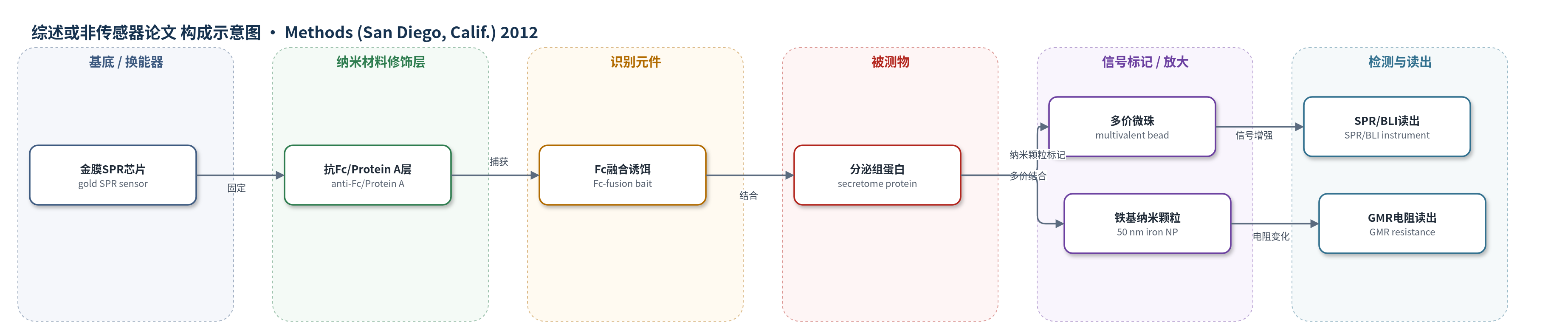
点击图片查看大图 · 依据论文自动绘制
传感器类型
综述或非传感器论文
检测对象
胞外蛋白-蛋白相互作用(extracellular protein–protein interactions, ePPI);分泌组蛋白/受体(secretome proteins/receptors);样品基质:纯化重组蛋白、细胞培养上清/条件培养基、细胞表面、蛋白微阵列
检测原理
该文综述的传感/微阵列方法通常先将诱饵蛋白、受体胞外域或蛋白库固定于金膜SPR芯片、BLI光纤、GMR传感面、玻璃微阵列或细胞表面,再加入候选胞外蛋白。特异性结合改变界面质量、折射率、磁阻或荧光强度:SPR/BLI通过光反射/干涉变化实时监测结合与解离;GMR通过铁基纳米颗粒靠近传感面引起电阻变化;蛋白微阵列通过荧光或成像检测结合点;细胞法通过流式或成像检测细胞表面结合。多价微珠、Fc或COMP多聚体通过亲合力增强低亲和力ePPI。信号随结合蛋白量或浓度增加而增强,可用于筛选和动力学分析。
检测灵敏度
未报告
效应效果
综述总结多种平台表现:TNF配体-受体流式筛选可鉴定超过100个特异性相互作用,假阳性很少;SPR可测低亲和力CD2-CD48(KD 60–90 μM)和CD2-CD58(KD 10–20 μM);GMR传感器相比相同抗体的夹心ELISA灵敏度至少提高两个数量级,并可估算高亲和力相互作用动力学;BLI发现TIGIT-PVR和Robo4-UNC5B,报告KD约3–12 nM;蛋白微阵列用1,334个分泌组蛋白对89个IgSF诱饵筛选,仅5个蛋白非特异命中率超过10%,并发现IGFL-TMEM149/IGFLR1互作。作者认为细胞法、生物传感器与微阵列互补,可扩大胞外互作组覆盖。
传感器的构成
- 基底/换能器:金膜SPR传感芯片(gold SPR sensor)或光纤BLI传感器(fiber optic BLI sensor),用于无标记结合检测。
- 修饰/固定层:环氧涂层玻璃(epoxy-coated glass)、聚羧酸水凝胶玻璃(polycarboxylate hydrogel glass)、Protein A微珠(Protein A microbeads)或抗Fc抗体涂层(anti-human Fc),用于固定蛋白库或捕获Fc融合诱饵。
- 识别元件:受体/配体胞外域(ECD)、Fc融合诱饵(Fc-fusion bait)、捕获抗体/受体/配体(capture antibody/receptor/ligand),用于特异性识别候选蛋白。
- 信号标记/放大:多价微珠(multivalent microbeads)、Fc/COMP多聚体(Fc/COMP multimers)、50 nm铁基纳米颗粒(50 nm iron-based nanoparticles)或PE偶联抗标签抗体(PE-coupled anti-tag antibody),用于增强低亲和力结合或产生信号。
- 样品/识别对象:分泌组蛋白库(secretome protein library)、细胞表面受体(cell-surface receptors)或条件培养基蛋白(conditioned media proteins),作为被筛蛋白。
- 读出系统:Biacore/ProteOn SPR、BLI、GMR电阻读出、CCD成像或流式细胞仪(flow cytometry),输出结合曲线、荧光或电阻变化。
中文摘要
约四分之一的人类基因编码在胞外空间发挥功能或连接胞外与胞内环境的蛋白。这些分泌组蛋白之间的物理相互作用调控多种生物活动,是重要治疗靶点;部分胞外蛋白也被病原体利用以进入宿主或逃避免疫。尽管胞外蛋白-蛋白相互作用(ePPI)重要,相关知识仍有限。弱亲和力和低丰度常使传统生化纯化、cDNA文库表达克隆等方法难以鉴定这些相互作用;现有大规模蛋白互作图谱也常低估胞外互作。本综述重点介绍与分泌组范围筛选兼容的新兴生物传感器和蛋白微阵列技术,以及较传统的细胞学方法,用于发现胞外蛋白-蛋白相互作用。这些方法的组合将快速扩展对胞外蛋白互作组的认识。
英文摘要
Approximately one quarter of all human genes encode proteins that function in the extracellular space or serve to bridge the extracellular and intracellular environments. Physical associations between these secretome proteins serve to regulate a wide range of biological activities and consequently represent important therapeutic targets. Moreover, some extracellular proteins are targeted by pathogens to allow host access or immune evasion. Despite the importance of extracellular protein-protein interactions, our knowledge in this area has remained sparse. Weak affinities and low abundance have often hindered efforts to identify these interactions using traditional methods such as biochemical purification and cDNA library expression cloning. Moreover, current large-scale protein-protein interaction mapping techniques largely under represent extracellular protein-protein interactions. This review highlights emerging biosensor and protein microarray technology, along with more traditional cell-based techniques, that are compatible with secretome-wide screens for extracellular protein-protein interaction discovery. A combination of these approaches will serve to rapidly expand our knowledge of the extracellular protein-protein interactome.