组成图示
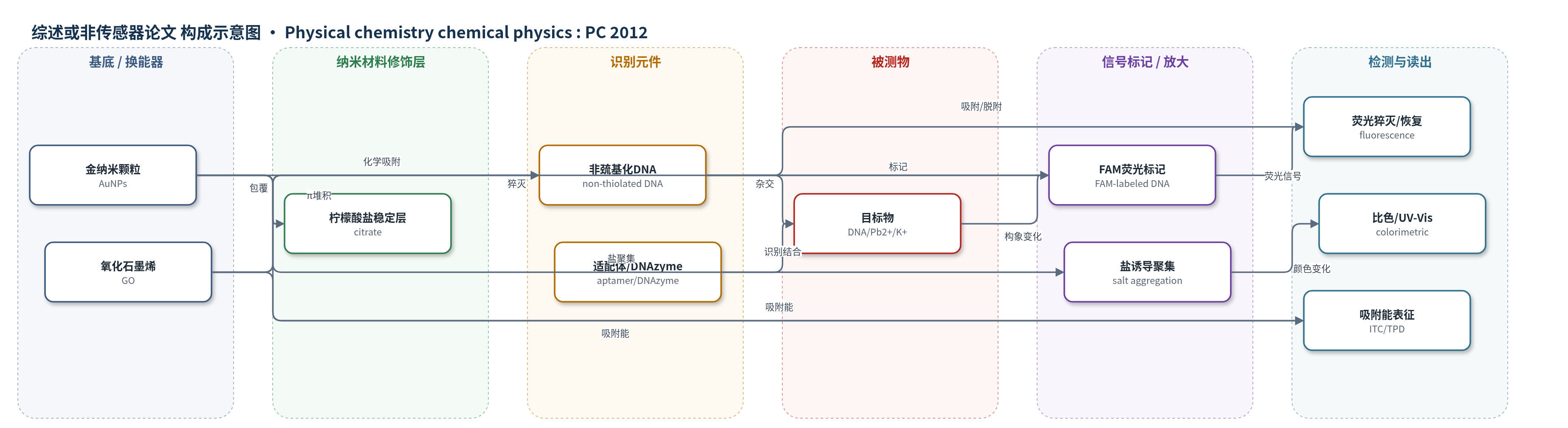
点击图片查看大图 · 依据论文自动绘制
传感器类型
综述或非传感器论文
检测对象
DNA(互补核酸)、金属离子(Pb2+、K+)、小分子、蛋白质、细胞;样品基质主要为水溶液/缓冲液,亦讨论血清蛋白干扰
检测原理
本文综述的传感机制基于DNA与AuNPs或GO的吸附/脱附。DNA磷酸骨架带负电,与带负电的AuNPs/GO存在静电排斥;加入盐、降低pH或升温可压缩双电层并克服能垒。AuNPs上DNA主要通过碱基与金表面的化学相互作用吸附,结合较强且脱附慢;GO上则主要依靠芳香π堆积和疏水作用,表面异质导致多种吸附能。FAM标记DNA吸附后被猝灭,目标物引起杂交、适配体构象变化或DNAzyme切割,使探针脱附或短ssDNA生成,从而恢复荧光或改变AuNP聚集状态。AuNP在盐诱导下聚集发生红移/蓝紫色比色变化,短ssDNA可保护其不聚集,实现无标记比色检测。
检测灵敏度
原文未报告LOD、线性范围、灵敏度斜率或相关系数。
效应效果
作为综述,本文未给出单一传感器的LOD、线性范围或回收率,但总结了关键性能:13 nm AuNP上非巯基化DNA吸附后脱附极慢,44-mer在2 h内仅约0.5%脱附;GO上DNA脱附受盐、pH和温度影响,过夜水浸泡约15%脱附,pH 9.5加热后约80%脱附,剩余约20%需过量互补DNA才能完全去除。AuNP比色法灵敏度高,可肉眼观察nM甚至pM颗粒,但高盐(>300 mM NaCl)仍可能诱导聚集,血清蛋白吸附可造成假阴性/假阳性。GO荧光法存在‘关’信号灵敏度有限及非特异置换问题。作者认为这些界面可用于DNA微阵列优化、生物传感器、纳米颗粒功能化与药物递送。
传感器的构成
- 基底/换能器:金纳米颗粒(AuNPs)或氧化石墨烯(GO),作为DNA吸附界面与荧光猝灭/比色换能载体
- 识别元件:非巯基化DNA、适配体(aptamer)或DNAzyme探针,识别目标核酸、金属离子、小分子或蛋白
- 信号标记物:FAM标记DNA,吸附后被AuNPs/GO猝灭,脱附后恢复荧光
- 稳定/封闭层:柠檬酸盐(citrate)包覆AuNPs维持胶体稳定;MCH用于平面金封闭非特异碱基吸附
- 读出层:紫外-可见吸收、荧光光谱、凝胶电泳、ITC、TPD等表征与信号输出
中文摘要
DNA与无机表面的相互作用受到广泛关注,因为深入理解其吸附与脱附对DNA微阵列优化、生物传感器开发和纳米颗粒功能化至关重要。金因独特光学与电学性质成为常用表面。多种表面科学工具表明,巯基化DNA不仅通过巯基,也可通过碱基与金相互作用。既往研究多集中于平面金,但所得结论未必适用于金纳米颗粒(AuNPs):DNA吸附亲和力随AuNP尺寸变化,高曲率改变相互作用,且AuNP胶体稳定性限制盐浓度,而平面金无此限制。氧化石墨烯(GO)作为DNA界面新材料,与AuNPs具有相似性质:两者表面均带负电却可强吸附DNA,且均为优良荧光猝灭剂,并已展示类似分析与生物医学应用。但作用力不同:DNA在AuNPs上通过特异性化学相互作用吸附,在GO上则通过芳香堆积和疏水作用吸附。本文综述非巯基化DNA随盐、pH、温度和DNA二级结构变化的吸附/脱附进展,并讨论未来方向与应用。
英文摘要
The interaction between DNA and inorganic surfaces has attracted intense research interest, as a detailed understanding of adsorption and desorption is required for DNA microarray optimization, biosensor development, and nanoparticle functionalization. One of the most commonly studied surfaces is gold due to its unique optical and electric properties. Through various surface science tools, it was found that thiolated DNA can interact with gold not only via the thiol group but also through the DNA bases. Most of the previous work has been performed with planar gold surfaces. However, knowledge gained from planar gold may not be directly applicable to gold nanoparticles (AuNPs) for several reasons. First, DNA adsorption affinity is a function of AuNP size. Second, DNA may interact with AuNPs differently due to the high curvature. Finally, the colloidal stability of AuNPs confines salt concentration, whereas there is no such limit for planar gold. In addition to gold, graphene oxide (GO) has emerged as a new material for interfacing with DNA. GO and AuNPs share many similar properties for DNA adsorption; both have negatively charged surfaces but can still strongly adsorb DNA, and both are excellent fluorescence quenchers. Similar analytical and biomedical applications have been demonstrated with these two surfaces. The nature of the attractive force however, is different for each of these. DNA adsorption on AuNPs occurs via specific chemical interactions but adsorption on GO occurs via aromatic stacking and hydrophobic interactions. Herein, we summarize the recent developments in studying non-thiolated DNA adsorption and desorption as a function of salt, pH, temperature and DNA secondary structures. Potential future directions and applications are also discussed.