组成图示
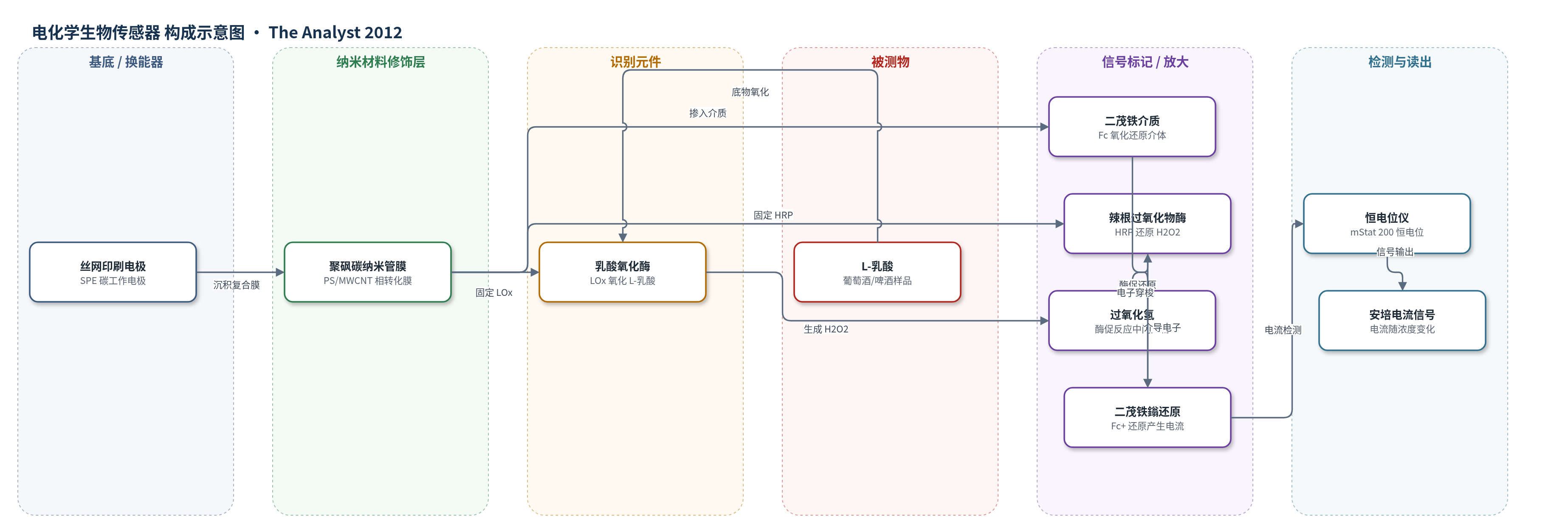
点击图片查看大图 · 依据论文自动绘制
传感器类型
电化学生物传感器
检测对象
L-乳酸(L-lactate / L-lactic acid);样品基质:葡萄酒、啤酒及磷酸盐缓冲液标准溶液
检测原理
该传感器采用双酶级联与氧化还原介导的安培检测机制。LOx 作为识别/催化元件,催化 L-乳酸与溶解氧反应生成丙酮酸和 H2O2;HRP 过量存在,催化 H2O2 还原为水,同时氧化膜内二茂铁(Fc)为二茂铁鎓(Fc+)。Fc+ 在碳电极表面于 -100 mV 被还原,产生与乳酸浓度成正比的稳态电流。MWCNT 提高膜导电性和电子传递速率,PS 膜将 LOx、HRP、Fc 和 BSA 共同固定,降低工作电位并减少高电位下干扰物氧化。由于 HRP 过量,信号动力学主要受 LOx 对乳酸的催化控制,因此电流随 L-乳酸浓度增加而增大。
检测灵敏度
LOD: 0.05 mg L−1 / 0.053 mg L−1;线性范围: 0.1 mg L−1 to 5 mg L−1 / 0.1–3.5 mg L−1;灵敏度: 1168.8 mA M−1 mm−2;R^2 = 0.999
效应效果
响应时间 20 s,1 mg/L L-乳酸 RSD 2.7%,校准斜率 RSD 1.4%。2 mg/L 干扰物中,仅没食子酸和抗坏血酸分别产生 1.7%、10.2% 乳酸电流,稀释后不显著;12% v/v 乙醇使灵敏度降约 20%。干存 4 ℃ 一天失活约 90%,PBS 4 ℃ 两周保留约 40%。葡萄酒/啤酒标准加入法测定,与分光光度试剂盒比较 r2=0.999,斜率 1.01±0.02,截距 0.002±0.012,差异约 -3.4% 至 5.9%。作者认为其快速、低成本,分析时间约 18 min,短于试剂盒 23 min,适合现场食品分析。
传感器的构成
- 基底/换能器电极:碳丝网印刷电极(SPE),含碳工作电极、碳对电极和银参比电极,提供电化学换能平台
- 复合膜修饰层:聚砜(PS)/多壁碳纳米管(MWCNT)相转化膜,提供导电通道、高比表面和酶固定基质
- 氧化还原介质:二茂铁(Fc),掺入膜中,介导 HRP 催化 H2O2 还原并降低工作电位
- 识别/催化元件:乳酸氧化酶(LOx,Pediococcus sp.),催化 L-乳酸氧化为丙酮酸并生成 H2O2
- 信号转换酶:辣根过氧化物酶(HRP,type II),催化 H2O2 还原为水并驱动介导电子转移
- 封闭/稳定蛋白:牛血清白蛋白(BSA),加入相转化溶液,改善酶在 PS 膜中的保留、微环境和重现性
中文摘要
本文报道了一种用于葡萄酒和啤酒中 L-乳酸分析的新型安培双酶生物传感器。该传感器通过相转化法将乳酸氧化酶(LOx)和辣根过氧化物酶(HRP)共同固定于多壁碳纳米管/聚砜(MWCNT/PS)复合膜中,并修饰在丝网印刷电极(SPE)上。为提高灵敏度并降低工作电位,作者优化了实验条件,并将二茂铁(Fc)作为氧化还原介质引入膜内,使过氧化氢可在 -100 mV 处被还原。测量在 pH 7.5 磷酸盐缓冲液、批量条件下进行。传感器对 L-乳酸的响应时间仅 20 s,重现性良好(RSD 2.7%),检出限为 0.05 mg/L,线性范围为 0.1–5 mg/L。最后将该传感器应用于不同葡萄酒和啤酒样品中 L-乳酸的测定,并与基于分光光度法的商业试剂盒结果进行比较,两者一致性良好,验证了该方法的有效性。
英文摘要
A novel amperometric bienzymatic biosensor has been developed based on the incorporation of Lactate Oxidase (LOx) and Horseradish Peroxidase (HRP) into a carbon nanotube/polysulfone membrane by the phase inversion technique onto screen-printed electrodes (SPEs). In order to improve the sensitivity and reduce the working potential, experimental conditions have been optimized and ferrocene has also been incorporated into the membrane as a redox mediator of the enzymatic reactions, which allows the reduction of H(2)O(2) at -100 mV. Measurements were carried out in phosphate buffer solution at pH 7.5 and under batch conditions. The biosensor response time to L-lactate was only 20 s and showed a good reproducibility (RSD 2.7%). Moreover, the detection limit was 0.05 mg L(-1) of l-lactate with a linear interval range from 0.1 mg L(-1) to 5 mg L(-1). Finally, the biosensor has been applied to the determination of l-lactic acid in different wine and beer samples. Then, the results obtained with the biosensor were compared with the ones obtained using, as a reference method, a commercial kit based on spectrophotometric measurements, obtaining an excellent agreement between the results, validating our approach.