组成图示
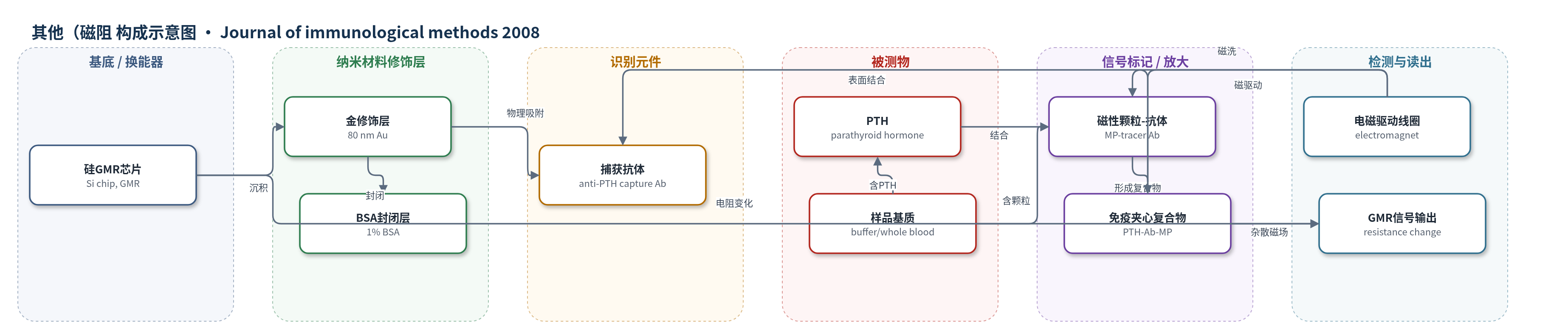
点击图片查看大图 · 依据论文自动绘制
传感器类型
其他(磁阻(GMR)生物传感器)
检测对象
甲状旁腺激素(PTH, parathyroid hormone);样品基质:缓冲液、50%全血(文中亦提及全血、唾液、牛奶等复杂基质)
检测原理
该方法为一步法免疫夹心检测。样品中的PTH与偶联在超顺磁性颗粒(MP)表面的示踪抗PTH抗体结合,形成PTH-抗体-磁性颗粒复合物;芯片金表面物理吸附捕获抗PTH抗体。上下电磁线圈施加磁场和梯度,驱动颗粒在样品中运动,提高目标捕获效率,并将复合物快速富集到传感器表面与捕获抗体结合;随后反向磁场进行磁洗,去除未结合和弱结合颗粒。结合在表面的磁性颗粒被激励线磁化,其杂散磁场改变GMR多层膜的电阻,GMR信号变化[(Si-Sf)/Si]与结合颗粒数成正比,因此随PTH浓度升高而增大。信号放大来自磁性颗粒大标记带来的高磁矩/大磁化体积,以及电磁驱动增强传质和表面富集。
检测灵敏度
LOD: 10 pM range(300 nm颗粒,15 min);0.8 pM(500 nm颗粒,15 min)
效应效果
该传感器在缓冲液和50%全血中均可检测,全血背景与蛋白缓冲液不可区分,无需样品前处理;一次性卡盒样品量仅1 µL,无液体置换步骤。300 nm磁性颗粒15 min可检测10 pM量级PTH,500 nm颗粒5 min可达到与300 nm 15 min相当信号,15 min可检测0.8 pM。校准曲线在临床相关范围内未出现高剂量钩状效应,最高至4 nm(原文单位)。文中未报告RSD、实际样品回收率及与ELISA/HPLC/qPCR的直接对比;作者认为其低样品量、高速度、紧凑GMR芯片适合急诊、救护车、诊室和居家等实验室外检测。
传感器的构成
- 基底/换能器:硅传感器芯片(Si chip),集成4个GMR传感器、GMR磁阻条和激励线,用于检测颗粒杂散磁场
- 金属修饰层:80 nm Au溅射层,提供抗体物理吸附表面
- 识别元件:anti-PTH capture antibody(捕获抗体,识别PTH 39–84位点),固定于Au表面,捕获PTH-颗粒复合物
- 封闭层:1 wt.% BSA in PBS,封闭芯片非特异结合位点
- 信号标记/识别元件:carboxylated superparamagnetic particles(MP,300/500 nm,Ademtech)经EDC偶联anti-PTH tracer antibody(示踪抗体,识别PTH 1–35位点),捕获PTH并作为磁性标记
- 驱动/分离元件:电磁线圈(copper windings around cobalt-iron alloy core),位于芯片上下,施加磁场/梯度驱动颗粒结合与磁洗
- 流体腔:一次性流路卡盒,1 µL样品腔,容纳样品和传感器
- 读出:GMR信号变化[(Si-Sf)/Si],由GMR芯片/读取器输出
中文摘要
本文报道了一种利用可驱动磁性颗粒标记并结合巨磁阻(GMR)生物传感器快速灵敏检测蛋白的方法。该方法采用一步法夹心免疫分析,无需液体置换步骤;样品中各结合反应以及结合/游离分离均由传感器芯片上下方电磁铁产生的磁力控制。与示踪抗体偶联的磁性颗粒在样品中被驱动以捕获目标蛋白,并迅速移至传感器表面,与固定化捕获抗体结合;弱结合或未结合标记物通过背离GMR表面的磁力去除。以甲状旁腺激素(PTH)为模型,使用300 nm颗粒时,总分析时间15 min可获得10 pM量级的检测限;使用500 nm颗粒时,5 min即可达到相同灵敏度;若500 nm颗粒用于15 min分析,则可检测0.8 pM PTH。该系统样品量低、分析性能高、速度快,且GMR生物传感器紧凑,特别适合实验室外环境中的灵敏检测。
英文摘要
A rapid method for the sensitive detection of proteins using actuated magnetic particle labels, which are measured with a giant magneto-resistive (GMR) biosensor, is described. The technique involves a 1-step sandwich immunoassay with no fluid replacement steps. The various assay binding reactions as well as the bound/free separation are entirely controlled by magnetic forces induced by electromagnets above and below the sensor chip. During the assay, particles conjugated with tracer antibodies are actuated through the sample for target capture, and rapidly brought to the sensor surface where they bind to immobilized capture antibodies. Weakly or unbound labels are removed with a magnetic force oriented away from the GMR sensor surface. For the measurement of parathyroid hormone (PTH), a detection limit in the 10 pM range is obtained with a total assay time of 15 min when 300 nm particles are used. The same sensitivity can be achieved in 5 min when 500 nm particles are used. If 500 nm particles are employed in a 15-minute assay, then 0.8 pM of PTH is detectable. The low sample volume, high analytical performance and high speed of the test coupled with the compact GMR biosensor make the system especially suitable for sensitive testing outside of laboratory environments.