组成图示
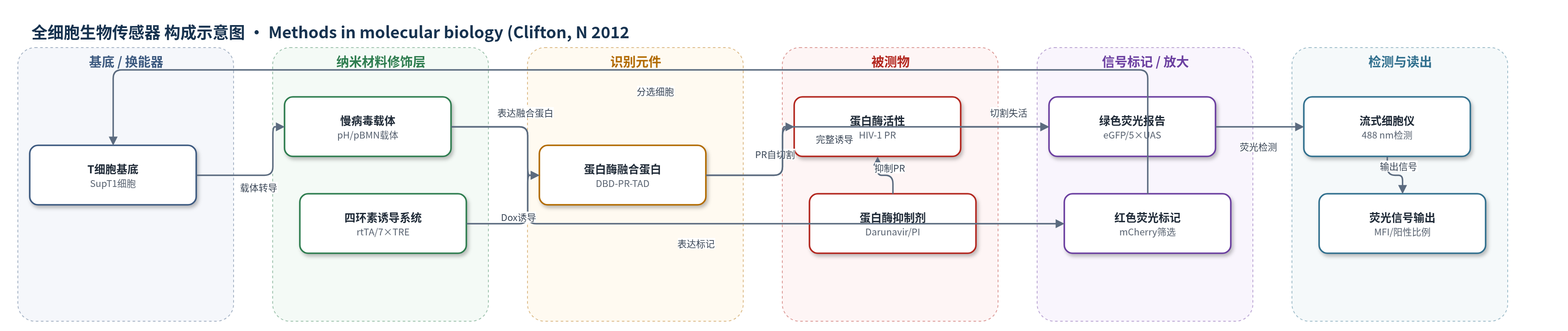
点击图片查看大图 · 依据论文自动绘制
传感器类型
全细胞生物传感器
检测对象
HIV-1蛋白酶活性(HIV-1 protease, PR)、蛋白酶抑制剂(protease inhibitors, PI,如Darunavir);样品基质:SupT1 T细胞培养体系
检测原理
该检测以SupT1 T细胞为天然感染微环境,通过慢病毒/逆转录病毒稳定导入rtTA、7×TRE-PR/Gal4和5×UAS-eGFP。加入强力霉素(Dox)后,Dox结合rtTA并使其结合7×TRE,诱导PR/Gal4融合蛋白表达。PR/Gal4由Gal4 DNA结合域(DBD)、HIV-1蛋白酶(PR)和反式激活域(TAD)串联组成。若PR具有催化活性,它会自催化切割自身与Gal4域的连接,使DBD与TAD分离,无法结合5×UAS并激活eGFP转录,eGFP荧光低;若PR被蛋白酶抑制剂(PI)阻断或本身无活性,融合蛋白保持完整,DBD结合UAS、TAD激活eGFP表达,荧光升高。因此eGFP荧光强度或阳性细胞比例与PR活性呈负相关,与抑制剂浓度呈正相关,最终由流式细胞仪488 nm激光读出。
检测灵敏度
未报告
效应效果
作者通过瞬时表达验证检测逻辑:在HEK293T细胞中共转染报告基因、PR/Gal4并加入1 mM Darunavir时,应获得最大eGFP激活;仅报告基因或无PI的PR/Gal4组应仅有最低eGFP背景。稳定克隆筛选以仅Dox处理组eGFP低、Dox加PI处理组接近100% eGFP表达且平均荧光强度最高为理想标准。文中指出Darunavir在该检测中表现出最低IC50,并在较高浓度下细胞死亡最少,因此推荐作为PI对照;原实验曾使用Indinavir作为对照。该体系在T细胞天然感染微环境中运行,可用于高通量筛选新型HIV-1蛋白酶抑制剂,也可替换其他蛋白酶用于催化活性监测。
传感器的构成
- 细胞基底/换能平台:SupT1 T细胞(HIV-1易感T细胞系),提供天然感染微环境并承载基因元件
- 诱导调控元件:rtTA反向四环素反式激活因子(rtTA)与7×TRE启动子,受强力霉素(Dox)诱导表达PR/Gal4
- 识别/传感元件:PR/Gal4融合蛋白,由Gal4 DNA结合域(DBD)、HIV-1蛋白酶(PR)和Gal4反式激活域(TAD)组成,PR活性决定融合蛋白是否被切割
- 报告基因/信号标记:5×UAS-eGFP报告构建体,eGFP作为PR活性荧光读出
- 病毒载体:慢病毒/逆转录病毒载体(pH-7×TRE-PR/Gal4、pH-5×UAS-GFP、pBMN-rtTA-i-mCherry),用于稳定转导
- 筛选标记:mCherry荧光蛋白,用于分选rtTA阳性细胞
- 检测试剂:蛋白酶抑制剂(PI,如Darunavir)和强力霉素(Dox),用于验证与诱导
- 读出系统:流式细胞仪(FACS)/荧光显微镜,488 nm激光检测eGFP
中文摘要
蛋白酶在病毒生命周期和成功感染建立中至关重要,简便监测其催化活性可显著促进新型抗病毒药物发现,并有助于阐明所研究病毒蛋白酶的作用与机制。作者实验室开发了一种在T细胞中监测HIV-1蛋白酶(PR)蛋白水解活性的检测体系,具有稳健读出。该检测利用原型转录因子Gal4,其由N端DNA结合域(DBD)和C端反式激活域(TAD)组成,并基于两点:将PR插入两个Gal4域之间形成PR/Gal4融合蛋白;以增强绿色荧光蛋白(eGFP)作为PR活性报告。为克服PR可能的细胞毒性,融合蛋白置于四环素诱导启动子控制下,仅在加入四环素或强力霉素时表达。当PR有活性时,其自催化切割自身与Gal4域的连接,导致无法诱导eGFP表达;若PR活性被阻断或无活性,两个域保持完整,从而诱导eGFP表达。因此,该检测可用于在感染自然微环境中分析因子、肽或化合物的抑制效果,eGFP作为PR活性的生物传感器。
英文摘要
Proteases are essential at different stages of the viral life cycle and for the establishment of a successful infection. Monitoring the catalytic activity of proteases in an easy and straightforward manner can thus drastically facilitate the discovery of novel antivirals, as well as help elucidate the activity and mechanism of action of the viral protease under study. In our laboratory, we have developed an assay in T-cells with a robust read-out to monitor the proteolytic activity of HIV-1 Protease (PR). The assay utilizes the prototypic transcription factor Gal4, which consists of the N-terminal DNA-binding domain and the C-terminal trans-activation domain. The assay is based upon (1) introduction of PR in between the two Gal4 domains to obtain a PR/Gal4 fusion protein and (2) utilization of the enhanced Green Fluorescent Protein as reporter of PR activity.In order to overcome the possible cellular cytotoxicity of PR, the fusion protein in our assay is under the control of a tetracycline-inducible promoter. This ensures that it will be expressed only when needed, upon the addition of tetracycline or doxycycline. When active, PR has autocatalytic activity and cleaves itself from the Gal4 domains, resulting in the inability to induce eGFP expression. However, if PR activity is blocked or it is inactive, the two domains remain intact, resulting in eGFP expression. The assay can therefore be utilized to analyze the inhibitory effects of factors, peptides or compounds, designed on a rational- or nonrational-based approach, in the natural milieu of infection, where eGFP serves as a biosensor for PR activity.