组成图示
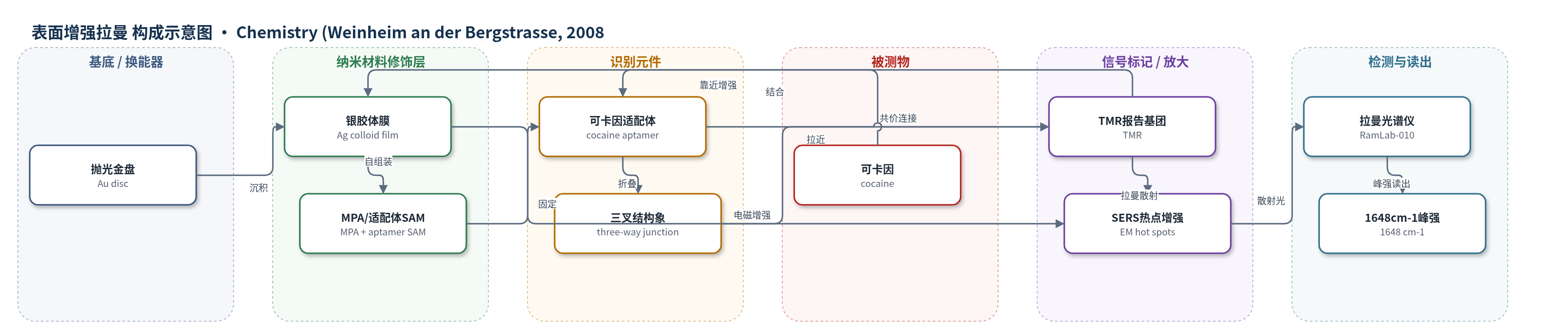
点击图片查看大图 · 依据论文自动绘制
传感器类型
表面增强拉曼(SERS)生物传感器
检测对象
可卡因(cocaine);样品基质:PBS缓冲液、人血清稀释液(50倍、10倍、5倍稀释)
检测原理
传感器采用“signal-on”无试剂SERS适配体设计。5'-巯基可卡因DNA适配体与MPA在可卡因模板存在下混合自组装于银胶体膜上,随后PBS洗脱模板,使适配体部分展开,3'-端TMR远离银膜,背景SERS弱。当可卡因结合适配体时,适配体折叠成三叉结,TMR被拉近至银纳米颗粒表面。SERS增强因子与报告基团到粗糙银膜距离的12次方成反比(ER/d^-12),因此TMR靠近“热点”后拉曼散射显著增强。选择1648 cm-1芳环C=C伸缩峰作为定量信号,峰强随可卡因浓度增加而增加。模板自组装优化适配体取向并减少空间位阻,提高响应。
检测灵敏度
LOD: 1 mM;线性范围: 1–3200 mM
效应效果
传感器对可卡因代谢物BE、ENME和ENDME显示良好选择性。模板组装使500 mM和1500 mM可卡因的SERS信号增幅分别达39.5%和51.8%,显著高于非模板组装的4.7%和16.2%。同一基底不同点RSD低于8.9%,批间信号比标准偏差0.3%;三批传感器在1.5 mM下增幅为51.8%、51.3%、51.3%。在PBS及50、10倍稀释人血清中,0.5 mM可卡因响应约40%,10次再生循环标准偏差为1.8%、2.0%、2.9%,可恢复空白;5倍稀释血清响应降至约25%且逐渐衰减。检测限1 mM,较荧光和电化学适配体传感器约提高10倍,与免疫分析相当,适合小分子多路灵敏检测。
传感器的构成
- 基底:抛光金盘(Au disc),机械支撑并固定银胶体膜
- SERS换能层:银胶体膜(Ag colloid film,Ag NPs,约40 nm),提供SERS电磁增强热点
- 混合自组装层:3-巯基丙酸(MPA)与5'-巯基适配体混合自组装,调控表面密度、提供负电亲水环境并减少空间位阻
- 识别元件:可卡因DNA适配体(cocaine aptamer,5'-SH-(CH2)6-GAC-AAG-GAA-AAT-CCT-TCA-ATG-AAG-TGG-GTC-3'),特异性结合可卡因
- 信号标记物:3'-端四甲基罗丹明(TMR),拉曼报告基团,结合靶标后靠近银膜产生增强SERS信号
中文摘要
本研究报道了一种基于表面增强拉曼散射(SERS)光谱的无试剂适配体生物传感器的原理验证,采用可卡因作为模型靶标,并构建“信号增强”(signal-on)型传感架构。该传感器利用表面固定适配体在结合靶标后发生构象变化,使特定拉曼报告基团靠近SERS基底,从而因SERS局部增强效应而提高拉曼散射信号。为提高响应性能,传感器通过在银胶体膜上以5'-端烷硫醇基团将3'-端四甲基罗丹明(TMR)标记的DNA适配体进行可卡因模板化混合自组装来制备。该固定化策略优化了适配体在表面的取向,并促进其结合靶标时的折叠。在优化检测条件下,可检测1 mM浓度的可卡因,与基于电化学和荧光技术的类似适配体传感器相比具有优势。传感器可通过缓冲液洗涤简便再生。结果表明,SERS换能器可为未来用于生物化学和生物医学研究中灵敏检测的适配体传感器开发提供新维度。
英文摘要
The present study reports the proof of principle of a reagentless aptameric sensor based on surface-enhanced Raman scattering (SERS) spectroscopy with "signal-on" architecture using a model target of cocaine. This new aptameric sensor is based on the conformational change of the surface-tethered aptamer on a binding target that draws a certain Raman reporter in close proximity to the SERS substrate, thereby increasing the Raman scattering signal due to the local enhancement effect of SERS. To improve the response performance, the sensor is fabricated from a cocaine-templated mixed self-assembly of a 3'-terminal tetramethylrhodamine (TMR)-labeled DNA aptamer on a silver colloid film by means of an alkanethiol moiety at the 5' end. This immobilization strategy optimizes the orientation of the aptamer on the surface and facilitates the folding on the binding target. Under optimized assay conditions, one can determine cocaine at a concentration of 1 muM, which compares favorably with analogous aptameric sensors based on electrochemical and fluorescence techniques. The sensor can be readily regenerated by being washed with a buffer. These results suggest that the SERS-based transducer might create a new dimension for future development of aptameric sensors for sensitive determination in biochemical and biomedical studies.