组成图示
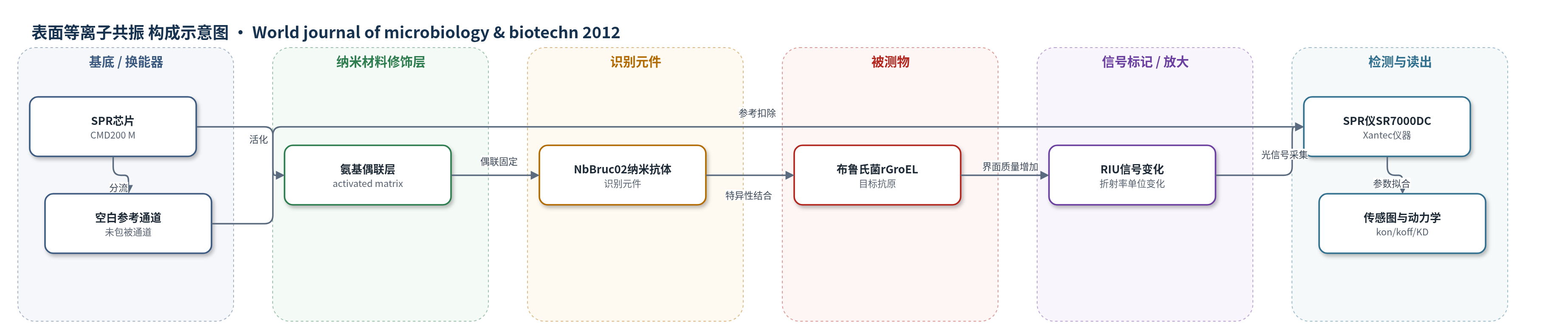
点击图片查看大图 · 依据论文自动绘制
传感器类型
表面等离子共振(SPR)生物传感器
检测对象
布鲁氏菌 GroEL/HSP-60(rGroEL,重组 GroEL);样品基质:布鲁氏菌总蛋白裂解液/提取物、纯化的布鲁氏菌 rGroEL 溶液、耶尔森菌 rGroEL 溶液(特异性对照)
检测原理
NbBruc02 通过氨基偶联固定于 SPR 芯片表面,形成识别层。当布鲁氏菌 rGroEL 随 HBS 缓冲液流过芯片时,纳米抗体识别其天然构象表位并与抗原结合,使芯片界面质量与局部折射率增加,导致表面等离子共振角位移,仪器以折射率单位 RIU 实时记录结合与解离过程。信号强度随 rGroEL 浓度升高而增大,通过多浓度传感图拟合得到结合与解离速率常数及亲和力。该方法无需标记,无酶促放大,特异性来自纳米抗体对布鲁氏菌天然 GroEL 构象表位的识别;耶尔森菌 rGroEL 在天然状态下不结合,从而区分交叉反应。
检测灵敏度
KD: 31.2 nM;kon: 1.2 × 10^4 M^-1 s^-1;koff: 3.72 × 10^-4 s^-1
效应效果
NbBruc02 能从布鲁氏菌总裂解液中免疫亲和捕获约 60 kDa 的天然 GroEL,并在 ELISA 中识别天然 rGroEL、在免疫印迹中识别变性 rGroEL。ELISA 中其对布鲁氏菌 rGroEL 的信号强于耶尔森菌 rGroEL,稀释度可达 1:30,000。SPR 显示其与布鲁氏菌天然 rGroEL 结合稳定,KD 为 31.2 nM,kon 1.2×10^4 M^-1 s^-1,koff 3.72×10^-4 s^-1;多次再生后结合能力无明显下降。耶尔森菌 rGroEL 在天然条件下不结合,表明其具有良好种属选择性。作者认为该纳米抗体可用于布鲁氏菌诊断、疫苗研究及干扰细菌黏附侵入。
传感器的构成
- 换能器芯片:CMD200 M SPR 芯片,提供表面等离子共振换能界面
- 识别元件:NbBruc02 纳米抗体,经氨基偶联固定于芯片通道,特异性结合布鲁氏菌 rGroEL
- 流动相缓冲液:HBS 缓冲液(10 mM Hepes pH 7.5、150 mM NaCl、3.5 mM EDTA、0.005% Tween-20),维持结合反应并降低非特异吸附
- 参考通道:未包被空白通道,用于扣除非特异信号
- 再生缓冲液:6 M 盐酸胍、0.1 M HCl 或 10 mM 甘氨酸-HCl pH 2.0,解离复合物恢复芯片
- 检测仪器:Xantec SR7000DC SPR 仪,实时监测折射率单位 RIU 传感图
中文摘要
布鲁氏菌对叙利亚公共卫生和畜牧业经济影响重大,因此亟需开发诊断与疫苗。此前作者从免疫骆驼中建立了广谱纳米抗体库,并筛选出布鲁氏菌特异性结合体 NbBruc02。蛋白组学提示其抗原为布鲁氏菌 60 kDa 热休克蛋白 GroEL/HSP-60。该抗原在布鲁氏菌感染巨噬细胞过程中的黏附与侵入中具有重要作用。本研究采用免疫层析法检测 NbBruc02 从布鲁氏菌总提取物中捕获天然 GroEL 的能力,并用布鲁氏菌重组 GroEL 进一步验证其相互作用。结果显示,NbBruc02 在 ELISA 和免疫印迹中分别识别天然和变性的 rGroEL;与既往报道一致,它仅能识别变性的耶尔森菌 rGroEL。表面等离子共振生物传感器表明,NbBruc02 与布鲁氏菌天然 rGroEL 呈纳摩尔级亲和力(KD≈10^-8 M),而与耶尔森菌无结合。由于 GroEL 功能依赖构象变化,NbBruc02 识别构象表位,为研究 GroEL 在布鲁氏菌生理中的作用提供了新工具。
英文摘要
Brucella has a great impact on health and economy in Syria, thus much effort is being placed on the development of diagnostics and vaccines. In this context, a wide Nanobody "immune" library was previously established, from which several Brucella-specific binders were isolated. One of these camel genetically engineered heavy-chain antibody fragments was referred to as NbBruc02. The precise antigen of NbBruc02 was presumed to be, according to proteomic approaches, the Brucella heat shock protein of 60 kDa (HSP-60). HSP-60, or alternatively named GroEL, is an interesting Brucella immunodominant antigen with important roles in the parasite life cycle, mainly adhesion and penetration during the infection of macrophages. In the present work, the capacity of NbBruc02 to filtrate the native GroEL from Brucella total extract was tested by immunochromatography approach. The interaction between NbBruc02 and its antigen was further confirmed using recombinant GroEL from Brucella. Interestingly, NbBruc02 was able to immunodetect the native as well as the denatured forms of the rGroEL in ELISA and immunoblotting, respectively. In agreement with previously reported data, NbBruc02 was able only to detect the denatured Yersinia rGroEL. Using surface plasmon resonance (SPR) biosensor, NbBruc02 showed a strong interaction, with nanomolar affinity (K (D) = ~10(-8) M), with the native rGroEL of Brucella and not of Yersinia. Because the casual conformational changes in the GroEL 3D structure make the base of its function, NbBruc02 by its ability to recognize a "conformational epitope," could open wide perspectives to study the role of GroEL in Brucella physiology.