组成图示
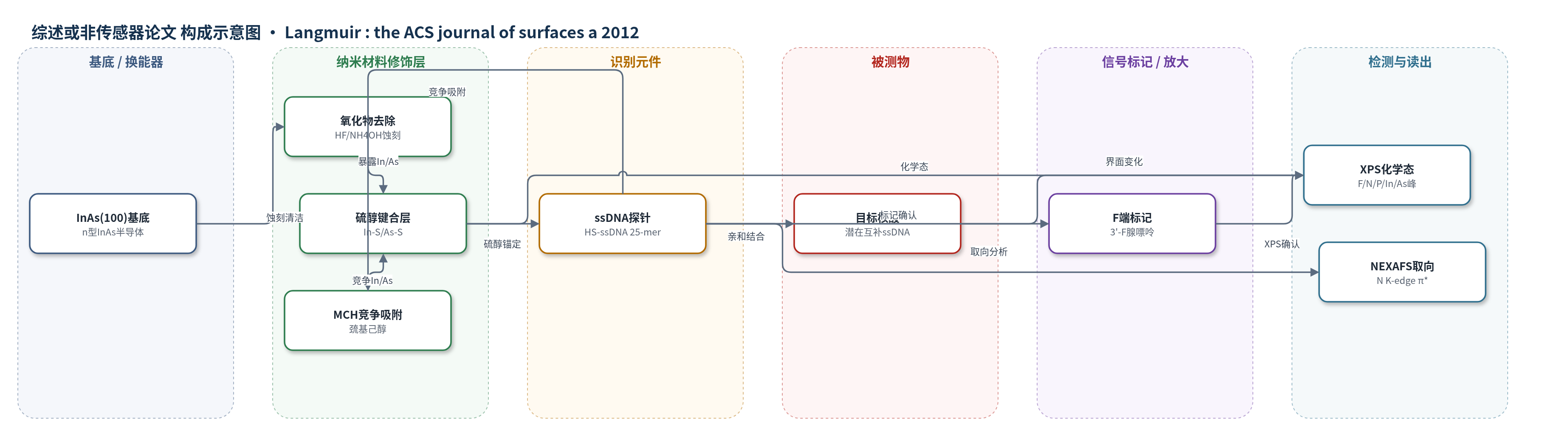
点击图片查看大图 · 依据论文自动绘制
传感器类型
综述或非传感器论文
检测对象
未明确实际检测对象;表征对象为固定在InAs(100)表面的巯基单链DNA探针(thiolated ssDNA),样品基质为TE、1 M NaCl-TE或NH4OH/TE缓冲液处理后的InAs表面。
检测原理
InAs表面通常存在二维电子气或电子积累层,其载流子浓度可被表面吸附、表面态和能带弯曲变化调制。若将该表面用作核酸传感平台,巯基ssDNA探针通过5'端硫醇与In/As形成In–S/As–S共价键,使探针以约45°倾角附着;目标核酸与探针杂交后,会在界面引入额外磷酸骨架电荷、改变偶极矩和表面态,从而改变InAs表面能带弯曲与电子积累/耗尽程度,最终表现为电学信号变化。本文未建立浓度-信号响应,而是用XPS的F 1s、N 1s、P 2p峰确认DNA固定,用As 3d/In 3d判断In–S/As–S键,用偏振NEXAFS的π*共振确定取向;NaCl通过静电屏蔽提高固定密度,但未报告LOD或线性范围。
检测灵敏度
未报告
效应效果
本文未开展选择性、抗干扰、重现性、加标回收率或与ELISA/qPCR等方法的传感性能对比,主要评价表面固定与界面化学。HF蚀刻比NH4OH更能去除As2O5,但两种蚀刻均残留少量As2O3;1 M NaCl使N 1s峰面积增大4–6倍,提高ssDNA固定密度。C1B-NaCl工艺氮含量最高(N 1s 6.2 at%),被作者认为最优;无MCH样品氮含量降至2.7–2.8 at%,硫含量升至4.7–5.5 at%,提示DTT残留。C1B-NaCl以In–S为主、少量As–S,C1A-NaCl中In–S与As–S接近;MCH在碱性条件下优先结合As。NEXAFS给出平均倾角45±2°、方位随机;F 1s在约10 h X射线曝光下未衰减,表明固定探针具有较好稳定性。
传感器的构成
- 基底/换能器:n型InAs(100)半导体,表面存在二维电子气/电子积累层,作为潜在电学传感基底
- 表面清洁层:HF或NH4OH水溶液蚀刻,去除原生InAs氧化物并暴露In/As表面
- 硫醇键合层:5'-巯基己基修饰ssDNA(HS-ssDNA)的硫醇端与In/As形成In-S/As-S共价键
- 识别元件:25碱基单链DNA探针(ssDNA),用于核酸亲和识别平台
- 信号标记物:3'端氟腺嘌呤(F-tag),提供F 1s XPS特征峰以确认DNA存在
- 共吸附/界面分子:巯基己醇(MCH),作为竞争硫醇研究In-S/As-S界面化学
- 功能化介质:TE缓冲液、1 M NaCl-TE、NH4OH/TE及TCEP,调控静电屏蔽并生成HS-ssDNA
- 读出/表征:XPS(Al Kα)与NEXAFS(N K-edge),用于化学态、元素组成和分子取向分析
中文摘要
将单链DNA固定在III–V半导体表面可构成潜在的高灵敏度生物传感器,理解DNA与InAs表面结合时发生的化学与电子变化对阐明DNA固定机制至关重要。本研究采用高分辨X射线光电子能谱(XPS)和近边X射线吸收精细结构谱(NEXAFS)表征DNA固定后的InAs表面化学性质。功能化前,分别用HF和NH4OH水溶液蚀刻去除InAs原生氧化物,并表征初始表面化学态。以3'端带氟腺嘌呤标记的巯基单链DNA(ssDNA)为探针,在两种功能化方法下固定于表面。XPS中F 1s、N 1s和P 2p峰证实DNA已固定;盐的存在显著影响InAs表面固定DNA密度。为研究界面化学,采用含或不含巯基己醇(MCH)的巯基ssDNA处理表面。As 3d和In 3d谱表明功能化后表面同时存在In–S和As–S键,其相对量取决于功能化方法及MCH是否存在。基于N K-edge偏振依赖NEXAFS确定吸附ssDNA取向:分子轴相对基底法线具有约45°的平均倾角,方位角随机分布。
英文摘要
Single-stranded DNA immobilized on an III-V semiconductor is a potential high-sensitivity biosensor. The chemical and electronic changes occurring upon the binding of DNA to the InAs surface are essential to understanding the DNA-immobilization mechanism. In this work, the chemical properties of DNA-immobilized InAs surfaces were determined through high-resolution X-ray photoelectron spectroscopy (XPS) and near-edge X-ray absorption fine structure (NEXAFS). Prior to DNA functionalization, HF- and NH(4)OH- based aqueous etches were used to remove the native oxide from the InAs surface. The initial chemical state of the surface resulting from these etches were characterized prior to functionalization. F-tagged thiolated single-stranded DNA (ssDNA) was used as the probe species under two different functionalization methods. The presence of DNA immobilized on the surface was confirmed from the F 1s, N 1s, and P 2p peaks in the XPS spectra. The presence of salt had a profound effect on the density of immobilized DNA on the InAs surface. To study the interfacial chemistry, the surface was treated with thiolated ssDNA with and without the mercaptohexanol molecule. An analysis of the As 3d and In 3d spectra indicates that both In-S and As-S are present on the surface after DNA functionalization. The amount of In-S and As-S was determined by the functionalization method as well as the presence of mercaptohexanol during functionalization. The orientation of the adsorbed ssDNA is determined by polarization-dependent NEXAFS utilizing the N K-edge. The immobilized ssDNA molecule has a preferred tilt angle with respect to the substrate normal, but with a random azimuthal distribution.