组成图示
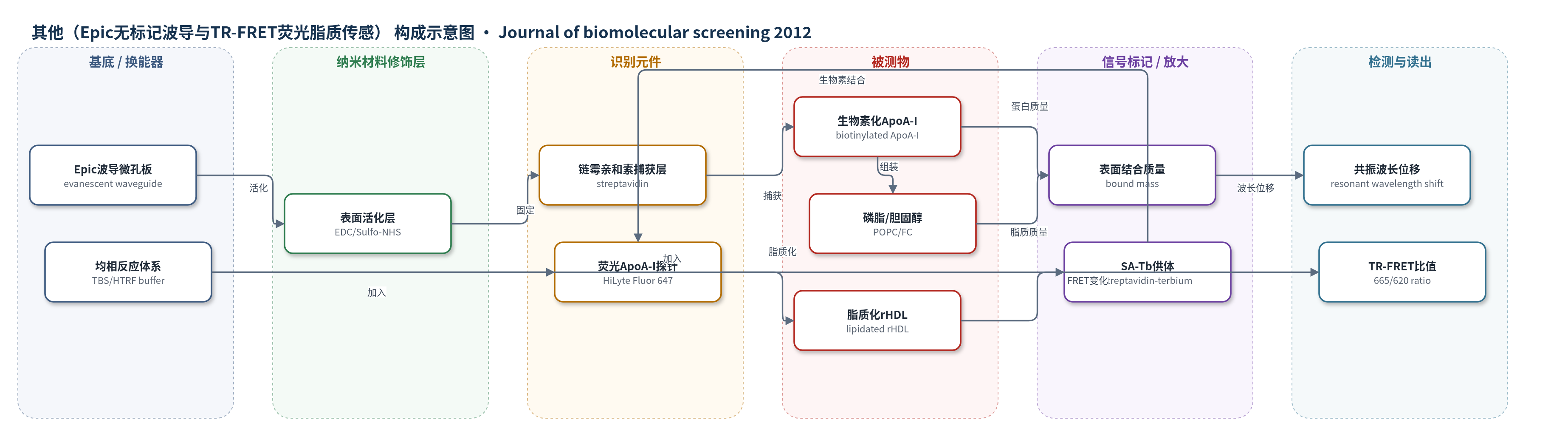
点击图片查看大图 · 依据论文自动绘制
传感器类型
其他(Epic无标记波导与TR-FRET荧光脂质传感)
检测对象
脂化载脂蛋白A-I(lipidated apolipoprotein A-I, ApoA-I)/重组高密度脂蛋白(recombinant HDL, rHDL)中ApoA-I结合脂质量;样品基质:TBS/HTRF缓冲液中的rHDL溶液、THP1细胞胆固醇外排上清(验证)。
检测原理
本文采用两种正交机制感知ApoA-I脂化。TR-FRET体系中,重组ApoA-I在C136位共价标记HiLyte Fluor 647作为FRET受体,N端Avi-tag经BirA生物素化后与链霉亲和素-铽螯合物(SA-Tb)结合形成供体-受体对。320 nm激发铽螯合物后,能量可转移至HiLyte Fluor 647;当磷脂和胆固醇掺入ApoA-I形成rHDL时,蛋白由无脂态展开为双超螺旋结构,N端与C136距离增大,FRET效率降低,665/620 nm发射比值随脂质/ApoA-I比例升高而下降。Epic体系中,生物素化ApoA-I被倏逝波导表面链霉亲和素捕获,脂质结合增加表面结合质量,改变波导折射率,产生与脂质质量成正比的共振波长位移(pm)。两者均无酶促放大,直接以构象距离或界面质量换能。
检测灵敏度
检测下限: 44 nM (1.4 µg/mL)(TR-FRET);240 nM (8 µg/mL)(Epic);适用浓度范围: 44–700 nM(TR-FRET,动态窗口1.7–3.0);>240 nM (8 µg/mL)且约500 nM (16 µg/mL)饱和(Epic);R^2 ≥0.80(TR-FRET,ApoA-I ≥44 nM);Z′ ≥0.66(TR-FRET,≥44 nM);S/B约35–38。
效应效果
两种方法均为非放射性、可高通量,优于传统放射性胆固醇外排检测,并能反映磷脂转移。TR-FRET为均相、时间分辨,S/B约35–38;≥44 nM(1.4 µg/mL)时Z′≥0.66,动态窗口1.7–3.0,R^2≥0.80,适合小分子筛选。Epic为无标记,链霉亲和素表面特异性捕获生物素化ApoA-I,BSA对照无结合;除最低两个浓度外Z′>0.5,>240 nM(8 µg/mL)稳健,约500 nM(16 µg/mL)饱和,灵敏度低于TR-FRET。荧光ApoA-I在THP1胆固醇外排中活性为天然ApoA-I的52%–56%(p<0.05),证明探针保留功能。作者认为可用于ABCA1增强剂筛选和HDL机制研究。
传感器的构成
- Epic基底/换能器:Corning Epic 384孔微孔板内嵌倏逝波导传感器(evanescent waveguide sensor),提供无标记光学换能。
- Epic表面活化层:EDC/Sulfo-NHS 活化 Epic 板表面,用于共价固定链霉亲和素或BSA。
- Epic识别/捕获层:链霉亲和素(streptavidin)固定层,特异性结合N端生物素化ApoA-I;BSA作非特异对照。
- Epic封闭剂:150 mM硼酸盐缓冲液(pH 9.2)加200 mM乙醇胺(ethanolamine),封闭非特异结合位点。
- TR-FRET供体:链霉亲和素-铽螯合物(streptavidin-terbium cryptate, SA-Tb),结合生物素并作为长寿命荧光供体。
- TR-FRET受体/探针:重组N8H-Avi-ApoA-I(E136C)-HiLyte Fluor 647,C136共价结合HiLyte Fluor 647,作为FRET受体。
- 脂质/被测物:磷脂POPC与游离胆固醇FC与ApoA-I组装成rHDL,脂化改变ApoA-I构象和表面结合质量。
- 读出层:EnVision 2102多标签读数仪(TR-FRET:320 nm激发,620/665 nm发射)或Epic系统共振波长位移(pm)。
中文摘要
载脂蛋白A-I(ApoA-I)是高密度脂蛋白(HDL)的主要蛋白,介导HDL形成和细胞胆固醇外排;其脂化由ATP结合盒转运体A1(ABCA1)调控。ABCA1活性不足会降低HDL形成和胆固醇外排,增加动脉粥样硬化风险。传统放射性胆固醇转运检测通量低、动态范围差,且不能检测磷脂转移。本文开发两种敏感、非放射性、高通量的ApoA-I脂化检测:一是基于时间分辨荧光共振能量转移(TR-FRET)的均相检测,采用HiLyte Fluor 647标记的ApoA-I,其N端生物素结合链霉亲和素-铽螯合物;当荧光ApoA-I掺入HDL后,TR-FRET信号随脂质/ApoA-I比例升高而下降,表明检测对ApoA-I结合脂质量敏感。二是基于Epic平台的无标记检测,生物素化ApoA-I被捕获在链霉亲和素包被的生物传感器表面,共振波长位移与ApoA-I结合脂质量成正比,证明该平台可感知ApoA-I脂化。
英文摘要
Apolipoprotein A-I (ApoA-I), a primary protein component of high-density lipoprotein (HDL), plays an important role in cholesterol metabolism mediating the formation of HDL and the efflux of cellular cholesterol from macrophage foam cells in arterial walls. Lipidation of ApoA-I is mediated by adenosine triphosphate (ATP) binding cassette A1 (ABCA1). Insufficient ABCA1 activity may lead to increased risk of atherosclerosis due to reduced HDL formation and cholesterol efflux. The standard radioactive assay for measuring cholesterol transport to ApoA-I has low throughput and poor dynamic range, and it fails to measure phospholipid transfer. We describe the development of two sensitive, nonradioactive high-throughput assays that report on the lipidation of ApoA-I: a homogeneous assay based on time-resolved fluorescence resonance energy transfer (TR-FRET) and a discontinuous assay that uses the label-free Epic platform. The TR-FRET assay employs HiLyte Fluor 647-labeled ApoA-I with N-terminal biotin bound to streptavidin-terbium. When fluorescent ApoA-I was incorporated into HDL, TR-FRET decreased proportionally to the increase in the ratio of lipids to ApoA-I, demonstrating that the assay was sensitive to the amount of lipid bound to ApoA-I. In the Epic assay, biotinylated ApoA-I was captured on a streptavidin-coated biosensor. Measured resonant wavelength shift was proportional to the amount of lipids associated with ApoA-I, indicating that the assay senses ApoA-I lipidation.