组成图示
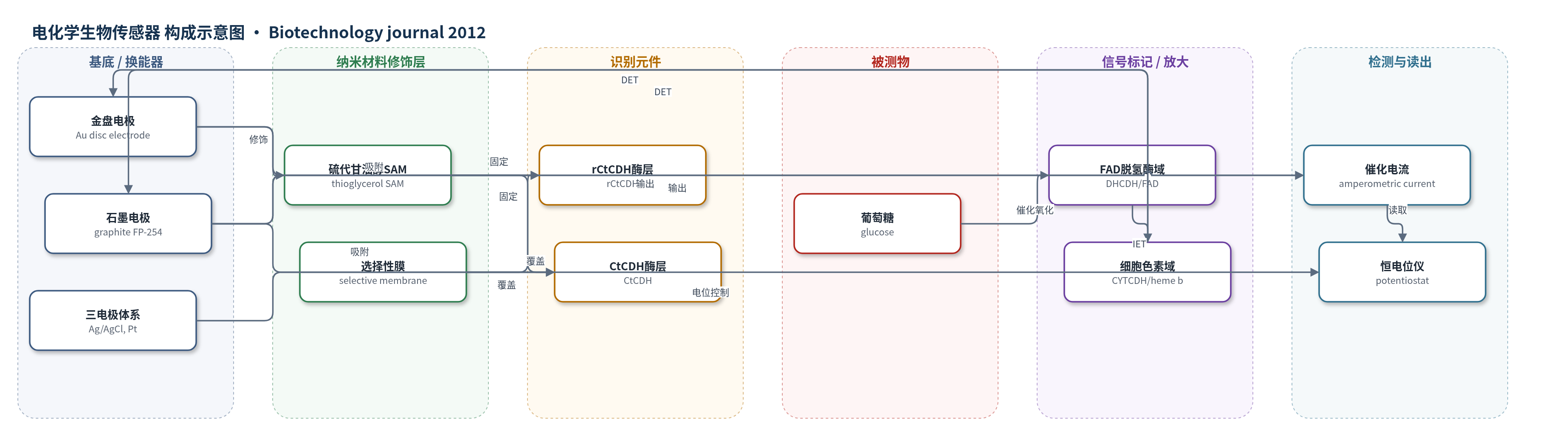
点击图片查看大图 · 依据论文自动绘制
传感器类型
电化学生物传感器
检测对象
葡萄糖(glucose);样品基质:缓冲液(McIlvaine buffer,pH 7.4/7.5)。另以纤维二糖(cellobiose)、乳糖(lactose)作底物进行酶学与电化学表征。
检测原理
葡萄糖进入电极界面后,被rCtCDH/CtCDH的FAD脱氢酶域(DHCDH)催化氧化,电子从FAD经柔性连接肽传递至细胞色素域(CYTCDH)的血红素b,完成分子内电子转移(IET)。由于CYTCDH暴露于电极表面,血红素b可直接与金或石墨电极发生直接电子转移(DET),无需外加氧化还原介质。施加约+200 mV vs NHE的低电位时,催化电流随葡萄糖浓度升高而增大;低电位可避免对乙酰氨基酚等干扰物的非特异性氧化,且CDH不依赖氧气作为电子受体,因而适合生理条件下的无介质葡萄糖传感。
检测灵敏度
原文未报告LOD、线性范围、灵敏度斜率或相关系数。
效应效果
rCtCDH在毕赤酵母中表达376 U/L、132 mg/L,纯化295 mg,收率71%;比活性2.84 U/mg,FAD占据率30%,kcat约为CtCDH的1/5,但KM与pH最适相近(葡萄糖88–93 mM,纤维二糖7.8–7.9 μM;cyt c pH 7.5)。金电极E1/2=100 mV vs NHE,峰间隔60 mV,50 mM葡萄糖催化电流30.3 μA/cm2(300 mV vs NHE);石墨电极CtCDH/rCtCDH为4.39/1.47 μA/cm2。可在+200 mV低电位工作,减少干扰,适合无介质葡萄糖传感器/燃料电池阳极。
传感器的构成
- 换能器电极:金盘电极(Au disc electrode, BASi)或光谱石墨电极(spectroscopic graphite electrode, FP-254),作为电子转导基底
- 界面修饰层:硫代甘油醇自组装单分子层(thioglycerol SAM),修饰金电极,提供界面并促进直接电子转移(DET)
- 识别/催化元件:重组热腐生镰刀菌纤维二糖脱氢酶(rCtCDH)或天然CtCDH,含FAD脱氢酶域(DHCDH)和细胞色素域(CYTCDH),氧化葡萄糖并传递电子
- 选择性覆盖层:选择性膜(permselective membrane),覆盖酶层,限制干扰物进入
- 读出电极体系:Ag|AgCl参比电极、铂丝/对电极块与恒电位仪,用于伏安/安培测量
中文摘要
纤维二糖脱氢酶(CDH)是生物电催化领域的新兴酶。其柔性细胞色素域可作为内置氧化还原介质,使CDH能够与电极表面发生直接电子转移(DET),从而用于无介质的“第三代”生物传感器。热腐生镰刀菌(Corynascus thermophilus)CDH能在生理条件下氧化葡萄糖,是微型葡萄糖生物传感器或葡萄糖驱动生物燃料电池阳极的候选酶。本文首次报道重组CDH在葡萄糖生物传感器中的电化学应用与表征。重组CtCDH(rCtCDH)在甲基营养型酵母毕赤酵母(Pichia pastoris)中表达,产量达376 U/L、132 mg/L。rCtCDH与天然CtCDH比较显示相同的pH最适、KM值和血红素b中点电位;但rCtCDH比活性为2.84 U/mg,转换数约为CtCDH的1/5,原因是催化位点黄素腺嘌呤二核苷酸(FAD)占据不足。rCtCDH修饰电极的电化学性能证明其适用于电化学研究,并为通过理性设计或定向进化改造C. thermophilus CDH的底物特异性提供可能。
英文摘要
Cellobiose dehydrogenase (CDH) is an emerging enzyme in the field of bioelectrocatalysis. Due to its flexible cytochrome domain, which acts as a built-in redox mediator, CDH is capable of direct electron transfer (DET) to electrode surfaces. This rare property is employed in mediatorless "third generation" biosensors. The ability of Corynascus thermophilus CDH to oxidize glucose under physiological conditions makes it a promising candidate for miniaturized glucose biosensors or glucose powered biofuel cell anodes. We report for the first time the electrochemical application and characterization of a recombinantly produced CDH in a glucose biosensor. Recombinant CDH from C. thermophilus (rCtCDH) was expressed by the methylotrophic yeast Pichia pastoris (376 U L(-1) , 132 mg L(-1) ). A comparative characterization of rCtCDH and CtCDH shows identical pH optima, K(M) values and heme b midpoint potentials. In contrast, the specific activity of rCtCDH (2.84 U mg(-1) ) and consequently the turnover numbers were ~five-times lower than for CtCDH, which was caused by a sub-stoichiometric occupation of catalytic sites with flavin-adenin-dinukleotid (FAD). The performance of rCtCDH-modified electrodes demonstrates the suitability for electrochemical studies. This opens the possibility to engineer the substrate specificity of C. thermophilus CDH for specific carbohydrates by rational engineering or directed evolution.