组成图示
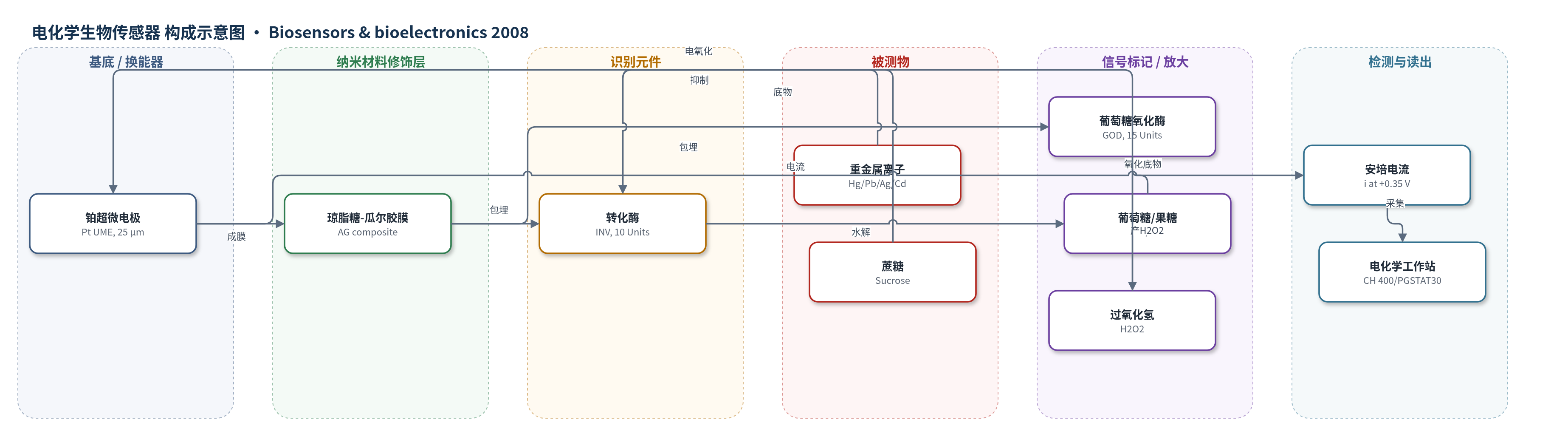
点击图片查看大图 · 依据论文自动绘制
传感器类型
电化学生物传感器
检测对象
汞(II) Hg(II)、银(I) Ag(I)、铅(II) Pb(II)、镉(II) Cd(II)(水样/水溶液);蔗糖 sucrose(磷酸盐缓冲液)
检测原理
该传感器采用双酶级联抑制机制。琼脂糖–瓜尔胶膜包埋的转化酶(INV)将蔗糖水解为葡萄糖和果糖;葡萄糖氧化酶(GOD)进一步氧化葡萄糖并产生过氧化氢(H2O2)。H2O2在铂超微电极(Pt UME)+0.35 V固定电位下发生电化学氧化,产生与蔗糖浓度成正比的安培电流。当水样中存在Hg(II)、Pb(II)、Ag(I)或Cd(II)时,金属离子与INV活性位点或巯基结合,引起不可逆或可逆竞争性抑制,使INV活性下降,葡萄糖和H2O2生成减少,电流降低。通过比较未抑制电流I1与抑制后电流I2,计算抑制率I%=(I1-I2)/I1×100%,该抑制率与重金属离子浓度呈线性关系。UME的小尺寸效应和薄AG膜的高亲水半透性提高了传质与灵敏度。
检测灵敏度
蔗糖: 线性范围 1 × 10^-10–1 × 10^-7 M;LOD: 1 × 10^-10 M。Hg(II): 线性范围 5 × 10^-10–12.5 × 10^-10 M;LOD: 5 × 10^-10 M。Pb(II): 线性范围 5 × 10^-8–2.5 × 10^-7 M;LOD: 3 × 10^-8 M。Ag(I): 线性范围 5 × 10^-8–5 × 10^-7 M;LOD: 5 × 10^-8 M。Cd(II): 线性范围 2.5 × 10^-8–12.5 × 10^-8 M;LOD: 2.5 × 10^-8 M。
效应效果
传感器响应时间约15 s,最适pH为5.5,可重复使用9次且保留85%初始响应,储存57天后保留68%响应。AG膜使电极不易污染,AFM和接触角证实酶被良好包埋且膜亲水。电化学法对Hg(II)灵敏度最高,0.5 ng mL^-1即可引起27.5%抑制;毒性顺序为Hg2+>Pb2+>Ag+>Cd2+,与DNSA光度法一致。加标样品结果与常规DNSA光度法可比,说明可靠性。作者认为该UME传感器比盘状Pt电极更灵敏,适合开发便携式重金属现场检测装置,但尚需提高离子选择性。
传感器的构成
- 基底/换能器电极:铂超微电极(Pt UME,直径25 μm),作为工作电极并转导电子信号
- 修饰/固定基质:琼脂糖–瓜尔胶复合水凝胶膜(AG,3%琼脂糖与1%瓜尔胶按3:1混合),物理包埋酶并提供亲水半透微环境
- 识别/抑制元件:酸转化酶(INV,EC 3.2.1.26,10 Units),水解蔗糖并受重金属离子抑制
- 信号转换酶:葡萄糖氧化酶(GOD,EC 1.1.3.4,15 Units),氧化葡萄糖生成H2O2
- 信号产物:过氧化氢(H2O2),在+0.35 V发生电化学氧化产生电流
- 电极体系:Ag/AgCl参比电极和Pt线对电极,构成三电极电化学测量体系
- 缓冲介质:0.2 M磷酸盐缓冲液(pH 5.5),维持酶活性并提供反应介质
中文摘要
本文报道了一种基于超微电极(UME)的电化学蔗糖生物传感器,用于检测水样中的重金属离子(Hg(II)、Ag(I)、Pb(II)、Cd(II))。直径25 μm的铂工作UME以琼脂糖–瓜尔胶(AG)复合水凝胶包埋转化酶(INV)和葡萄糖氧化酶(GOD)修饰。接触角和原子力显微镜(AFM)结果表明AG膜亲水且两种酶被良好限制。pH 5.5下,蔗糖传感器动态范围为1×10^-10至1×10^-7 M,检出限1×10^-10 M,可重复使用9次。光谱与电化学研究均显示重金属离子浓度与INV抑制程度线性相关,毒性顺序为Hg2+>Pb2+>Ag+>Cd2+。电化学传感器对汞的线性范围为5×10^-10至12.5×10^-10 M,检出限5×10^-10 M。加标样品结果与DNSA光度法一致,验证了可靠性。
英文摘要
We are reporting fabrication and characterization of electrochemical sucrose biosensor using ultra-microelectrode (UME) for the detection of heavy metal ions (Hg(II), Ag(I), Pb(II) and Cd(II)). The working UME, with 25 microm diameter, was modified with invertase (INV, EC: 3.2.1.26) and glucose oxidase (GOD, EC: 1.1.3.4) entrapped in agarose-guar gum. The hydrophilic character of the agarose-guar gum composite matrix was checked by water contact angle measurement. The atomic force microscopy (AFM) images of the membranes showed proper confinement of both the enzymes during co-immobilization. The dynamic range for sucrose biosensor was achieved in the range of 1 x 10(-10) to 1 x 10(-7)M with lower detection limit 1 x 10(-10)M at pH 5.5 with 9 cycles of reuse. The spectrophotometric and electrochemical studies showed linear relationship between concentration of heavy metal ions and degree of inhibition of invertase. The toxicity sequence for invertase using both methods was observed as Hg(2+)>Pb(2+)>Ag(+)>Cd(2+). The dynamic linear range for mercury using electrochemical biosensor was observed in the range of 5 x 10(-10) to 12.5 x 10(-10)M for sucrose. The lower detection limit for the fabricated biosensor was found to be 5 x 10(-10)M. The reliability of the electrochemical biosensor was conformed by testing the spike samples and the results were comparable with the conventional photometric DNSA method.