组成图示
点击图片查看大图 · 依据论文自动绘制
传感器类型
全细胞生物传感器
检测对象
精氨酸(arginine, Arg)、组氨酸(histidine, His)、异亮氨酸(isoleucine, Ile)、亮氨酸(leucine, Leu)、赖氨酸(lysine, Lys)、甲硫氨酸(methionine, Met)、苯丙氨酸(phenylalanine, Phe)、脯氨酸(proline, Pro)、苏氨酸(threonine, Thr)、色氨酸(tryptophan, Trp)、酪氨酸(tyrosine, Tyr);样品基质:MMAB 最小培养基标准品及大肠杆菌培养上清(ΔhisL、ΔtdcC)
检测原理
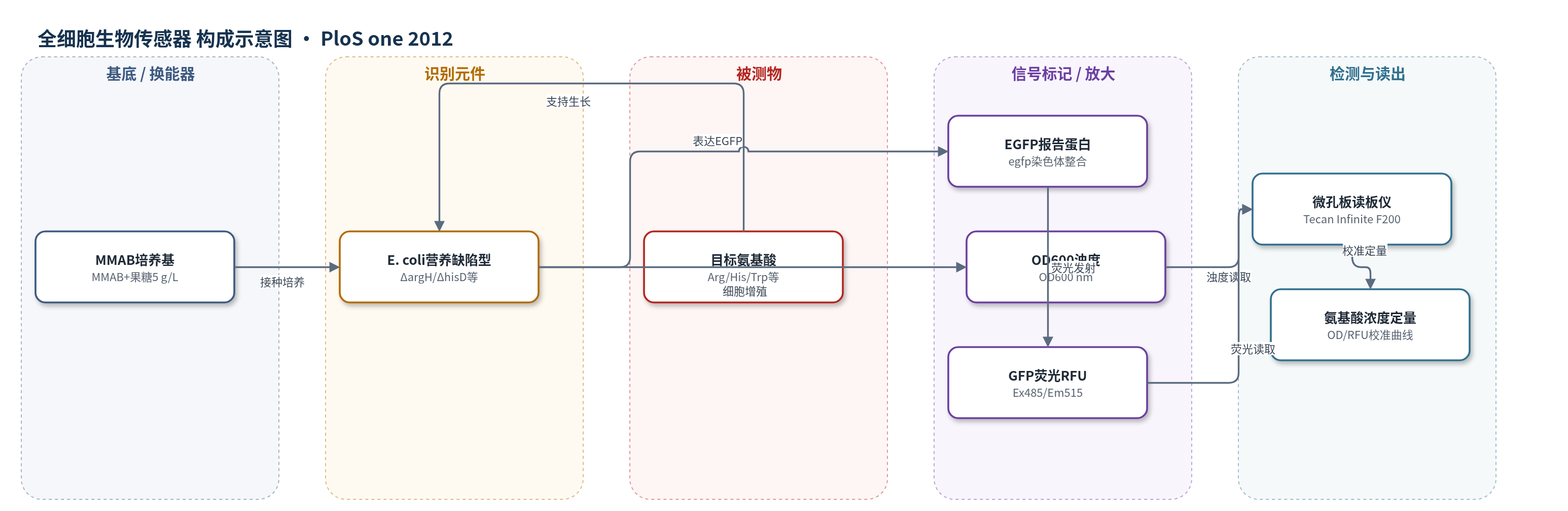
该传感器基于全细胞营养缺陷型识别与生长换能。大肠杆菌单基因缺失突变体缺失目标氨基酸生物合成末端酶,不能合成该氨基酸,也不能由其他蛋白原氨基酸转化,因此其生长严格依赖外源目标氨基酸。将突变体接种到含目标氨基酸的 MMAB 最小培养基中,目标氨基酸被细胞利用并解除生长限制,细胞增殖。染色体整合的 egfp 在 IPTG 诱导下表达 EGFP,细胞量增加使总 EGFP 荧光增强;同时细胞浊度 OD600 增加。培养 18 或 24 h 后,用微孔板读板仪测量 OD600 或 GFP 荧光(RFU),与标准氨基酸浓度建立线性校准曲线,反推样品中氨基酸浓度。信号随氨基酸浓度升高而线性增加,全细胞生长过程提供生物放大。
检测灵敏度
细胞检测限: GFP 1.47±0.15×10^8 cells mL^-1,OD600 2.03±0.11×10^8 cells mL^-1;线性范围: His、Trp、Ile、Lys 0.5–10 mM,Met、Phe、Tyr 0.5–25 mM,Arg、Leu、Thr、Pro 1–50 mM;R^2: Arg OD 0.987/RFU 0.985;His OD 0.991/RFU 0.988;Ile OD 0.996/RFU 0.994;Leu OD 0.987/RFU 0.992;Lys OD 0.985/RFU 0.994;Met OD 0.996/RFU 0.999;Phe OD 0.984/RFU 0.999;Pro OD 0.943/RFU 0.960;Thr OD 0.981/RFU 0.969;Trp OD 0.952/RFU 0.986;Tyr OD 0.973/RFU 0.997
效应效果
选择性方面,11 种营养缺陷型基本只依赖目标氨基酸生长,不能将其他蛋白原氨基酸转化为目标氨基酸;除 ΔtrpC 和 ΔtyrA 在含其他氨基酸时弱生长外,其他传感器未在两种过产上清中检出非目标氨基酸。校准曲线线性良好,R^2 多为 0.97 以上,脯氨酸 OD/RFU 约 0.943/0.960、色氨酸 OD 约 0.952、苏氨酸 RFU 约 0.969。GFP 荧光法细胞检测限较 OD600 降低约 30%(1.47×10^8 对 2.03×10^8 cells/mL)。实际样品中,ΔhisL 上清组氨酸 7.4 mM,ΔtdcC 上清色氨酸 3 mM;组氨酸与 HPLC 无显著差异,色氨酸荧光法与 HPLC 一致,浊度法高估 26%。作者认为该公开传感器阵列可用于高通量筛选和复杂基质中生物可利用氨基酸定量。
传感器的构成
- 识别/换能元件:大肠杆菌单基因缺失营养缺陷型菌株(E. coli auxotrophs,如 ΔargH、ΔhisD、ΔilvA、ΔleuB、ΔlysA、ΔmetB、ΔpheA、ΔproC、ΔthrC、ΔtrpC、ΔtyrA),缺失氨基酸合成末端基因,仅依赖外源目标氨基酸生长。
- 荧光报告元件:增强绿色荧光蛋白基因 egfp(EGFP),经 Tn7 转座系统定点整合至染色体,表达 EGFP 作为生长/细胞量荧光标记。
- 表达诱导与选择元件:IPTG(1 mM)诱导 lacZ 启动子驱动 egfp 表达;卡那霉素(kanamycin)维持整合标记/选择压力。
- 反应培养基:MMAB 最小培养基加果糖(5 g/L),提供碳源与营养缺陷型生长基质,目标氨基酸作为被测物加入。
- 读出装置:微孔板读板仪(Tecan Infinite F200),测量 OD600 浊度与 GFP 荧光(Ex 485 nm/Em 515 nm)。
中文摘要
本研究开发了一套基于大肠杆菌营养缺陷型的全细胞生物传感器阵列,用于高效、低成本地高通量定量生理体液或微生物培养物中的氨基酸。作者利用在线数据库进行理性设计,筛选氨基酸生物合成途径末端基因,预测其单基因缺失可产生对特定氨基酸的营养缺陷型。针对精氨酸、组氨酸、异亮氨酸、亮氨酸、赖氨酸、甲硫氨酸、苯丙氨酸、脯氨酸、苏氨酸、色氨酸和酪氨酸,获得相应单基因缺失突变体,并通过表型验证确认其既不能在缺乏目标氨基酸的最小培养基中生长,也不能将其他蛋白原氨基酸转化为目标氨基酸。随后将 egfp 基因通过 Tn7 系统定点整合到各传感器染色体中,使 GFP 标记细胞的检测限较浊度测量降低约 30%。最后用该传感器阵列测定两种氨基酸过产大肠杆菌菌株(ΔhisL 和 ΔtdcC)上清中的氨基酸浓度,并与 HPLC 结果比较,验证了系统的实用性。研究提供了基因型和表型充分表征的公开氨基酸生物传感器,并证明了理性设计策略的可行性。
英文摘要
Efficient and inexpensive methods are required for the high-throughput quantification of amino acids in physiological fluids or microbial cell cultures. Here we develop an array of Escherichia coli biosensors to sensitively quantify eleven different amino acids. By using online databases, genes involved in amino acid biosynthesis were identified that - upon deletion - should render the corresponding mutant auxotrophic for one particular amino acid. This rational design strategy suggested genes involved in the biosynthesis of arginine, histidine, isoleucine, leucine, lysine, methionine, phenylalanine, proline, threonine, tryptophan, and tyrosine as potential genetic targets. A detailed phenotypic characterization of the corresponding single-gene deletion mutants indeed confirmed that these strains could neither grow on a minimal medium lacking amino acids nor transform any other proteinogenic amino acid into the focal one. Site-specific integration of the egfp gene into the chromosome of each biosensor decreased the detection limit of the GFP-labeled cells by 30% relative to turbidometric measurements. Finally, using the biosensors to determine the amino acid concentration in the supernatants of two amino acid overproducing E. coli strains (i.e. ΔhisL and ΔtdcC) both turbidometrically and via GFP fluorescence emission and comparing the results to conventional HPLC measurements confirmed the utility of the developed biosensor system. Taken together, our study provides not only a genotypically and phenotypically well-characterized set of publicly available amino acid biosensors, but also demonstrates the feasibility of the rational design strategy used.