组成图示
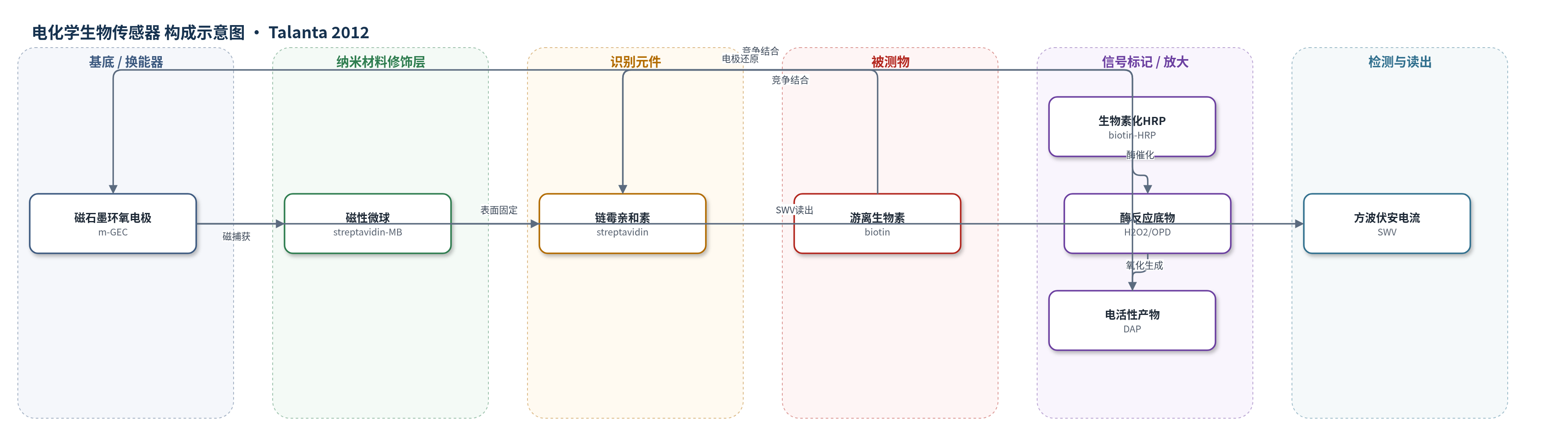
点击图片查看大图 · 依据论文自动绘制
传感器类型
电化学生物传感器
检测对象
生物素(biotin,维生素B7/B8/H);样品基质:生物素强化膳食补充剂、婴儿配方奶粉等食品样品(1.5%甲酸提取上清)
检测原理
该传感器采用直接竞争法。链霉亲和素修饰磁性微球(streptavidin-MB)与样品中的游离生物素及生物素化辣根过氧化物酶(biotin-HRP)同时孵育,两者竞争结合链霉亲和素的有限结合位点。样品中生物素浓度越高,结合到磁珠上的biotin-HRP越少。随后磁珠被磁石墨-环氧复合电极(m-GEC)捕获,加入H2O2和OPD,HRP催化OPD氧化生成电活性2,3-二氨基苯并噻嗪(DAP)。DAP在电极表面被还原,方波伏安法(SWV)记录还原峰电流密度。电流密度与生物素浓度呈负相关,采用四参数逻辑方程拟合。
检测灵敏度
LOD: 8.4 × 10^-8 mol L^-1(原文标注20 mg L^-1);动态范围: 0.94–2.4 × 10^-7 mol L^-1;校准范围: 1.4 × 10^-8–3.57 × 10^-7 mol L^-1;IC50: 1.34 × 10^-7 mol L^-1;相关系数: 0.992
效应效果
方法在食品样品中表现良好。生物素强化膳食补充剂测得131 mg/100g(标签150 mg/100g,RSD 19%,n=3),婴儿配方奶粉测得29 mg/100g(标签12.1 mg/100g,RSD 20%,n=3),占标示量87%和233%。无生物素奶粉基质加标回收率为95%–110%,RSD<15%(n=3);实际样品加标回收率80%–120%,RSD<20%(n=3)。标准溶液1.8×10^-7 mol/L重复性RSD 13%,回收率107%(n=4)。LOD低于HPLC、HPLC-MS/MS等方法,总分析时间40 min/20个样品。
传感器的构成
- 换能器电极:磁石墨-环氧复合电极(m-GEC),作为工作电极捕获磁性微球并传导电子
- 磁性固相载体:链霉亲和素修饰磁性微球(streptavidin-MB,Dynabeads M-280 Streptavidin),提供可磁分离的固相支持
- 识别元件:链霉亲和素(streptavidin),固定于磁珠表面,与生物素高亲和结合
- 竞争标记物:生物素化辣根过氧化物酶(biotin-HRP),与游离生物素竞争结合链霉亲和素并产生酶信号
- 酶反应底物:过氧化氢(H2O2)和邻苯二胺(OPD),HRP催化OPD氧化生成电活性产物
- 缓冲支持电解质:磷酸盐缓冲液(pH 6.0,含KCl),维持酶反应与电导
- 信号产物:2,3-二氨基苯并噻嗪(DAP),在电极上还原产生电流
中文摘要
本文报道了一种用于食品样品中生物素快速测定的电化学磁生物传感器。亲和反应在链霉亲和素修饰的磁性微球上进行,采用直接竞争格式:样品中的游离生物素与生物素化辣根过氧化物酶(biotin-HRP)竞争结合磁性微球表面的链霉亲和素结合位点。反应后,修饰磁珠可被磁石墨-环氧复合电极(m-GEC)简便捕获,电化学信号基于加入过氧化氢(H2O2)和邻苯二胺(OPD)后HRP的酶活性,通过方波伏安法(SWV)检测。方法检出限为8.4×10^-8 mol/L(原文标注20 mg/L),动态范围为0.94–2.4×10^-7 mol/L。对生物素强化膳食补充剂和婴儿配方奶粉样品进行检测,结果良好,总分析时间为40 min/20个样品。
英文摘要
An electrochemical magneto biosensor for the rapid determination of biotin in food samples is reported. The affinity reaction was performed on streptavidin-modified magnetic microbeads as a solid support in a direct competitive format. The biotinylated horseradish peroxidase enzyme (biotin-HRP) competes with free biotin in the sample for the binding sites of streptavidin on the magnetic microbeads. The modified magnetic beads were then easily captured by a magneto graphite-epoxy composite electrode and the electrochemical signal was based on the enzymatic activity of the HRP enzyme under the addition of H(2)O(2) as the substrate and o-phenilendiamine as cosubstrate. The response was electrochemically detected by square wave voltammetry. The limit of detection was 8.4×10(-8) mol L(--1) of biotin (20 μg L(--1)) with a dynamic range from 0.94 to 2.4×10(-7) mol L(--1). Biotin-fortified commercial dietary supplement and infant formula samples were evaluated obtaining good performances in the results. Total time of analysis was 40 min per 20 assays.