组成图示
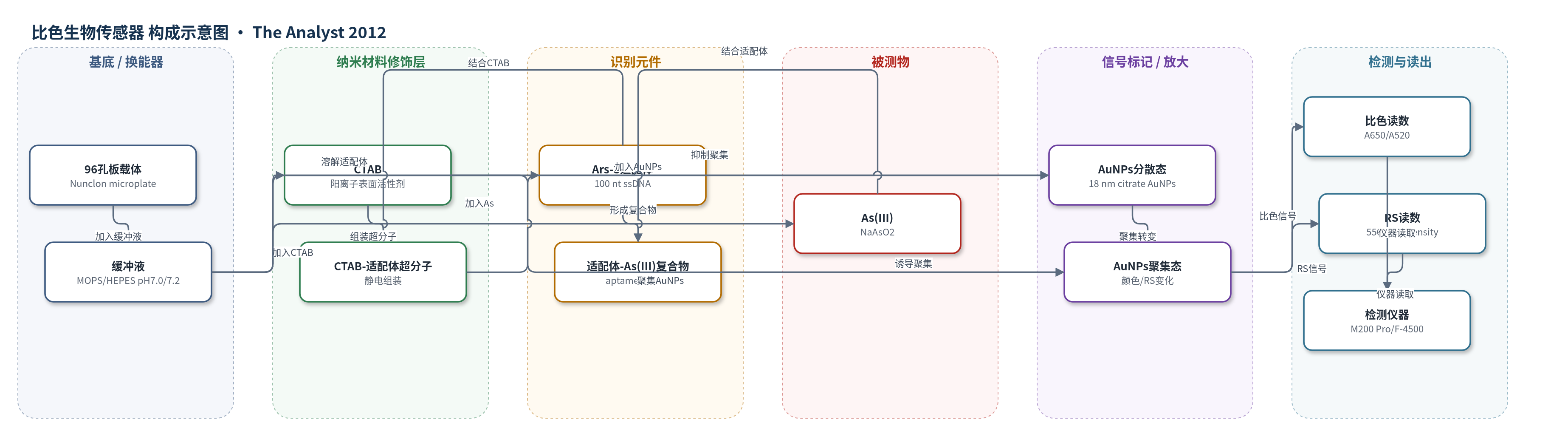
点击图片查看大图 · 依据论文自动绘制
传感器类型
比色生物传感器
检测对象
三价砷(As(III),arsenite/NaAsO2);样品基质:水溶液、环境水样/饮用水
检测原理
该传感器基于适配体、CTAB 与 As(III) 之间的竞争性结合控制 AuNPs 聚集。无 As(III) 时,Ars-3 aptamer 与 CTAB 通过静电作用组装成超分子,消耗 CTAB,AuNPs 保持分散;加入 As(III) 后,aptamer 优先与 As(III) 结合形成 aptamer–As(III) 复合物,降低其对 CTAB 的结合,使剩余 CTAB 破坏 AuNPs 表面电荷稳定并诱导聚集。AuNPs 聚集导致局域表面等离子体共振红移,A520 下降、A650 上升,A650/A520 增大;同时颗粒尺寸增大增强共振散射,550 nm RS 强度增大。As(III) 浓度越高,剩余 CTAB 越多,聚集程度越大,信号随浓度呈指数/Hill 型变化,低浓度下近似线性。
检测灵敏度
LOD: 40 ppb(肉眼);0.6 ppb(比色法);0.77 ppb(RS法);检测范围: 1–1500 ppb;线性范围: 1–100 ppb(CTAB, 18 nm AuNPs, 比色法);比色低浓度线性: y = 3.54 × 10⁻³x + 0.012 (R = 0.996);RS低浓度线性: y = 0.022x + 0.013 (R = 0.994);Hill 拟合相关系数: 0.997(比色)/0.998(RS)
效应效果
该传感器对As(V)、Pb(II)、Cd(II)、Hg(II)、Ag(I)、Mg(II)、Zn(II)、Mn(II)、Ni(II)、Cu(II)、Fe(II)、Ca(II)等竞争离子在100和1000 ppb下干扰轻微且可忽略,选择性良好。信号在2 min内达到最大值,适合快速检测。实际水样加标回收率为94.6%–124%,RSD为2.0%–8.2%。比色法LOD 0.6 ppb、RS法0.77 ppb,低于WHO/EPA饮用水10 ppb限值,且优于此前阳离子聚合物法5.3 ppb,作者认为可用于环境水样中As(III)的现场、实时监测。
传感器的构成
- 基底/载体:96-well microplate(Nunclon),作为溶液反应与比色读数的载体。
- 纳米换能材料:AuNPs(gold nanoparticles,约18 nm,柠檬酸稳定),分散/聚集引起吸收与共振散射变化。
- 识别元件:Ars-3 aptamer(100 nt 单链 DNA),特异性结合 As(III) 形成 aptamer–As(III) 复合物。
- 聚集调控剂:CTAB(hexadecyltrimethylammonium bromide),阳离子表面活性剂,与适配体组装并诱导 AuNPs 聚集。
- 缓冲介质:MOPS(pH 7.0)与 HEPES(pH 7.2),维持反应 pH 和适配体稳定性。
- 信号读出:Microplate Spectrophotometer M200 Pro 与 F-4500 荧光分光光度计,读取 A650/A520 和 550 nm RS 强度。
中文摘要
本文报道了一种基于表面活性剂诱导金纳米颗粒(AuNPs)聚集的比色与共振散射(RS)生物传感器,用于水溶液中三价砷(As(III))的超灵敏检测。该体系利用砷结合适配体(Ars-3 aptamer)、As(III) 与阳离子表面活性剂十六烷基三甲基溴化铵(CTAB)之间的特殊相互作用。无 As(III) 时,适配体与 CTAB 组装形成超分子,消耗 CTAB,使 AuNPs 保持分散;加入 As(III) 后,适配体优先与 As(III) 结合形成 aptamer–As(III) 复合物,使后续加入的 CTAB 能够聚集 AuNPs,引起溶液颜色和 RS 强度的显著变化。圆二色(CD)、扫描探针显微镜(SPM)和透射电镜(TEM)证实了超分子、aptamer–As(III) 复合物及 AuNPs 聚集的形成。吸收和 RS 强度变化与 As(III) 浓度在 1–1500 ppb 范围内呈指数关系,肉眼检出限 40 ppb,比色法 0.6 ppb,RS 法 0.77 ppb。该传感器快速、选择性高,并在实际水样中表现出良好回收率,具有环境监测应用潜力。
英文摘要
This paper reports the colorimetric and resonance scattering (RS)-based biosensor for the ultrasensitive detection of As(III) in aqueous solution via aggregating gold nanoparticles (AuNPs) by the special interactions between arsenic-binding aptamer, target and cationic surfactant. Aptamers and the cationic surfactant could assemble to form a supramolecule, which prevented AuNPs from aggregating due to the exhaustion of cationic surfactant. The introduction of As(III) specifically interacted with the arsenic-binding aptamer to form the aptamer-As(III) complex, so that the following cationic surfactant could aggregate AuNPs and cause the remarkable change in color and RS intensity. The results of circular dichroism (CD) and scanning probe microscope (SPM) testified to the formation of the supramolecule and aptamer-As(III) complex, and the observation of transmission electron microscope (TEM) further confirmed that the aggregation of AuNPs could be controlled by the interactions among the aptamer, As(III) and cationic surfactant. The variations of absorbance and RS intensity were exponentially related to the concentration of As(III) in the range from 1 to 1500 ppb, with the detection limit of 40 ppb for the naked eye, 0.6 ppb for colorimetric assay and 0.77 ppb for RS assay. Additionally, the speed of the present biosensor was rapid, and it also exhibited high selectivity over other metal ions with an excellent recovery for detection in real water samples, suggesting that the proposed biosensor will play an important role in environmental detection.