组成图示
点击图片查看大图 · 依据论文自动绘制
传感器类型
综述或非传感器论文
检测对象
非分析物检测;实验操控对象为质膜磷脂 PI(4,5)P2、PI(3,4,5)P3,样品基质为活细胞(COS-7、tsA-201、PC12)
检测原理
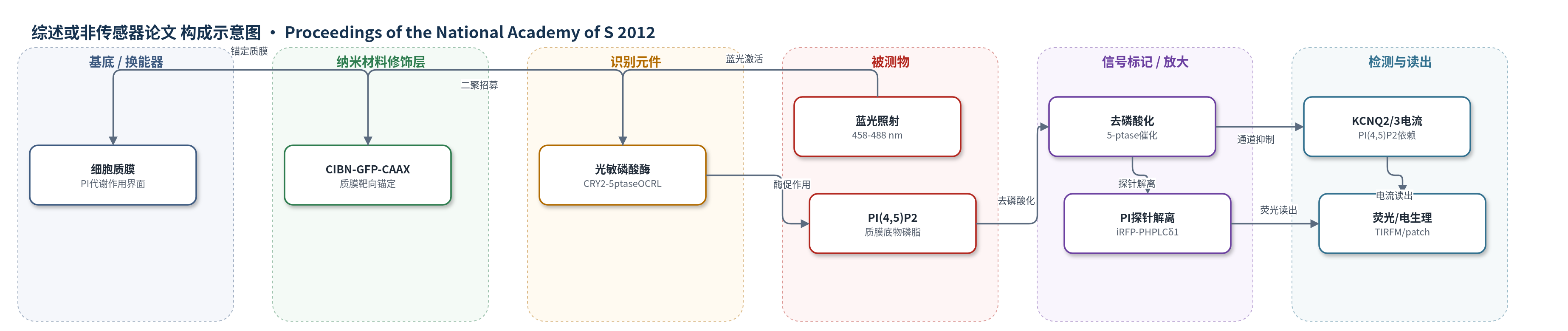
蓝光被CRY2PHR中的FAD吸收,诱导构象变化并与CIBN结合,将融合5-磷酸酶从胞质快速招募到质膜。5-磷酸酶催化PI(4,5)P2/PI(3,4,5)P3的5位去磷酸化,使膜上PI水平下降。PI(4,5)P2探针PHPLCδ1因失去结合底物而从膜解离,荧光由膜移向胞质;KCNQ2/3通道因失去PI(4,5)P2正调控而关闭,电流下降;包被小窝形成和膜皱褶减少。停止蓝光后CRY2-CIBN解离,酶离开膜,PI重新合成,信号恢复。聚焦光照仅激活受照区下方胞质中的CRY2,形成局部PI梯度并诱导细胞极性。若招募PI3K,则局部合成PI(3,4,5)P3,激活Rac/肌动蛋白成核,产生膜皱褶。
检测灵敏度
原文未报告 LOD、线性范围、灵敏度斜率或相关系数。
效应效果
系统快速可逆:5-磷酸酶招募t1/2约2.8–3.0 s,PI(4,5)P2探针解离t1/2约3.1 s,恢复约6.8 min;TIRFM下解离t1/2为20±2 s。KCNQ2/3电流抑制t1/2为1.2±0.3 s,抑制约95%,恢复t1/2为286±33 s。蓝光后2 min内包被小窝减少约80%,10 min内恢复。催化失活突变无探针解离或电流变化,证明依赖酶活性。多PI探针显示底物特异性,PI3K效应可被wortmannin或LY294002阻断。
传感器的构成
- 细胞作用界面:质膜(plasma membrane),作为PI代谢与光遗传招募的作用位点
- 光敏招募模块:mCherry-CRY2PHR-5-ptaseOCRL/INPP5E或mCherry-CRY2-iSH2,蓝光下与CIBN结合并携带催化结构域
- 膜锚定模块:CIBN-GFP-CAAX,CAAX基序将CIBN靶向质膜,作为膜上诱饵
- 催化识别元件:OCRL/INPP5E肌醇5-磷酸酶或PI3K p110α/iSH2,催化PI(4,5)P2/PI(3,4,5)P3去磷酸化或合成
- 荧光读出探针:iRFP/RFP-PHPLCδ1、mCherry-PHGRP1、GFP-PHOSBP、mRFP-PHTapp1、RFP-PHAkt,报告不同PI水平
- 电生理读出元件:KCNQ2/3通道,PI(4,5)P2依赖电流用于高时间分辨监测
- 内吞读出标记:μ2-mCherry或CLC-mRFP,标记包被小窝形成
中文摘要
磷脂酰肌醇(PIs)是细胞膜脂质,调控多种细胞功能。本研究利用植物蛋白隐花色素2(CRY2)与转录因子CIBN在蓝光下诱导的二聚化,快速、局部且可逆地控制质膜PI水平。将OCRL的肌醇5-磷酸酶结构域(5-ptaseOCRL,作用于PI(4,5)P2和PI(3,4,5)P3)融合到CRY2的光解酶同源区,并将CIBN融合到质膜靶向基序。对表达这些构建体的哺乳动物细胞进行458–488 nm蓝光照射,使5-ptaseOCRL几乎瞬时招募至质膜,并在数秒内快速、数分钟内可逆地使其底物去磷酸化。多种细胞学检测证实:PI(4,5)P2和PI(3,4,5)P3生物传感器从膜上解离、内吞包被小窝消失、KCNQ2/3通道电流几乎完全被抑制以及膜皱褶消失。聚焦照射引起局部、短暂的5-ptaseOCRL招募和PI(4,5)P2去磷酸化,导致受照侧细胞边缘或突起局部塌陷回缩,并在细胞对侧出现PI(4,5)P2生物传感器和膜皱褶的代偿性积累。采用相同策略招募PI3K可诱导局部PI(3,4,5)P3合成和膜皱褶,同时远端皱褶减少。该技术为以高时空动力学解析多种PI的细胞功能并可逆调控这些信号脂质下游效应器提供了有力工具。
英文摘要
Phosphoinositides (PIs) are lipid components of cell membranes that regulate a wide variety of cellular functions. Here we exploited the blue light-induced dimerization between two plant proteins, cryptochrome 2 (CRY2) and the transcription factor CIBN, to control plasma membrane PI levels rapidly, locally, and reversibly. The inositol 5-phosphatase domain of OCRL (5-ptase(OCRL)), which acts on PI(4,5)P(2) and PI(3,4,5)P(3), was fused to the photolyase homology region domain of CRY2, and the CRY2-binding domain, CIBN, was fused to plasma membrane-targeting motifs. Blue-light illumination (458-488 nm) of mammalian cells expressing these constructs resulted in nearly instantaneous recruitment of 5-ptase(OCRL) to the plasma membrane, where it caused rapid (within seconds) and reversible (within minutes) dephosphorylation of its targets as revealed by diverse cellular assays: dissociation of PI(4,5)P(2) and PI(3,4,5)P(3) biosensors, disappearance of endocytic clathrin-coated pits, nearly complete inhibition of KCNQ2/3 channel currents, and loss of membrane ruffling. Focal illumination resulted in local and transient 5-ptase(OCRL) recruitment and PI(4,5)P(2) dephosphorylation, causing not only local collapse and retraction of the cell edge or process but also compensatory accumulation of the PI(4,5)P(2) biosensor and membrane ruffling at the opposite side of the cells. Using the same approach for the recruitment of PI3K, local PI(3,4,5)P(3) synthesis and membrane ruffling could be induced, with corresponding loss of ruffling distally to the illuminated region. This technique provides a powerful tool for dissecting with high spatial-temporal kinetics the cellular functions of various PIs and reversibly controlling the functions of downstream effectors of these signaling lipids.