组成图示
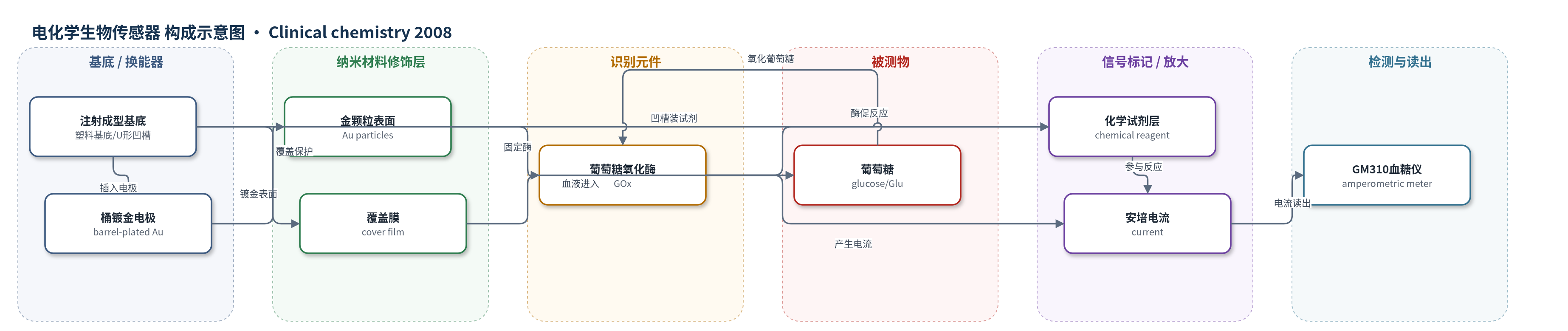
点击图片查看大图 · 依据论文自动绘制
传感器类型
电化学生物传感器
检测对象
葡萄糖(glucose, Glu);样品基质:毛细血管全血(指尖、手掌、手臂)及静脉血/血浆。
检测原理
试纸中的葡萄糖氧化酶(GOx)特异性识别并催化葡萄糖氧化,生成过氧化氢等反应产物;该反应发生在注射成型基底的 U 形凹槽内,化学试剂层参与酶促反应并维持电子传递环境。镀金电极提供导电界面,金颗粒表面增大酶固定面积并加速电子转移。葡萄糖浓度越高,酶促反应产生的可电化学氧化产物越多,在恒定电位下产生的安培电流越大。GM310 血糖仪通过电接触读取电流,并在 5 s 内换算为静脉血浆等效葡萄糖浓度。简化的一步电极制造使电化学面积更一致,从而提高测量精密度。
检测灵敏度
线性范围: 0.6–33.3 mmol/L;y = 0.96x + 0.07 mmol/L;R^2 = 0.9977
效应效果
批内不精密度 CV 为 1.7%–3.5%,总 CV 2.1%,优于多数丝网印刷碳电极血糖仪的 3%–6%;5 台仪器间均值最大差异 0.08 mmol/L(1.6%),P>0.05。139 名受试者指尖、手掌、手臂检测均符合 ISO 15197:2003;EGA 100% 位于 A+B 区,A 区分别为 97.8%、97.8%、96.4%。与 Olympus AU640 六磷酸激酶法比较,相关系数 r 为 0.989–0.990,残差标准差 0.85–0.90 mmol/L。作者认为该简化制造电极适用于替代部位血糖监测,但红细胞压积仍可能影响准确性。
传感器的构成
- 基底:注射成型塑料基底(injection-molded base),承载电极并形成 U 形凹槽。
- 换能电极:桶镀金电极(barrel-plated gold electrodes),插入基底并与血糖仪电接触,传导安培电流。
- 修饰层:金颗粒表面(gold particles),提供较大比表面积以固定葡萄糖氧化酶。
- 识别元件:葡萄糖氧化酶(glucose oxidase, GOx),固定于金电极表面,特异性催化葡萄糖氧化。
- 信号试剂层:化学试剂(chemical reagent),位于 U 形凹槽,与 GOx 共同构成酶促反应层。
- 覆盖膜:cover film,覆盖反应层并允许血液进入。
中文摘要
多数用于丝网印刷碳电极(SPCE)的生物传感器制造工艺复杂。本研究提出一种用于注射成型生物传感器电极的一步制造新方法:将桶镀金电极插入注射成型基底,使电极直接与血糖仪电接触。作者对该生物传感器进行了测量范围、批内不精密度和仪器间不精密度等技术测试,并在临床研究中由经验丰富的技术人员对指尖、手掌和手臂 3 个替代部位进行检测,同时以 Olympus AU640 仪器六磷酸激酶法测得的血浆葡萄糖值为参照。结果按 ISO 15197:2003 和 Clarke 误差网格分析(EGA)评价,并计算 CV 评估批内不精密度。葡萄糖测量范围为 0.6–33.3 mmol/L(y=0.96x+0.07 mmol/L,R^2=0.9977);批内 CV 为 1.7%–3.5%,总 CV 为 2.1%。5 台仪器均值差异无统计学意义(P>0.05)。临床结果符合 ISO 15197:2003;EGA 中 100% 数值位于 A+B 区,A 区比例超过 95%。结论:Bionime Rightest GM310 采用简化电极制造工艺,在替代部位血糖监测中表现可接受。
英文摘要
BACKGROUND: Most processes for fabricating biosensors applied to screen-printed carbon electrodes (SPCEs) are complex. This study presents a novel one-step process for manufacturing electrodes for injection-molding biosensors.
METHODS: During the sensor-fabrication process, barrel-plated gold electrodes were inserted into an injection-molded base. The electrode directly touched the electrical contact of a meter. We analyzed technical measurements for this biosensor, including tests of the measurement range, within-run imprecision, and between-meter imprecision. In clinical trials, experienced technicians tested 3 alternative sites (fingertip, palm, and arm). The results were simultaneously compared with plasma values obtained with the hexokinase method on the Olympus AU640 instrument. Analytical results were evaluated according to International Standards Organization 15197 (ISO 15197:2003) criteria and by Clarke error grid analysis (EGA), and CVs were calculated to evaluate within-run imprecision.
RESULTS: The glucose measurement range was 0.6- 33.3 mmol/L (y = 0.96x + 0.07 mmol/L; r(2) = 0.9977). The CVs in the within-run imprecision test were 1.7%-3.5%, and the overall CV was 2.1%, indicating good reproducibility of results. The Student t-tests of mean values from 5 meters revealed statistically insignificant differences (P > 0.05). In clinical trials, the agreement of the Rightest GM310 meter results with those of a laboratory method complied with ISO 15197:2003 criteria. In the EGA, 100% of the values were within the acceptable zones (A + B), and the proportion of values within zone A exceeded 95%.
CONCLUSIONS: The Bionime Rightest GM310 meter applied a simplified process for biosensor fabrication and displayed acceptable performance for monitoring glucose concentrations at alternative test sites.