组成图示
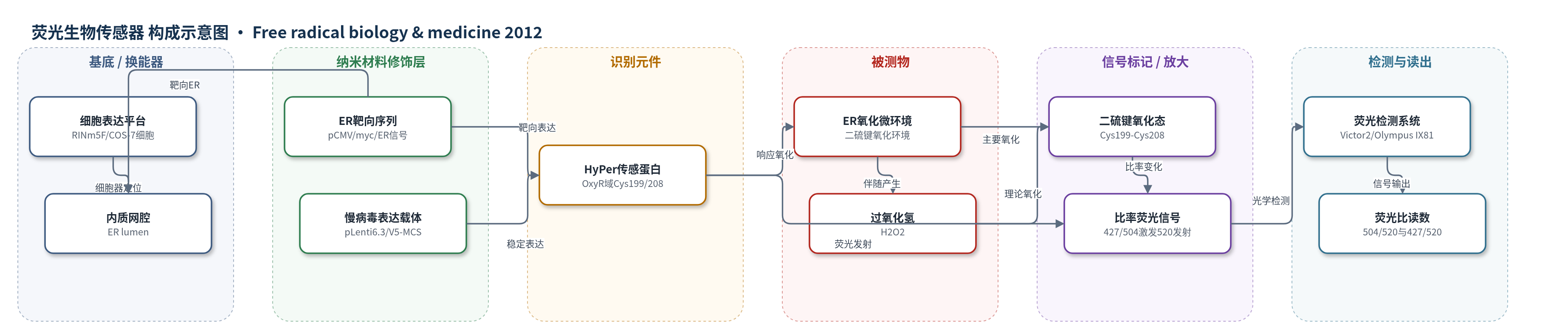
点击图片查看大图 · 依据论文自动绘制
传感器类型
荧光生物传感器
检测对象
过氧化氢(H2O2)、内质网氧化性巯基–二硫键微环境(ER oxidizing thiol–disulfide milieu);样品基质:RINm5F胰岛素产生细胞与COS-7细胞内质网腔。
检测原理
HyPer为遗传编码的H2O2敏感荧光蛋白,其OxyR调控域中Cys199与Cys208可形成分子内二硫键。当传感蛋白处于氧化环境时,二硫键形成改变荧光蛋白构象,使427 nm激发峰下降、504 nm激发峰上升,发射峰约520 nm,因此504/520与427/520的比率荧光随氧化程度升高。将HyPer通过ER靶向序列表达于内质网腔后,ER中二硫键形成相关的氧化性巯基–二硫键微环境使ER-HyPer保持较高氧化态,荧光比升高。理论上H2O2可氧化HyPer,但ER中PRDXIV清除H2O2、环己酰亚胺抑制蛋白合成均不改变ER-HyPer信号,说明其信号主要反映ER氧化还原环境而非H2O2浓度。该传感器无外源放大,依靠比率荧光自报告。
检测灵敏度
原文未报告LOD、线性范围、灵敏度斜率或R^2。
效应效果
RINm5F中Cyto-HyPer、Peroxi-HyPer、Mito-HyPer荧光比分别为0.78±0.03、0.88±0.07、1.18±0.08,ER-HyPer约高3倍。外源H2O2 10–50 mM使细胞质、过氧化物酶体和线粒体HyPer荧光比指数升高,100–200 mM时完全氧化;ER-HyPer无响应。0.5 mM DTT显著降低ER-HyPer荧光比,洗脱后100 mM H2O2可恢复。过表达细胞质/线粒体catalase或GPx不改变ER-HyPer信号。PRDXIV过表达在5、25、50 mM H2O2下显著保护细胞活力(p<0.01或p<0.001),但不改变ER-HyPer荧光比。未报告RSD、回收率或常规方法对比;作者认为ER-HyPer不适合监测ER H2O2,但可实时显示ER氧化还原状态。
传感器的构成
- 表达载体:pCMV/myc/ER质粒与pLenti 6.3/V5-MCS慢病毒载体,携带HyPer cDNA并实现稳定转导
- ER靶向元件:pCMV/myc/ER中的内质网靶向序列,将HyPer定位至ER腔
- 传感识别元件:HyPer荧光蛋白(H2O2-sensitive fluorescent protein),含OxyR调控域,Cys199/Cys208二硫键形成作为氧化识别事件
- 信号标记物:HyPer自身比率荧光,激发427/504 nm、发射520 nm,氧化态使504/520与427/520荧光比升高
- 表达平台:RINm5F胰岛素产生细胞或COS-7细胞,提供活细胞ER氧化还原微环境
- 检测读出:Victor2 1420多标签计数器或Olympus IX81倒置显微镜,测量比率荧光并输出氧化还原状态
中文摘要
内质网(ER)中的氧化性蛋白折叠伴随天然二硫键形成,并不可避免地产生过氧化氢(H2O2)。胰腺β细胞因分泌活性高且抗氧化能力极低,氧化性蛋白折叠产生的H2O2可能构成显著氧化负担。本研究通过将H2O2敏感荧光生物传感器HyPer靶向并特异性表达于ER(ER-HyPer),在胰岛素产生RINm5F细胞中阐明二硫键形成过程中的H2O2生成,并考察ER驻留H2O2代谢酶过氧化物酶IV(PRDXIV)过表达对H2O2水平的影响。结果显示,ER-HyPer荧光蛋白处于完全氧化态,而表达于细胞质、过氧化物酶体和线粒体的HyPer主要处于还原态,提示ER腔内存在较高基础H2O2浓度;该结果在非胰岛素产生COS-7细胞中亦得到证实。PRDXIV过表达可有效保护RINm5F细胞免受H2O2介导的毒性,但不改变ER-HyPer荧光信号。此外,环己酰亚胺抑制新生蛋白合成及其相关H2O2生成后,ER-HyPer氧化还原态未受影响。综上,H2O2敏感生物传感器主要反映ER的氧化性巯基–二硫键微环境,而非ER腔内H2O2浓度。
英文摘要
Oxidative protein folding in the endoplasmic reticulum (ER) is associated with the formation of native disulfide bonds, which inevitably results in the formation of hydrogen peroxide (H(2)O(2)). Particularly in pancreatic β-cells with their high secretory activity and extremely low antioxidant capacity, the H(2)O(2) molecules generated during oxidative protein folding could represent a significant oxidative burden. Therefore this study was conducted to elucidate the H(2)O(2) generation during disulfide bond formation in insulin-producing RINm5F cells by targeting and specifically expressing the H(2)O(2)-sensitive biosensor HyPer in the ER (ER-HyPer). In addition the influence of overexpression of the H(2)O(2)-metabolizing ER-resident peroxiredoxin IV (PRDXIV) on H(2)O(2) levels was examined. The ER-HyPer fluorescent protein was completely oxidized, whereas HyPer expressed in cytosol, peroxisomes, and mitochondria was prevalently in the reduced state, indicating a high basal H(2)O(2) concentration in the ER lumen. These results could also be confirmed in non-insulin-producing COS-7 cells. Overexpression of PRDXIV in RINm5F cells effectively protected against H(2)O(2)-mediated toxicity; however, it did not affect the fluorescence signal of ER-HyPer. Moreover, the inhibition of de novo protein synthesis and the associated H(2)O(2) generation by cycloheximide had no influence on the ER-HyPer redox state. Taken together, these findings strongly suggest that the H(2)O(2)-sensitive biosensor reflects exclusively the oxidative milieu in the ER and not the H(2)O(2) concentration in the ER lumen.