组成图示
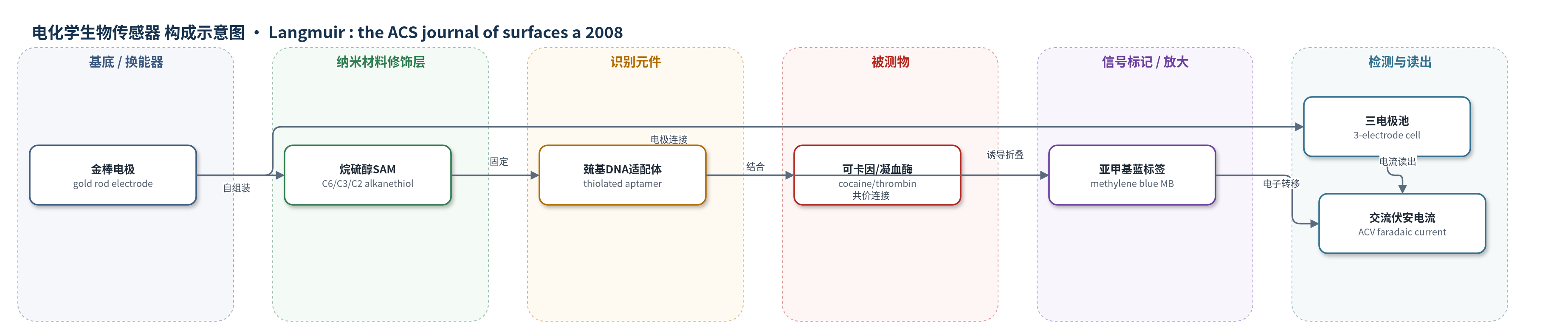
点击图片查看大图 · 依据论文自动绘制
传感器类型
电化学生物传感器
检测对象
可卡因(cocaine,1× SSC缓冲液)、凝血酶(thrombin,Tris缓冲液)
检测原理
E-AB传感器以金电极为换能器,表面通过烷硫醇自组装固定5′-巯基DNA适配体,适配体3′端连接亚甲基蓝(MB)氧化还原标签。无目标时,可卡因适配体部分展开、凝血酶适配体基本展开,MB与金表面距离较远或碰撞频率较低,电子转移效率较低。目标分子结合后诱导适配体发生构象折叠:可卡因传感器中折叠使MB靠近电极,法拉第电流增加(signal-on);凝血酶传感器中折叠使MB被固定远离电极,电流降低(signal-off)。MB发生两电子一质子还原,交流伏安法在E=E°处读取峰电流,峰电流与有效参与电子转移的MB数量成正比,因此随目标浓度呈双曲线变化。该体系无需酶或外加试剂,信号放大主要来自适配体结合诱导的构象变化及探针密度、SAM厚度对电子转移和折叠平衡的调控。
检测灵敏度
原文未报告LOD、线性范围、灵敏度斜率、相关系数。
效应效果
适配体识别与SAM钝化降低非特异吸附。可卡因传感器增益由60%升至200%,最大在1.6×10^12 molecules/cm2,较最初报道提高约6倍;凝血酶抑制率16%–42%,中等密度最优。交流频率在可卡因约1 Hz、凝血酶约50 Hz以上影响很小。可卡因高密度下4 s内平衡;凝血酶时间常数随密度增加40倍由11 min增至20 min。C6、C3、C2 SAM峰电流分别为2.5×10^-8、1.0×10^-7、1.9×10^-7 A,但C3增益约为C6的80%,C2降低约10倍。未报告稳定性、RSD、回收率或方法对比;该框架可用于未来E-AB制备。
传感器的构成
- 基底/换能器电极:金棒电极(gold rod electrode,1.6 mm直径,BAS),抛光清洗后作为工作电极,提供电子转移界面并产生法拉第电流。
- 自组装单分子层:烷硫醇SAM(6-巯基-1-己醇 C6、3-巯基-1-丙醇 C3、2-巯基乙醇 C2),钝化金表面并调控电子隧穿与界面化学。
- 识别元件:5′-巯基己基修饰、3′-亚甲基蓝标记DNA适配体(thiolated methylene blue-labeled DNA aptamer),可卡因适配体32 nt、凝血酶适配体31 nt,通过硫醇自组装固定并识别目标。
- 信号标记物:亚甲基蓝(methylene blue, MB),位于适配体3′端,发生两电子一质子还原,产生可测量的交流伏安法拉第电流。
- 封闭/钝化层:3 mM 6-巯基-1-己醇(C6)溶液,用于置换非特异性吸附DNA并钝化剩余电极面积。
中文摘要
电化学适配体(E-AB)传感器由修饰有表面固定、氧化还原标记DNA适配体的电极构成,是新兴的生物传感器平台。为进一步提升该技术,作者系统研究了探针(适配体)堆积密度、用于检测的交流频率以及用于钝化电极的自组装单分子层(SAM)性质,对针对小分子可卡因和蛋白凝血酶的两类代表性E-AB传感器性能的影响。通过控制制备过程中适配体浓度,可在约一个数量级范围内调控电极表面探针DNA密度。在该范围内,可卡因传感器的信号增益从60%变化到200%,并在最低探针密度附近达到最大;凝血酶传感器的信号变化从16%变化到42%,在中等密度时最优。在低赫兹截止频率以上,两种传感器对交流电位频率均无显著依赖。此外,E-AB信号增益对钝化电极的烷硫醇SAM性质敏感:较薄SAM可提高绝对电流,但将SAM从6碳缩短到2碳会使可卡因传感器观测到的信号增益降低约10倍。结果表明,制备与运行参数可被优化以获得最佳传感器性能,并为未来传感器制备提供基本框架。
英文摘要
Electrochemical, aptamer-based (E-AB) sensors, which are comprised of an electrode modified with surface immobilized, redox-tagged DNA aptamers, have emerged as a promising new biosensor platform. In order to further improve this technology we have systematically studied the effects of probe (aptamer) packing density, the AC frequency used to interrogate the sensor, and the nature of the self-assembled monolayer (SAM) used to passivate the electrode on the performance of representative E-AB sensors directed against the small molecule cocaine and the protein thrombin. We find that, by controlling the concentration of aptamer employed during sensor fabrication, we can control the density of probe DNA molecules on the electrode surface over an order of magnitude range. Over this range, the gain of the cocaine sensor varies from 60% to 200%, with maximum gain observed near the lowest probe densities. In contrast, over a similar range, the signal change of the thrombin sensor varies from 16% to 42% and optimal signaling is observed at intermediate densities. Above cut-offs at low hertz frequencies, neither sensor displays any significant dependence on the frequency of the alternating potential employed in their interrogation. Finally, we find that E-AB signal gain is sensitive to the nature of the alkanethiol SAM employed to passivate the interrogating electrode; while thinner SAMs lead to higher absolute sensor currents, reducing the length of the SAM from 6-carbons to 2-carbons reduces the observed signal gain of our cocaine sensor 10-fold. We demonstrate that fabrication and operational parameters can be varied to achieve optimal sensor performance and that these can serve as a basic outline for future sensor fabrication.