组成图示
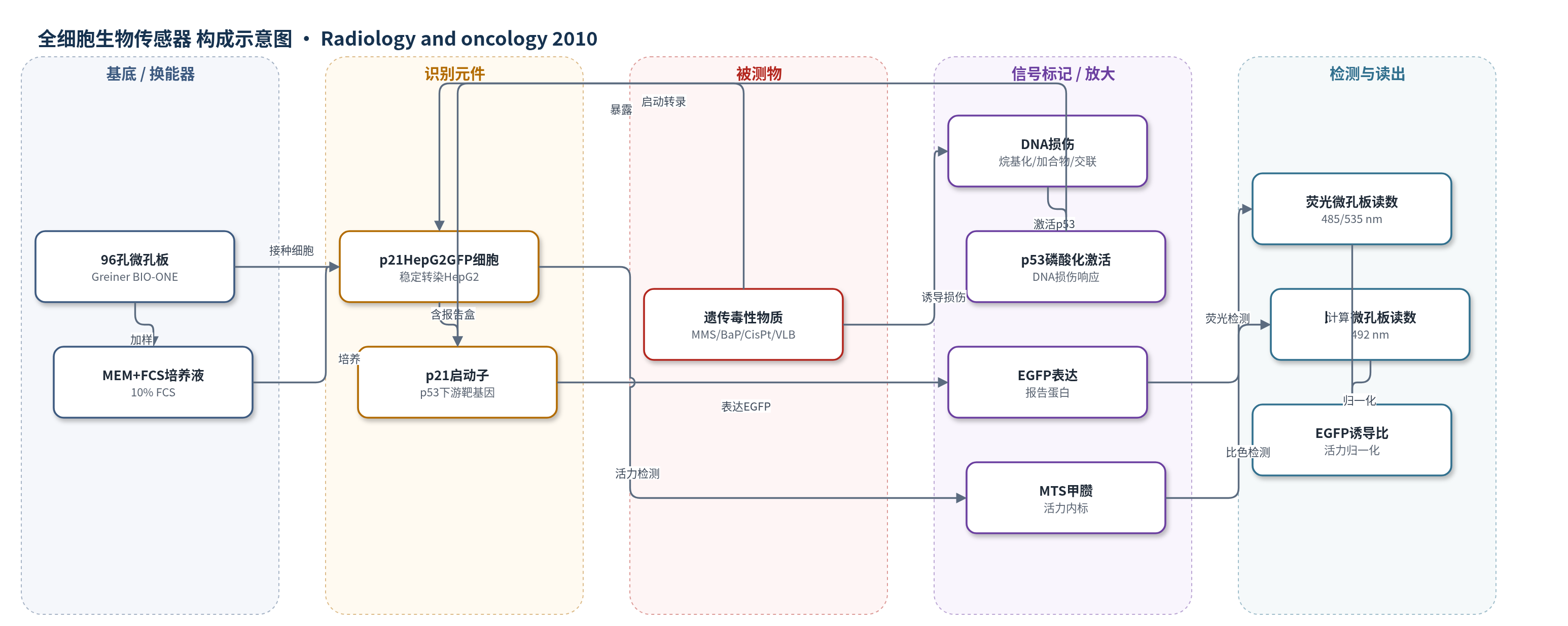
点击图片查看大图 · 依据论文自动绘制
传感器类型
全细胞生物传感器
检测对象
甲基甲烷磺酸酯(MMS)、苯并[a]芘(BaP)、顺铂(CisPt)、长春碱(VLB);样品基质:细胞培养液(MEM + 10% FCS)
检测原理
该传感器以稳定转染的 p21HepG2GFP 人肝癌细胞为识别与换能单元。遗传毒性物质进入细胞后,通过直接烷基化、代谢激活形成苯并[a]芘二醇环氧化物(BPDE)-DNA 加合物或顺铂 DNA 交联等方式造成 DNA 损伤。DNA 损伤激活 DNA 损伤响应激酶,使 p53 磷酸化并上调其下游靶基因 p21 的转录。p21 启动子驱动增强型绿色荧光蛋白(EGFP)表达,EGFP 在 485 nm 激发、535 nm 发射下产生荧光,荧光强度随 DNA 损伤程度和遗传毒性物质浓度增加。由于遗传毒性物质可能抑制细胞增殖,作者并行使用 MTS 比色法测定线粒体脱氢酶活性,以 492 nm 甲臜吸光度反映细胞活力,并将处理组与对照组 EGFP 荧光比值按活力归一化,得到相对 EGFP 诱导比,从而定量反映遗传毒性。
检测灵敏度
未报告 LOD、线性范围、灵敏度斜率或 R^2;LOEC: MMS 20 µg/mL;LOEC: BaP 0.13 µg/mL (0.5 µM);LOEC: CisPt 0.41 µg/mL;VLB 0.1 µg/mL(24 h)
效应效果
系统对直接和间接遗传毒性物质均有效。MMS LOEC 20 µg/mL,与 GreenScreen HC 的 25 µg/mL 及 MCF-7 p53R2 约 10 µg/mL 相当。BaP LOEC 0.13 µg/mL(0.5 µM),1.26 µg/mL 24 h 诱导比 8.54;较 MCF-7 无代谢激活 0.26 µg/mL 和 GreenScreen 流式 1.25 µg/mL 更敏感,但低于 GADD153 系统 0.0025 µg/mL。CisPt LOEC 0.41 µg/mL,优于 GreenScreen 1 µg/mL 和 MCF-7 约 10 µg/mL。VLB 0.1 µg/mL 24 h 显著,但高浓度细胞毒性明显,72 h 活力降>40%,168 h 降>90%。MTS 与增殖相关 r=0.94;实验为三次或四次独立重复±SD,未报告实际样品回收率与 RSD。作者认为可用于化学品、药物安全及环境/职业监测。
传感器的构成
- 微孔板基底:96-well black microtiter plates with clear bottom(Greiner BIO-ONE),承载细胞并用于荧光/比色读数
- 细胞培养液:MEM(minimum essential medium)+10% FCS(fetal calf serum),维持 HepG2 细胞代谢活性
- 全细胞识别元件:p21HepG2GFP 稳定转染 HepG2 人肝癌细胞,作为遗传毒性识别与换能单元
- 报告基因盒:p21 启动子-EGFP(enhanced green fluorescent protein)表达盒,将 DNA 损伤信号转换为荧光
- 信号标记物:EGFP,受 p21 启动子调控,在 p53-p21 通路激活后表达并产生 485/535 nm 荧光
- 细胞活力内标:MTS(CellTiter 96 Aqueous One Solution),被线粒体脱氢酶还原为甲臜,492 nm 吸光度用于归一化
中文摘要
人类暴露于遗传毒性物质构成健康威胁,快速评估其遗传毒性对化学品、药物开发及环境监测很重要。p21 是激活 p53 的主要下游靶基因,介导 DNA 损伤后细胞周期停滞,并被遗传毒性致癌物特异性上调。本研究建立基于人类细胞的生物传感器系统,用于快速检测遗传毒性物质。作者将受 p21 启动子控制的增强型绿色荧光蛋白(EGFP)报告基因稳定转染至代谢活性 HepG2 人肝癌细胞,获得 p21HepG2GFP 细胞系。用已知机制的遗传毒性物质诱导 DNA 损伤后,以荧光微孔板读数仪检测 EGFP 表达增加,并用 MTS 比色法测定细胞活力进行归一化。结果显示,直接烷基化剂甲基甲烷磺酸酯(MMS)在 48 h、20 µg/mL 时显著增加 EGFP;间接致癌物苯并[a]芘(BaP)和交联剂顺铂(CisPt)呈剂量依赖性诱导 EGFP 荧光,分别在 0.13 µg/mL 和 0.41 µg/mL 时显著;不直接损伤 DNA 的长春碱(VLB)仅在 24 h、0.1 µg/mL 时小幅增加,高浓度则显著降低细胞活力。结果表明,p21HepG2GFP 细胞系可作为快速、简单的生物传感器系统检测化学物遗传损伤。
英文摘要
BACKGROUND: Human exposure to genotoxic agents in the environment and everyday life represents a serious health threat. Fast and reliable assessment of genotoxicity of chemicals is of main importance in the fields of new chemicals and drug development as well as in environmental monitoring. The tumor suppressor gene p21, the major downstream target gene of activated p53 which is responsible for cell cycle arrest following DNA damage, has been shown to be specifically up-regulated by genotoxic carcinogens. The aim of our study was to develop a human cell-based biosensor system for simple and fast detection of genotoxic agents.
METHODS: Metabolically active HepG2 human hepatoma cells were transfected with plasmid encoding Enhanced Green Fluorescent Protein (EGFP) under the control of the p21 promoter (p21HepG2GFP). DNA damage was induced by genotoxic agents with known mechanisms of action. The increase in fluorescence intensity, due to p21 mediated EGFP expression, was measured with a fluorescence microplate reader. The viability of treated cells was determined by the colorimetric MTS assay.
RESULTS: The directly acting alkylating agent methylmethane sulphonate (MMS) showed significant increase in EGFP production after 48 h at 20 μg/mL. The indirectly acting carcinogen benzo(a)pyren (BaP) and the cross-linking agent cisplatin (CisPt) induced a dose- dependent increase in EGFP fluorescence, which was already significant at concentrations 0.13 μg/mL and 0.41 μg/mL, respectively. Vinblastine (VLB), a spindle poison that does not induce direct DNA damage, induced only a small increase in EGFP fluorescence intensity after 24 h at the lowest concentration (0.1 μg/mL), while exposure to higher concentrations was associated with significantly reduced cell viability.
CONCLUSIONS: The results of our study demonstrated that this novel assay based on the stably transformed cell line p21HepG2GFP can be used as a fast and simple biosensor system for detection of genetic damage caused by chemical agents.