组成图示
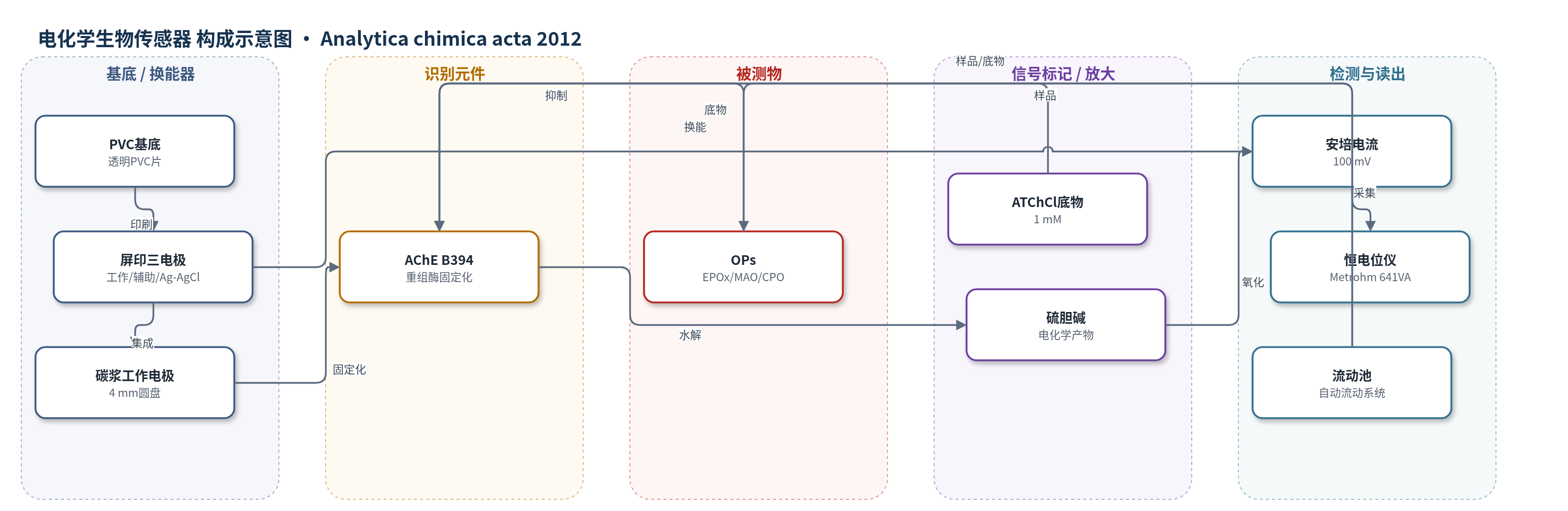
点击图片查看大图 · 依据论文自动绘制
传感器类型
电化学生物传感器
检测对象
有机磷农药(organophosphates, OPs):乙基对氧磷(EPOx)、马拉氧磷(MAO)、毒死蜱氧磷(CPO);样品基质:水、牛奶(加标真实牛奶)
检测原理
该检测基于重组乙酰胆碱酯酶(AChE)B394 的酶抑制机制。AChE 固定化于屏印工作电极,在流动池中催化底物乙酰硫代胆碱氯化物(ATChCl)水解生成硫胆碱;硫胆碱在 100 mV 下发生安培氧化,产生与酶活性成正比的电流。当样品中存在有机磷农药(OPs)时,OPs 与 AChE 活性位点结合并抑制其催化活性,使硫胆碱生成减少,电流下降。通过比较 OPs 孵育前后的电流抑制率,可定量 OPs 浓度。PTE 解毒柱中,磷酸三酯酶将 OPs 水解为不抑制 AChE 的产物,使电流恢复,从而评估解毒效率。
检测灵敏度
LOD: EPOx 1 × 10⁻⁹ M、MAO 1 × 10⁻¹⁰ M、CPO 1 × 10⁻¹¹ M;线性范围: 1 × 10⁻⁶–1 × 10⁻¹¹ M
效应效果
传感器对 1 mM ATChCl 连续 8–10 次测量稳定,电极间 CV 1.08%–1.12%,日内 RSD 2.73%、日间 RSD 2.40%,最大信号波动 5%;抑制实验 CV 3.43%,三种 OPs 平均 RSD 2.82%。PTE 柱在水中 3 周保留约 75% 活性,CV 2.2%;牛奶中 7 天保留约 50%。优化流速 0.5 mL/min 下,水中 EPOx、CPO 解毒率约 100%,MAO 88%;牛奶中 EPOx 86%、CPO 76%、MAO 70%,混合 OPs 最高 86%。方法适用于真实加标牛奶,具低成本、环境友好和现场监测价值。
传感器的构成
- 基底:透明 PVC 片(200 mm×100 mm×80.5 mm),作为屏印电极支撑。
- 电极:屏印三电极(工作电极 4 mm 圆盘、辅助电极 16 mm×1.5 mm、Ag/AgCl 伪参比 5 mm×1.5 mm),采用 Electrodag PE-410/423SS/6037SS 浆料,甘油邻苯二甲酸涂料作绝缘层。
- 识别元件:重组乙酰胆碱酯酶 AChE B394,固定化于工作电极,用于识别 OPs 抑制。
- 底物:乙酰硫代胆碱氯化物 ATChCl(1 mM),由 AChE 催化水解。
- 信号产物:硫胆碱(thiocholine),在 100 mV 下安培氧化产生电流。
- 流动池:定制流动池与自动注射泵/多通阀,用于样品、底物输送和 OPs 孵育。
中文摘要
有机磷农药(OPs)因高毒性和广泛使用而受到关注。本文报道了一种低成本柱式生物传感器系统,用于水和牛奶中 OPs 的解毒。将磷酸三酯酶(PTE)通过共价偶联固定化在活化 Sepharose 4B 上,并装填于 OmniFit 玻璃柱中。以乙基对氧磷(EPOx)、马拉氧磷(MAO)和毒死蜱氧磷(CPO)加标水和牛奶为对象,考察单一农药及混合农药的累计解毒效果。解毒效率采用基于重组乙酰胆碱酯酶(AChE)B394 的高灵敏度流动式生物传感器评估。优化柱条件后,在真实牛奶加标样品中,牛奶中 OPs 解毒率最高达 86%,水中可达 100%。结果表明,PTE 柱可在数分钟内快速水解 OPs,为水和食品中有机磷残留的现场解毒与监测提供了可行方法。
英文摘要
Among known pesticide groups, organophosphates (OPs) have grasped attention due to their hazardous nature and their applications as pesticides and chemical weapons. This work presents the development of cost-effective column based biosensor for detoxification of OPs in water and milk. Enzyme phosphotriesterase (PTE) was immobilized on an activated Sepharose 4B via covalent coupling using an Omnifit glass column. Three different OPs, ethyl paraoxon (EPOx), malaoxon (MAO) and chlorpyriphos-oxon (CPO) were spiked in water and milk to test the detoxification of OPs. Mixtures of these pesticides were also tested to check the cumulative detoxification in the real samples. The efficiency of detoxification was evaluated using a highly sensitive acetylcholinesterase (AChE) B394 biosensor based flow system. The column conditions were optimized for the detoxification studied. The method was shown to be promising when we tested real milk samples spiked with OPs. Detoxification obtained in milk was up to 86% whereas in water, 100% detoxification was obtained.