组成图示
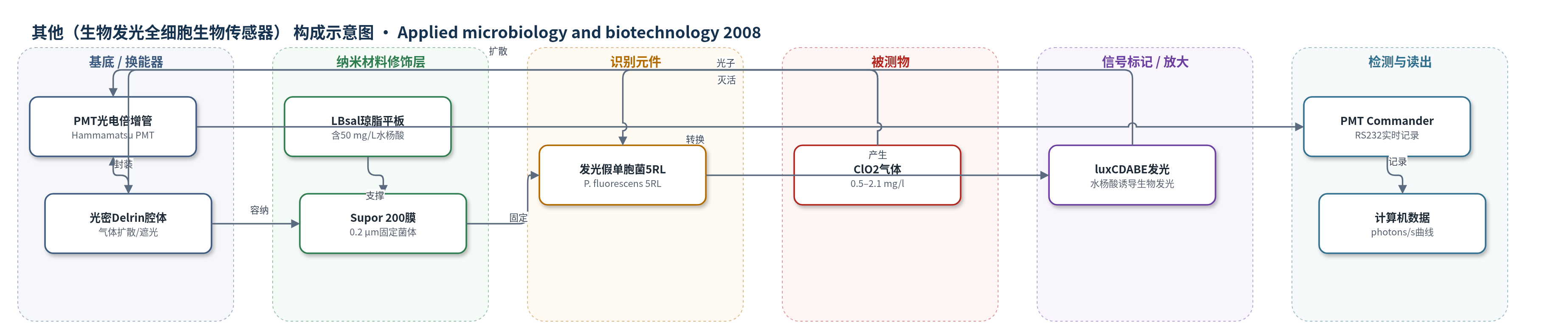
点击图片查看大图 · 依据论文自动绘制
传感器类型
其他(生物发光全细胞生物传感器)
检测对象
二氧化氯气体(chlorine dioxide, ClO2)及其消毒效力(微生物灭活动力学);样品基质:气相 ClO2 处理环境(空气/气体处理室,相对湿度 40–80%)
检测原理
传感器以重组发光菌 Pseudomonas fluorescens 5RL 作为识别与报告元件。该菌携带 Vibrio fischeri luxCDABE 荧光素酶基因,在 LBsal 培养基中的水杨酸诱导下持续产生生物发光。ClO2 气体经 Delrin 腔体孔道扩散进入样品区,接触膜上菌体;ClO2 的强氧化性造成细胞损伤、代谢受抑或死亡,使荧光素酶反应底物/能量供应下降,发光强度随时间降低。PMT 将光子转换为电信号,PMT Commander 软件实时记录 photons/s。ClO2 浓度越高,发光下降越快,LRT 越短,因此可通过发光衰减动力学间接反映 ClO2 气体消毒效力。该体系利用内源高生物发光信号实现在线监测,无需外加化学发光标记或酶促放大。
检测灵敏度
线性范围: 10^3–10^7 photons/s(对应 10^3–10^6 CFU/filter);工作曲线: y = 8.5533x^0.9456;R^2 = 0.9943;LRT 线性回归 R^2 = 0.96;z value: 3.4 mg/l ClO2
效应效果
背景与暗电流低:暗电流 36.5±8.5 photons/s,材料背景最高 377.9±30.0 photons/s;ClO2 化学发光背景约 3200 photons/s,远低于 10^7 photons/s。78% RH 下,0.5、1.0、1.6、2.1 mg/l ClO2 的 LRT 为 102.5、80、52.5、35 s,R^2=0.96;z 值 3.4 mg/l。初始 10^6 CFU/filter,处理后存活 200、83、25、0 CFU/filter,达 4–6 log 灭活。40%、60%、80% RH 滞后约 65、100、135 s;腔内湿度无响应,说明 Delrin 外壳延缓水蒸气扩散。作者认为可实时监测气体消毒,但尚不能直接关联 CFU 与光强。
传感器的构成
- 光电换能器:Hammamatsu PMT 传感器模块(含内置微控制器),接收生物发光光子并转换为电信号
- 光密气体扩散腔体:黑色 Delrin 三层同心圆柱(95、74、57 mm,高 152 mm),带交替孔,允许 ClO2 气体扩散并屏蔽环境光
- 培养基/支撑层:LBsal 琼脂平板(Luria-Bertani 含 50 mg/L 水杨酸),提供营养并诱导 luxCDABE 表达
- 细胞固定层:47 mm 0.2 μm Supor® 200 膜(Pall Corporation),过滤并固定 P. fluorescens 5RL 菌体
- 识别/报告元件:重组发光菌 Pseudomonas fluorescens 5RL,携带 luxCDABE 基因,受 ClO2 毒性影响导致发光下降
- 内源信号标记物:Vibrio fischeri luxCDABE 荧光素酶系统,水杨酸诱导产生生物发光光子
- 数据读出:PMT Commander 软件与计算机,经 RS232 实时记录 photons/s 发光曲线
中文摘要
本研究设计并构建了一种基于生物发光的原型生物传感器,用于在不同处理条件下在线评估二氧化氯(ClO2)气体的抗菌消毒效力。该传感器由发光报告菌荧光假单胞菌 Pseudomonas fluorescens 5RL、光电倍增管(PMT)光学换能器以及容纳报告菌和换能器的光密腔体组成。重组 P. fluorescens 5RL 携带 luxCDABE 发光基因,在水杨酸诱导下可产生强生物发光,从而在 ClO2 气体消毒过程中实现发光强度的在线监测。实验考察了相对湿度(40%、60%、80%)和 ClO2 气体浓度(0.5、1.0、1.6、2.1 mg/L)对报告菌的影响。结果表明,ClO2 浓度越高,发光下降越快;在 78% 相对湿度下,0.5、1.0、1.6 和 2.1 mg/L ClO2 对应的发光对数下降时间(LRT)分别为 103、78、53 和 35 s,使 LRT 发生十倍变化的 ClO2 浓度(z 值)为 3.4 mg/L。该原型传感器可用于实时监测微生物灭活动力学,并帮助理解影响气体消毒效果的关键参数。
英文摘要
A prototype bioluminescence-based biosensor was designed and constructed to evaluate the antimicrobial efficacy of chlorine dioxide (ClO(2)) gas under various treatment conditions. The biosensor consisted of a bioluminescent bioreporter (Pseudomonas fluorescens 5RL), an optical transducer (photomultiplier tube), and a light-tight chamber housing, the bioreporter and the transducer. The bioluminescent recombinant P. fluorescens 5RL in the biosensor allowed for online monitoring of bioluminescence during ClO(2) gas disinfection. Experiments were performed to evaluate the effects of the two key physical parameters associated with ClO(2) disinfection: relative humidity (40, 60, 80%) and ClO(2) gas concentration (0.5, 1.0, 1.6, 2.1 mg/l) on the bioreporter. Results showed that increasing concentrations of ClO(2) gas corresponded to a faster decrease in luminescence. The rates of luminescence decrease from P. fluorescens 5RL, and the log reduction time (LRT, time required to obtain 1-log reduction in luminescence) were calculated for each treatment tested. The LRT values of luminescence were 103, 78, 53, and 35 s for 0.5, 1.0, 1.6, and 2.1 mg/l of ClO(2) gas treatment, respectively, at 78% relative humidity. The gas concentration which caused a tenfold change in LRT (z value) for luminescence of P. fluorescens 5RL was 3.4 mg/l of ClO(2). The prototype biosensor showed potential for many applications, such as monitoring real-time microbial inactivation and understanding parameters that influence the efficacy of gaseous decontamination procedures.