组成图示
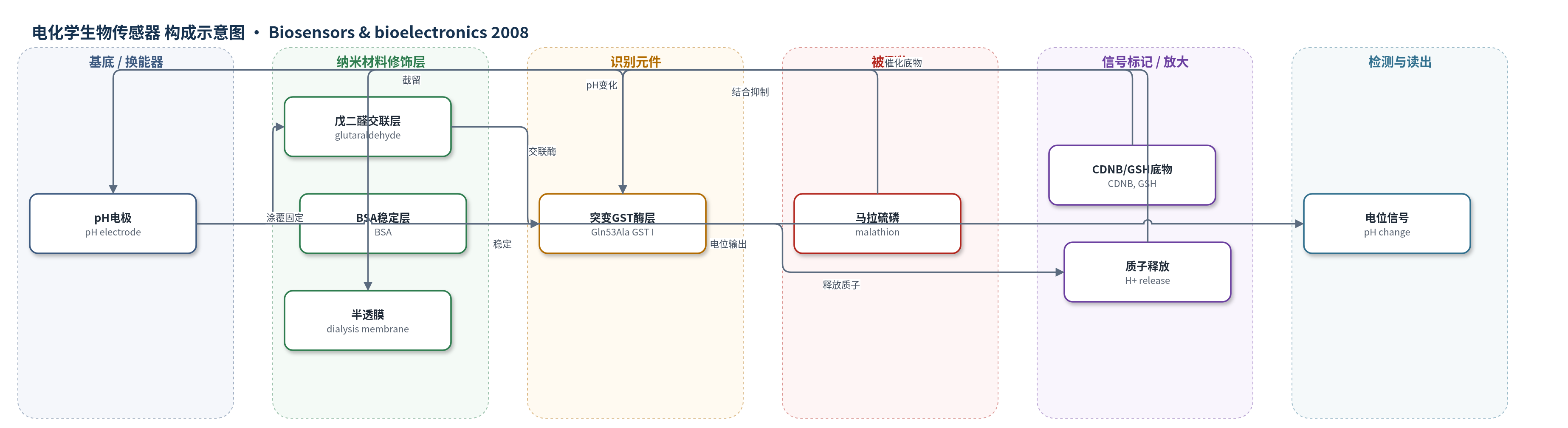
点击图片查看大图 · 依据论文自动绘制
传感器类型
电化学生物传感器
检测对象
马拉硫磷(malathion);样品基质:磷酸盐缓冲液(pH 7.5,含 CDNB/GSH 反应液),文中提及可用于马拉硫磷残留现场监测
检测原理
该传感器以 Gln53Ala 突变玉米 GST I 为识别元件。GST 催化还原型谷胱甘肽(GSH)与 1-氯-2,4-二硝基苯(CDNB)发生结合反应,并伴随释放 HCl/质子;在低缓冲容量体系中,质子积累使 pH 下降,下降速率与酶活成正比。马拉硫磷进入酶层后结合 GST 的底物结合位点(G-site/H-site),竞争性抑制 CDNB/GSH 结合反应,从而降低质子释放速率。pH 电极将界面 pH 变化转换为电位信号,通过初始反应速率或抑制率与马拉硫磷浓度建立校准关系。Gln53Ala 突变增强马拉硫磷结合与抑制效力,使检测阈值降低;戊二醛交联和半透膜固定酶层,同时允许底物与质子透过。
检测灵敏度
线性范围: 0–20 μM
效应效果
Gln53Ala 对 23 种异生物中 15 种抑制敏感性高于野生型,对马拉硫磷约 100% 抑制;IC50 为 8.4 μM,野生型 77.6 μM,Ile118Phe 61.2 μM。游离酶重现性 RSD ±3–5%(N=5),回收率 87%–108%,平均 96.7%(N=5)。固定化酶活 0.01 units/mg gel,低于名义 0.05 units/mg gel,但响应类似游离酶,校准 0–20 μM。Tm 57.6 °C,4 °C 无稳定剂半衰期 12 d,GSH/甘油分别为 18 d/16 d。与 HPLC(0.53–4.25 μg/g)、GC-FPD(0.21–3.05 μg/L)相比线性范围更宽、回收率更高,分析约 10 min,作者认为可用于马拉硫磷残留现场监测。
传感器的构成
- 换能器电极:pH 电极(pH electrode),检测反应释放 H+ 引起的电位/pH 变化
- 酶识别层:Gln53Ala 突变玉米 GST I(Gln53Ala GST I),结合马拉硫磷并催化 CDNB/GSH 结合反应
- 交联固定剂:戊二醛(glutaraldehyde),交联酶形成三维网络并固定于电极表面
- 稳定/封闭剂:牛血清白蛋白(BSA),稳定交联网络并保护酶活
- 半透膜:透析膜(dialysis membrane,12,000–14,000 MW cut-off),截留酶层并允许小分子底物和质子通过
- 反应底物:1-氯-2,4-二硝基苯(CDNB)与还原型谷胱甘肽(GSH),在溶液中参与 GST 催化反应并释放 H+
中文摘要
胞质谷胱甘肽转移酶(GSTs)是一类高容量配体结合蛋白,可识别多种疏水性化合物。本研究通过动力学抑制、定点突变和分子建模,考察非底物异生物(除草剂和杀虫剂)与玉米 GST I 的结合。结果表明,异生物结合于底物结合位点。基于分子对接分析,选择两个残基评估其对异生物结合的贡献;Gln53Ala 突变体对杀虫剂马拉硫磷的抑制效力较野生型提高 9.2 倍。作者开发了基于电位法的马拉硫磷测定方法,利用异生物抑制 GST 催化 1-氯-2,4-二硝基苯(CDNB)与还原型谷胱甘肽(GSH)结合反应的能力。传感方案基于低缓冲体系中 GST 反应引起的 pH 变化,并用 pH 电极进行电位测量。获得马拉硫磷校准曲线,有效浓度范围为 0–20 μM;方法重现性约 ±3–5%,马拉硫磷回收率为 96.7±2.8%。固定化 Gln53Ala 突变 GST 用于组装马拉硫磷生物传感器,酶经戊二醛交联并截留于 pH 电极前的半透膜后。结果表明固定化酶行为与游离酶相似。
英文摘要
Cytosolic glutathione transferases (GSTs) are a major reserve of high-capacity ligand binding proteins which recognise a large variety of hydrophobic compounds. In the present study, the binding of non-substrate xenobiotic compounds (herbicides and insecticides) to maize GST I was investigated by employing kinetic inhibition studies, site-directed mutagenesis and molecular modelling studies. The results showed that the xenobiotics bind at the substrate binding site. Based on in silico docking analysis, two residues were selected for assessing their contribution to xenobiotic binding. The mutant Gln53Ala of GST I Exhibits 9.2-fold higher inhibition potency for the insecticide malathion, compared to the wild-type enzyme. A potentiometric assay was developed for the determination of malathion using the Gln53Ala mutant enzyme. The assay explores the ability of the xenobiotic to promote inhibition of the GST-catalysing 1-chloro-2,4-dinitrobenzene (CDNB)/glutathione (GSH) conjugation reaction. The sensing scheme is based on the pH change occurring in a low buffer system by the GST reaction, which is measured potentiometrically using a pH electrode. Calibration curve was obtained for malathion, with useful concentration range 0-20 microM. The method's reproducibility was in the order of +/-3-5% and malathion recoveries were 96.7+/-2.8%. Immobilized Gln53Ala mutant GST was used to assemble a biosensor for malathion. The enzyme was immobilized by crosslinking with glutaraldehyde and trapped behind a semipermeable membrane in front of the pH electrode. The results demonstrated that the immobilized enzyme behaved similar to free enzyme.