组成图示
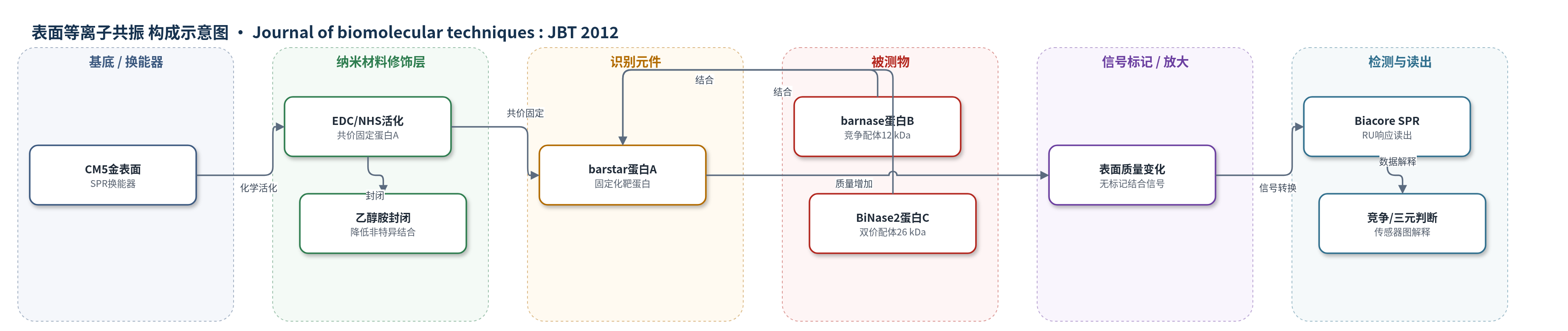
点击图片查看大图 · 依据论文自动绘制
传感器类型
表面等离子共振(SPR)生物传感器
检测对象
barnase(核糖核酸酶 B,protein-B)、BiNase2(双价 barnase 变体,protein-C)对固定化 barstar(protein-A)的结合/竞争;样品基质:50 mM 乙酸铵 pH 8.0、100 mM NaCl 蛋白缓冲液及 PBS-T 运行缓冲液
检测原理
将 barstar(protein-A)通过 EDC/NHS 化学固定于 CM5 金表面,并用乙醇胺封闭。barnase(protein-B)或 BiNase2(protein-C)注入后,与 barstar 同一结合位点结合,引起传感器表面质量与折射率变化;SPR 换能将结合事件转换为共振角变化,仪器以 RU 读出。信号随分析物浓度升高而增加,但 B 与 C 竞争同一表位,混合注入信号低于二者单独信号之和,表明不能形成三元复合物。BiNase2 为双价蛋白,低浓度下可二价结合两个 barstar,产生亲合力并减缓解离;高浓度下主要高亲和域单价结合。实验通过 pre-mix 与 tandem blocking 比较单独、混合及顺序结合信号判断竞争。
检测灵敏度
未报告
效应效果
12 个生物传感器参与者中,9 个正确判断 barnase 与 BiNase2 竞争结合 barstar,不形成三元复合物;3 个(#25、#29、#32)结论错误,原因包括数据质量不足、误读表面未饱和或非特异结合,以及错误假设蛋白活性分数。SPR/BLI 在 10^-7-10^-10 M 浓度范围工作,未检测到高浓度下出现的 A:C:A 复合物。质谱参与者中,ESI-MS 识别 A:B 1:1 复合物但 C 信号弱;MALDI-TOF 高质量检测在 10^-6 M 下观察到 A:B、A:C 及 50,824 Da(或 50,831-50,854 Da)A:C:A 复合物。研究说明生物传感器平台设计灵活,但缺乏统一标准,且数据解释易受表面占据、非特异结合和蛋白活性影响。
传感器的构成
- 基底/换能器:CM5 金表面 SPR 芯片,提供表面等离子共振换能
- 化学活化层:EDC/NHS 活化羧基表面,用于共价固定蛋白 A
- 识别元件:barstar(protein-A,His-tagged C40A,C82A)固定化,作为靶蛋白结合位点
- 封闭层:ethanolamine 封闭未反应位点,降低非特异结合
- 分析物/竞争配体:barnase(protein-B)与 BiNase2(protein-C),无标记蛋白,结合引起表面质量变化
- 信号标记物:无外源标记,蛋白结合质量/折射率变化作为 SPR 信号
- 读出系统:Biacore 2000/3000/T100 SPR 仪器,输出 RU 响应
中文摘要
高通量蛋白质组学技术不断揭示蛋白互作网络,但同一靶蛋白同时结合多个配体时,如何准确判断多蛋白复合物能否组装以及不同配体是否竞争同一结合位点,仍是重要挑战。ABRF-MIRG 开展了一项以生物传感器技术为核心的基准研究,评估各实验室利用表面等离子共振(SPR)等技术正确描述两蛋白配体与靶蛋白相互作用的能力。参与者获得微克级三种未知蛋白 A、B 和 C,需判断能否形成三元 A-B-C 复合物,或 B 与 C 竞争性结合 A。本文总结参与者采用的实验设计、数据解释及不同生物传感器仪器结果,并说明 SPR、生物层干涉(BLI)和质谱方法在三组分蛋白体系中的表现与局限。
英文摘要
Protein-protein interactions identified through high-throughput proteomics efforts continue to advance our understanding of the protein interactome. In addition to highly specific protein-protein interactions, it is becoming increasingly more common for yeast two-hybrid, pull-down assays, and other proteomics techniques to identify multiple protein ligands that bind to the same target protein. A resulting challenge is to accurately characterize the assembly of these multiprotein complexes and the competition among multiple protein ligands for a given target. The Association of Biomolecular Resource Facilities-Molecular Interactions Research Group recently conducted a benchmark study to assess participants' ability to correctly describe the interactions between two protein ligands and their target protein using primarily biosensor technologies, such as surface plasmon resonance. Participants were provided with microgram quantities of three proteins (A, B, and C) and asked to determine if a ternary A-B-C complex can form or if protein-B and protein-C bind competitively to protein-A. This article will summarize the experimental approaches taken by participants to characterize the molecular interactions, the interpretation of the data, and the results obtained using different biosensor instruments.