组成图示
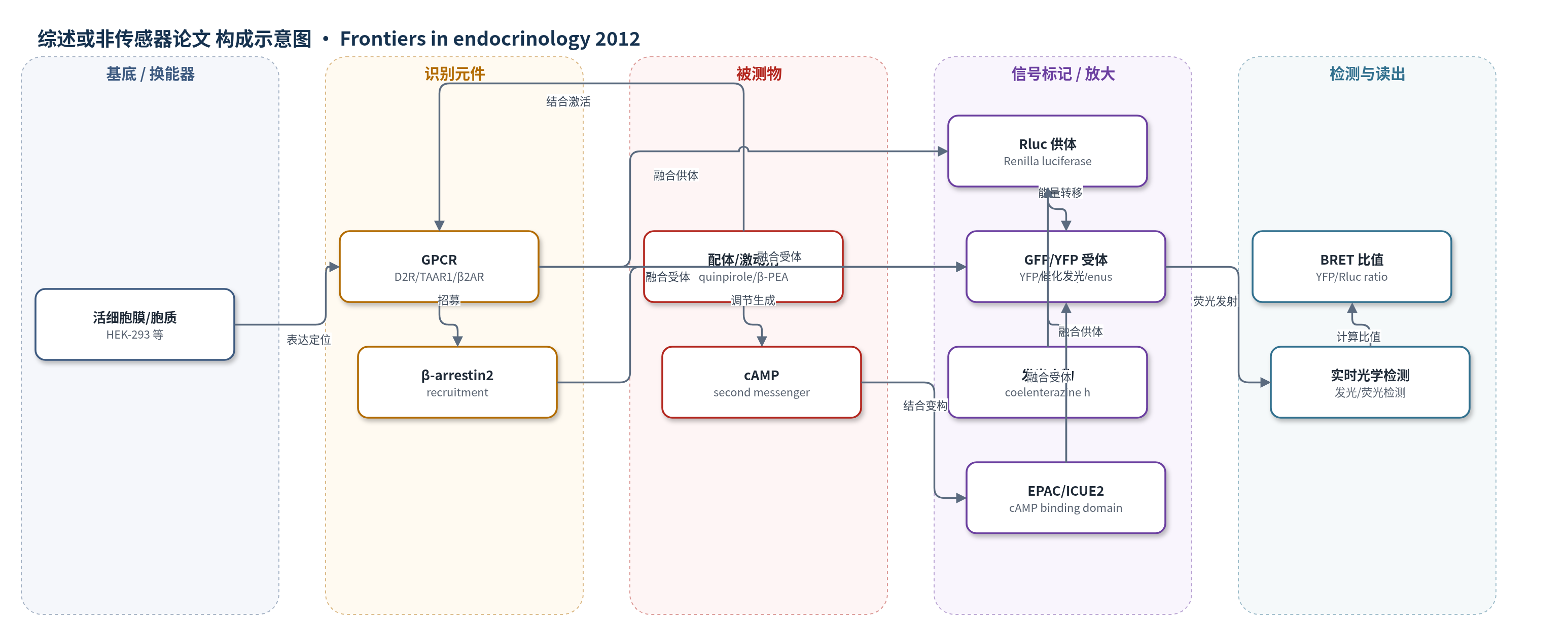
点击图片查看大图 · 依据论文自动绘制
传感器类型
综述或非传感器论文
检测对象
GPCR 配体(激动剂/拮抗剂,如 quinpirole、β-PEA、抗精神病药)、cAMP、β-arrestin2 招募、TAAR1–D2R 异源二聚体;样品基质:活细胞(HEK-293 等转染细胞)
检测原理
BRET 生物传感器以 Renilla 荧光素酶(Rluc)为供体、GFP 变体(YFP/Citrine 等)为受体。加入 coelenterazine 后,Rluc 催化底物氧化发光,激发态供体在距离小于 100 Å 时通过非辐射共振能量转移激发荧光受体,后者发射荧光。当 GPCR 被激动剂/拮抗剂结合后,受体与 G 蛋白、β-arrestin 或另一受体的结合状态、取向或构象改变;cAMP 结合 EPAC/ICUE2 也会引起分子内构象变化。这些变化改变供受体距离或取向,使 BRET 比值(受体荧光/供体发光)升高或降低。由于无需外部激发,背景较低,可在活细胞中实时、可逆地监测配体效应、第二信使波动和蛋白相互作用。
检测灵敏度
原文未报告具体 LOD、线性范围、灵敏度斜率或相关系数。
效应效果
BRET 无需外部激发,相比 FRET 可减少直接激发和光漂白背景,适合活细胞实时定量。β-arrestin 招募 BRET 已用于高通量筛选 CCR5 拮抗剂;EPAC cAMP 传感器筛选 1,000 个类药化合物,初筛约 20 个,最终确认 4 个 TAAR1 激动剂,其中 3 个为已知激动剂,第 4 个 guanabenz 后被证实为强效激动剂。与放射性 cAMP 柱色谱法相比,BRET 定性相似且略敏感。抗精神病药对 D2R/β-arrestin2 转位的拮抗效力比 G 蛋白通路高 3–150 倍,aripiprazole 对 quinpirole 反应最大阻断约 30%。TAAR1–D2R 异源二聚体 BRET 滴定呈双曲线,D1R 对照呈线性;未标记 D2R 竞争降低 BRET,haloperidol 几乎完全消除信号。
传感器的构成
- 细胞基底:活细胞膜/胞质(HEK-293 等),承载融合蛋白并维持信号微环境
- 生物分子供体:Renilla reniformis luciferase(Rluc)融合于受体/蛋白,催化底物发光
- 荧光受体:GFP 变体(YFP、Citrine、Venus、GFP10、GFP2)融合于结合伙伴或同一蛋白,接受能量并发荧光
- 识别元件:GPCR(D2R、TAAR1、β2AR)或 G 蛋白/β-arrestin/EPAC/PKA 亚基,结合配体或 cAMP
- 信号底物:coelenterazine(coelenterazine h),被 Rluc 催化产生激发态供体
- 读出参数:BRET 比值(YFP/Rluc),随供受体距离、取向或结合状态变化
中文摘要
生物发光共振能量转移(BRET)生物传感器在过去十年中已被广泛用于在活细胞中研究蛋白-蛋白相互作用和细胞内信号转导。本综述讨论为研究 G 蛋白偶联受体(GPCR)生物学、药理学和信号转导而开发的多种 BRET 生物传感器。GPCR 可形成包含 G 蛋白或 β-arrestin 的两类多蛋白信号复合物,具有功能选择性的药物可分别影响 G 蛋白或 β-arrestin 信号。BRET 尤其擅长阐明受体、G 蛋白、β-arrestin 及其结合伙伴在活细胞中的动态相互作用,并测量受体激活后第二信使的生成与积累。文中重点介绍 BRET 在多巴胺受体和痕量胺受体信号研究中的应用,包括用于检测 cAMP 的 EPAC 生物传感器、用于判断 β-arrestin 招募的 β-arrestin 生物传感器,以及用于研究 D2 受体与 TAAR1 异源二聚化的受体生物传感器。随着 BRET 生化谱扩展,可测量的信号通路将增加,有助于评价功能选择性、加速偏倚药物表征,并拓展新活性化合物筛选应用。
英文摘要
Bioluminescence resonance energy transfer (BRET)-based biosensors have been extensively used over the last decade to study protein-protein interactions and intracellular signal transduction in living cells. In this review, we discuss the various BRET biosensors that have been developed to investigate biology, pharmacology, and signaling of G protein-coupled receptors (GPCRs). GPCRs form two distinct types of multiprotein signal transduction complexes based upon their inclusion of G proteins or β-arrestins that can be differentially affected by drugs that exhibit functional selectivity toward G protein or β-arrestin signaling. BRET has been especially adept at illuminating the dynamics of protein-protein interactions between receptors, G proteins, β-arrestins, and their many binding partners in living cells; as well as measuring the formation and accumulation of second messengers following receptor activation. Specifically, we discuss in detail the application of BRET to study dopamine and trace amine receptors signaling, presenting examples of an exchange protein activated by cAMP biosensor to measure cAMP, β-arrestin biosensors to determine β-arrestin recruitment to the receptor, and dopamine D2 receptor and trace amine-associated receptor 1 biosensors to investigate heterodimerization between them. As the biochemical spectrum of BRET biosensors expands, the number of signaling pathways that can be measured will concomitantly increase. This will be particularly useful for the evaluation of functional selectivity in which the real-time BRET capability to measure distinct signaling modalities will dramatically shorten the time to characterize new generation of biased drugs. These emerging approaches will further expand the growing application of BRET in the screening for novel pharmacologically active compounds.