组成图示
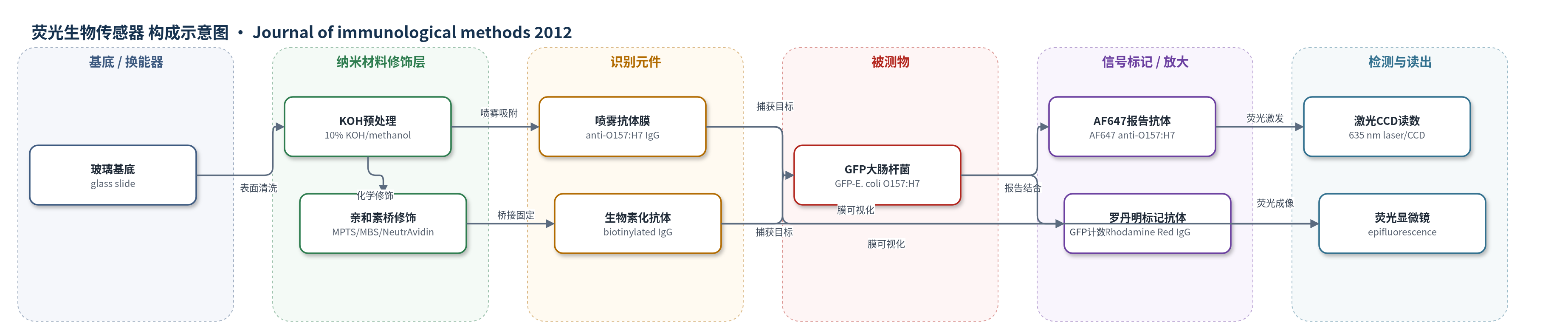
点击图片查看大图 · 依据论文自动绘制
传感器类型
荧光生物传感器
检测对象
大肠杆菌O157:H7(Escherichia coli O157:H7),样品基质为磷酸盐/氯化钠缓冲液(NaPCl)细菌悬液
检测原理
玻璃表面经KOH/甲醇清洗后,未标记山羊抗大肠杆菌O157:H7 IgG通过气动喷雾直接物理吸附形成高密度随机抗体膜;对照中玻璃经硅烷、马来酰亚胺交联剂和NeutrAvidin修饰,再固定生物素化抗体。样品中的GFP-E. coli O157:H7与捕获抗体特异性结合,随后AF647标记检测抗体结合被捕获菌。635 nm激光激发AF647产生荧光,CCD采集感兴趣区与背景,计算RFU和SNR,SNR≥3判阳性。信号随菌浓度升高而增强;喷雾膜依靠高抗体密度补偿随机取向,无核酸或酶催化放大。
检测灵敏度
检测浓度范围: 10^5–10^7 cells/ml;阳性判据: SNR≥3
效应效果
两种方法均特异性检测大肠杆菌O157:H7,对E. coli K12、O124:H7、沙门氏菌、志贺氏菌和金黄色葡萄球菌10^7 cells/ml无检出,非目标SNR≤0.2±2,阳性SNR为15.2±10.5和14.6±6.4。喷雾膜在10^6、10^7 cells/ml的RFU低于桥接膜(P=0.0072、0.0104),但捕获效率无显著差异(P=0.5600、0.1673、0.9964)。10张喷雾载玻片均形成至少6行清晰抗体膜;4℃储存100天后仍检出10^7 cells/ml,RFU 1600–4300。固定化时间由24 h缩短至7 min,膜厚155.25±11.78 Å,抗体质量约31.69 ng/mm2,适合低成本批量制备。
传感器的构成
- 基底:普通显微镜玻璃载玻片/玻璃波导(glass slide/waveguide),提供光学透明表面并承载抗体膜。
- 表面预处理:10% KOH/甲醇处理,清洗玻璃表面并增强抗体附着。
- 亲和素-生物素桥修饰层:(3-mercaptopropyl) triethoxysilane、4-maleimidobutyric acid N-hydroxysuccinimide ester 和 NeutrAvidin,形成共价连接桥。
- 识别元件:未标记山羊抗大肠杆菌O157:H7 IgG(气动喷雾直接吸附)或生物素化山羊抗大肠杆菌O157:H7 IgG(桥接固定),特异性捕获目标菌。
- 信号标记物:AlexaFluor 647(AF647)标记山羊抗大肠杆菌O157:H7报告抗体,与捕获菌结合后发射荧光。
- 可视化标记物:Rhodamine Red 驴抗山羊IgG,用于荧光显微镜观察抗体膜形貌。
- 读出系统:635 nm激光、Peltier冷却CCD相机和生物传感器阵列读数仪,采集AF647荧光图像。
中文摘要
本研究考察气动喷雾在玻璃表面形成薄抗体膜作为捕获病原目标的潜在固定化技术。以山羊抗大肠杆菌O157:H7 IgG经气动喷雾制备抗体膜,并与亲和素-生物素桥固定化膜比较,使用GFP转化大肠杆菌O157:H7细胞和荧光报告抗体进行检测。测试了膜的功能性、稳定性和固定化效果。气动喷雾膜荧光强度低于亲和素-生物素桥膜,但在10^5–10^7 cells/mL样品浓度下对大肠杆菌O157:H7的检测相似,且未检出非O157:H7菌株。两种方法捕获效率相似。结果表明,气动喷雾固定化未使抗体失活,并形成稳定抗体膜。固定化时间从亲和素-生物素桥的24 h显著缩短至7 min,同时大幅减少材料和化学试剂使用。气动喷雾技术有望成为玻璃载玻片上抗体固定化、用于捕获病原目标及生物传感器器件的替代方法。
英文摘要
The formation of a thin antibody film on a glass surface using pneumatic spray was investigated as a potential immobilization technique for capturing pathogenic targets. Goat-Escherichia coli O157:H7 IgG films were made by pneumatic spray and compared against the avidin-biotin bridge immobilized films by assaying with green fluorescent protein (GFP) transformed E. coli O157:H7 cells and fluorescent reporter antibodies. Functionality, stability, and immobilization of the films were tested. The pneumatic spray films had lower fluorescence intensity values than the avidin-biotin bridge films but resulted in similar detection for E. coli O157:H7 at 10(5)-10(7)cells/ml sample concentrations with no detection of non-E. coli O157:H7 strains. Both methods also resulted in similar percent capture efficiencies. The results demonstrated that immobilization of antibody via pneumatic spray did not render the antibody non-functional and produced stable antibody films. The amount of time necessary for immobilization of the antibody was reduced significantly from 24h for the avidin-biotin bridge to 7 min using the pneumatic spray technique, with additional benefits of greatly reduced use of materials and chemicals. The pneumatic spray technique promises to be an alternative for the immobilization of antibodies on glass slides for capturing pathogenic targets and use in biosensor type devices.