组成图示
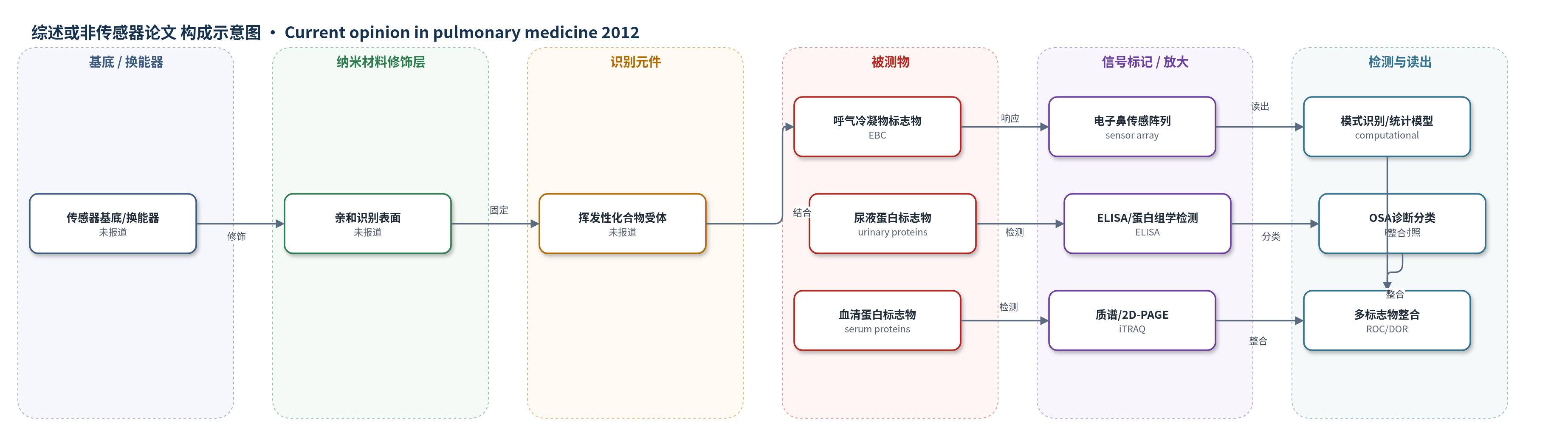
点击图片查看大图 · 依据论文自动绘制
传感器类型
综述或非传感器论文
检测对象
儿童阻塞性睡眠呼吸暂停(pediatric OSA)相关生物标志物:血清蛋白(serum proteins)、尿液蛋白(urinary proteins,如 kallikrein-1、urocortin-3、orosomucoid-1、uromodulin)、呼气冷凝物炎症/氧化应激标志物(exhaled breath condensate, EBC)及挥发性化合物(volatile compounds);样品基质:血清、尿液、呼气冷凝物。
检测原理
儿童 OSA 的间歇性低氧、睡眠片段化和上气道炎症/氧化应激会改变外周血白细胞基因表达、血清与尿液蛋白谱以及呼气冷凝物中的炎症、氧化应激和挥发性代谢物。转录组学通过基因表达芯片检测差异表达基因,信号为探针杂交强度或表达量,随基因表达水平变化;蛋白质组学通过 2D-PAGE、质谱或 ELISA 检测蛋白丰度,信号强度随蛋白浓度变化;呼气分析通过 EBC 标志物浓度或电子鼻/人工鼻传感器阵列对挥发性化合物的响应模式反映气道炎症与代谢状态。上述信号经 ROC、诊断优势比、聚类或模式识别等统计方法整合,用于区分 OSA、主鼾和对照。综述未报道单一传感器的具体换能机制或信号放大策略。
检测灵敏度
未报道 LOD、线性范围、灵敏度斜率或相关系数。
效应效果
综述指出,多导睡眠监测(PSG)是儿童 OSA 诊断金标准,但复杂、昂贵且等待时间常达 5–6 个月;临床病史和体格检查不能可靠区分主鼾与 OSA。基因表达芯片结合层次聚类可近乎完美地将 OSA、主鼾和对照儿童分类。尿液蛋白质组学发现 16 种差异蛋白,ELISA 验证 4 种(kallikrein-1、urocortin-3、orosomucoid-1、uromodulin),组合标志物回顾性诊断 OSA 的敏感度为 95%、特异度为 100%,但需独立大样本验证。呼气冷凝物中炎症和氧化应激标志物随 OSA 严重度变化;电子鼻、人工鼻和在线快速气相色谱具有便携、非侵入、近实时优势。作者认为这些方法有望加速儿童 OSA 筛查和诊断。
传感器的构成
- 基底或换能器:未报道(综述未给出具体传感器基底或电极材料)
- 纳米材料修饰层:未报道(综述未给出具体纳米修饰层)
- 识别元件:未报道(综述提及人工鼻/电子鼻传感器阵列与亲和表面,但未给出具体识别材料)
中文摘要
儿童睡眠实验室资源有限,导致儿童阻塞性睡眠呼吸暂停(OSA)诊断和治疗延迟,增加 OSA 相关并发症风险。本文综述转录组学、蛋白质组学及呼气冷凝物生物标志物发现进展,并评估其用于建立可靠、经过验证的儿童 OSA 诊断方法的可行性。基因表达芯片显示,少数基因在儿童 OSA 中发生显著且可重复的表达改变,可能具备区分 OSA 的能力。多种尿液蛋白也表现出优异的受试者工作特征(ROC)诊断性能。呼气分析中在线高压快速色谱技术以及具有挥发性化合物亲和力的生物传感器表面等进展,若与计算方法结合,有望实现儿童 OSA 的非侵入性诊断。作者认为,目前儿童 OSA 生物标志物发现工作虽有限,但未来几年将显著加速,并可能形成筛查和诊断该疾病的全新范式。
英文摘要
PURPOSE OF REVIEW: The scarcity of pediatric sleep laboratories has thus far precluded timely diagnosis and treatment of pediatric obstructive sleep apnea (OSA), thereby increasing the risk for residual OSA-associated morbidities. Recent developments in transcriptomics, proteomics, and exhaled condensate biomarker discovery will be reviewed in the context of exploring the validity of such methods towards development of reliable and validated diagnostic approaches for pediatric OSA.
RECENT FINDINGS: Gene expression arrays have revealed significant and reproducible changes in a restricted number of genes that should enable discriminatory ability in the recognition of OSA in children. Similarly, a number of urinary proteins have been identified that display outstanding receiver-operator properties towards the diagnosis of pediatric OSA. The technological improvements in both exhaled breath online high-pressure fast chromatography and biosensor surfaces with affinity for volatile compounds should also permit noninvasive diagnosis of pediatric OSA when combined and integrated with computational methods.
SUMMARY: It is likely that the modest efforts thus far realized in the context of biomarker discovery for the diagnosis and clinical monitoring of OSA in children will experience major acceleration in the upcoming years and lead to a completely novel paradigm in the screening and diagnosis of this disease.