组成图示
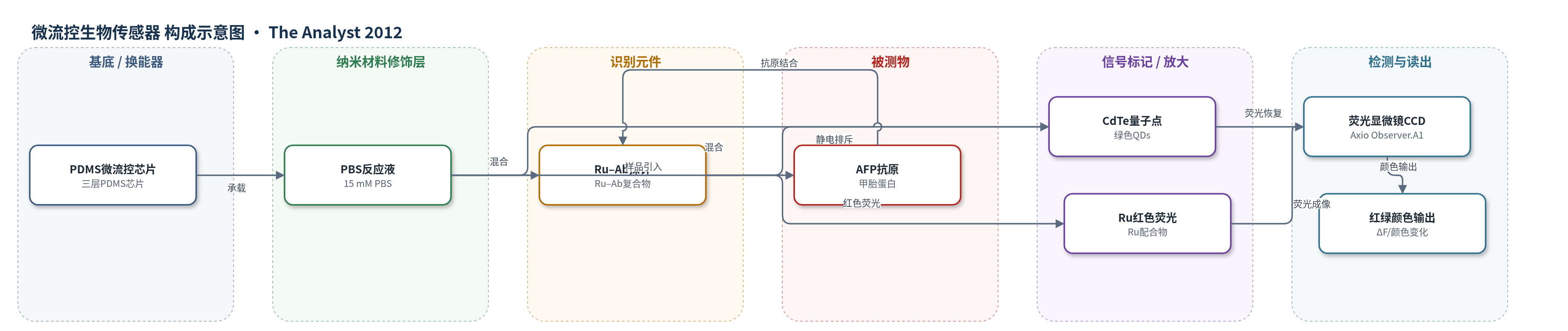
点击图片查看大图 · 依据论文自动绘制
传感器类型
微流控生物传感器
检测对象
甲胎蛋白(AFP, alpha-fetoprotein);样品基质:PBS缓冲液、稀释人血清(临床血清)
检测原理
该传感器采用无固定、无洗涤的均相液滴免疫分析。Ru–Ab复合物带正电,绿色CdTe QDs带负电,二者通过静电作用靠近,Ru–Ab淬灭QDs绿色荧光,液滴主要显示Ru红色荧光。加入AFP后,AFP与Ru–Ab特异性结合形成带负电的Ru–Ab–AFP复合物,其抗原-抗体亲和力远强于静电作用,使Ru–Ab远离QDs表面,QDs绿色荧光恢复。随着AFP浓度升高,红色Ru荧光与绿色QD荧光叠加比例变化,液滴颜色由红逐渐变为绿。微流控芯片将QDs、Ru–Ab和AFP液滴按需生成、融合并捕获,荧光显微镜/CCD成像获取颜色与荧光恢复量ΔF,ΔF与log CAFP呈线性关系。
检测灵敏度
LOD: 0.06 ng ml−1;线性范围: 0.0005–1 mg ml−1;R^2 = 0.9612;血清LOD: 0.4 ng ml−1;血清线性范围: 0.675 ng ml−1–0.0675 mg ml−1;R^2 = 0.9969
效应效果
该传感器对AFP具有良好选择性:HSA、IgG、转铁蛋白、氨基酸及Na+、K+、Mg2+、Ca2+等干扰物在0.1 mg ml−1或相应浓度下未引起明显颜色变化,仅0.1 mg ml−1 AFP产生显著响应。缓冲液中11次重复测定0.01 mg ml−1 AFP的RSD为2.8%。在稀释人血清中,线性范围为0.675 ng ml−1–0.0675 mg ml−1,R^2=0.9969,LOD为0.4 ng ml−1;7份临床血清结果与医院参考值一致,3份独立血清RSD小于10%。作者认为其试剂用量少、无需孵育洗涤、检测简便低成本,适合POCT和癌症标志物筛查。
传感器的构成
- 微流控芯片基底:三层PDMS微流控芯片(three-layer PDMS microfluidic chip),用于液滴生成、融合、捕获与成像
- 反应介质:15 mM PBS缓冲液(pH 8.0,10 mM NaCl),作为水相反应环境
- 识别元件:AFP单克隆抗体(Ab)与Ru偶联形成的Ru–Ab复合物,作为AFP抗原捕获探针
- 信号标记/淬灭剂:Ru(bpy)2(mcbpy-O-Su-ester)(PF6)2配合物(Ru),提供红色荧光并淬灭QDs绿色荧光
- 荧光信号纳米材料:N-乙酰半胱氨酸(NAC)包覆CdTe量子点(QDs),提供绿色荧光参考与恢复信号
- 被测物:甲胎蛋白(AFP)抗原液滴,与Ru–Ab特异性结合
- 读出装置:倒置荧光显微镜(Axio Observer.A1)配10×物镜与CCD(Spot RT3),采集液滴颜色与荧光强度
中文摘要
液滴方法已成功用于DNA杂交分析和蛋白质-蛋白质相互作用研究,但现有液滴平台检测方法受昂贵且高维护设备限制。比色法作为一种便捷检测手段,可提高微尺度分析效率并简化检测流程。本文首次将比色法与液滴平台结合,建立了一种用于甲胎蛋白(AFP)的微尺度免疫分析方法。作者将Ru(bpy)2(mcbpy-O-Su-ester)(PF6)2配合物(Ru)与AFP单克隆抗体(Ab)偶联,形成稳定的红色Ru–Ab复合物,该复合物既可作为绿色CdTe量子点(QDs)的淬灭剂,又可作为AFP捕获探针。无AFP时,混合液滴呈红色;随着AFP浓度增加,AFP与QDs竞争结合Ru–Ab,使液滴颜色由红色逐渐变为绿色。该生物传感器对AFP具有良好的灵敏度和特异性,缓冲液中检出限为0.06 ng/mL,稀释人血清中检出限为0.4 ng/mL。基于该原理,有望建立用于癌症生物标志物筛查的肉眼可视液滴平台。
英文摘要
Droplet methods have been successfully applied in DNA hybridization analysis and protein-protein interaction. Existing assay methods implemented in droplet platforms are severely limited by expensive and high-maintenance equipment. As a convenient detection method, colorimetry provides a new path for microscale assay since it can enhance assay efficiency and simplify the detection procedure. Here, a microscale immunoassay for α-fetoprotein (AFP) was developed for the first time by the incorporation of colorimetry and droplet platform. Ru(bpy)(2)(mcbpy-O-Su-ester)(PF(6))(2) complex (Ru) was coupled with the monoclonal antibody (Ab) of AFP to form a stable red Ru-Ab complex both as a quencher for green CdTe quantum dots (QDs) and as a capture probe for AFP. In the absence of AFP, the mixed droplet showed a red color. With the increase of AFP concentration, the color change of the droplet was from red to green as a result of the competition of AFP with QDs for Ru-Ab. The biosensor exhibited not only good sensitivity and specificity for AFP with a detection limit of 0.06 ng ml(-1), but also satisfactory performance in diluted human sera with a detection limit of 0.4 ng ml(-1). Notably, a visual droplet platform for screening cancer biomarkers by the naked eye based on this principle is anticipated.