组成图示
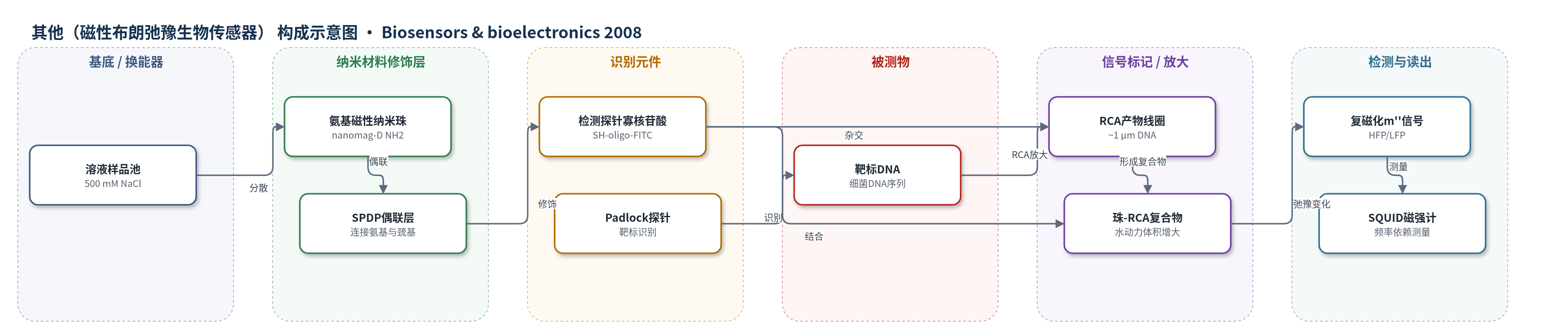
点击图片查看大图 · 依据论文自动绘制
传感器类型
其他(磁性布朗弛豫生物传感器)
检测对象
靶标DNA序列(Target 1、Vibrio cholerae DNA、Vibrio vulnificus DNA);样品基质:水相缓冲液(NaCl 500 mM)中的RCA产物溶液,可含基因组背景材料。
检测原理
靶标DNA与padlock probe互补识别并经连接形成环状模板,随后rolling circle amplification(RCA)生成约1 μm的RCA-coils长链DNA,实现信号放大。表面修饰寡核苷酸检测探针的磁性纳米珠通过碱基杂交结合到RCA-coils上,使自由磁珠被固定,水动力体积由珠径增大到RCA线圈尺度,布朗弛豫频率显著降低。SQUID磁强计测量频率依赖复磁化虚部m'':自由珠的高频峰HFP随固定化减少而下降(turn-off),固定化珠/线圈复合物的低频峰LFP随RCA产物增加而上升(turn-on)。RCA产物浓度越高,HFP下降越多、LFP上升越多,从而实现检测。小珠更易进入线圈内部,大珠易交联多个线圈形成聚集体。
检测灵敏度
LOD: 4 pM(前文130 nm珠体系);LOD: 100 pM(40 nm珠,Fig. 1(b),turn-off/turn-on);LOD: 33 pM(40 nm珠,Fig. 1(d)与Fig. 2(a));LOD: 11 pM(40 nm珠Fig. 2(b);250 nm珠Fig. 3 batch VII);LOD: 4 pM(250 nm珠Fig. 3 batch VIII);补充材料提示LOD接近1 pM。
效应效果
提高珠表面寡核苷酸覆盖度可提高固定化效率。40 nm珠可同时实现turn-off和turn-on检测,大珠仅turn-off。降低珠浓度增强LFP信号与曲线间距,40 nm珠LOD由33 pM降至11 pM;250 nm珠LOD由11 pM降至4 pM,与130 nm珠前文相当。300 pM样品中,40 nm珠每线圈约固定11颗,130 nm约3颗,250 nm约0.14颗。小珠固定化更快,多在混合中完成。加入大量基因组背景后仍有效,提示LOD接近1 pM,背景可降低沉降/吸附。双尺寸珠对Vibrio cholerae和Vibrio vulnificus DNA实现定性双靶标检测,显示多重检测潜力。
传感器的构成
- 样品基质/溶液介质:水相缓冲液(检测条件NaCl 500 mM、MgCl2 0 M),承载反应与布朗弛豫测量
- 磁性纳米珠:nanomag-D NH2氨基功能化簇状磁珠(40/130/250 nm),作为磁信号载体与布朗弛豫换能单元
- 表面偶联层:SPDP偶联化学,将氨基珠与巯基化寡核苷酸检测探针连接
- 信号捕获探针:SH-寡核苷酸检测探针(Detection probe 1/2/3,FITC标记),修饰于磁珠表面并与RCA-coils杂交
- 靶标识别元件:Padlock probe(Padlock probe 1/2/3),与靶标DNA互补识别并启动RCA
- 信号放大元件:RCA产物(RCA-coils),由rolling circle amplification生成的约1 μm长链DNA宏分子
- 换能器/读出装置:SQUID磁强计,测量频率依赖复磁化m''的HFP/LFP
中文摘要
本文研究体积放大磁性纳米珠检测法中珠尺寸、珠表面探针寡核苷酸覆盖度、珠浓度和滚环扩增(RCA)时间对检测机制的影响,以改进对该生物传感器微观机制的理解。该检测法将锁探针(padlock probe)靶标识别、RCA信号放大与布朗弛豫磁性纳米珠读出相结合。主要发现包括:(i)小尺寸磁性珠交叉连接多个RCA产物的倾向显著降低,因此可同时采用磁化开启(turn-on)和关闭(turn-off)检测策略,而较大珠仅适合turn-off检测;(ii)小珠固定化动力学更快,可缩短诊断检测完成时间,并且以更大数量固定到RCA产物上;(iii)利用130 nm和250 nm珠对细菌DNA序列进行定性双靶标检测,证明该生物检测法具备多重检测能力。
英文摘要
The volume amplified magnetic nanobead detection assay [Strömberg, M., Göransson, J., Gunnarsson, K., Nilsson, M., Svedlindh, P., Strømme, M., 2008. Nano Letters 8, 816-821] was investigated with respect to bead size, bead surface coverage of probe oligonucleotides, bead concentration and rolling circle amplification (RCA) time, with the objective to improve the understanding of the microscopic mechanisms influencing the assay. The most important findings for future biosensor development were the following: (i) small beads exhibit a much reduced tendency to cross-link several RCA products, thus enabling use of both complex magnetisation turn-on and turn-off detection strategies, whereas larger beads only allow for turn-off detection; (ii) small beads exhibit faster immobilisation kinetics, thus reducing the time for diagnostic test completion, and also immobilise in larger numbers than larger beads. Finally, (iii) by demonstrating qualitative dual-target detection of bacterial DNA sequences using 130 and 250nm beads, the bioassay was shown to allow for multiplexed detection.