组成图示
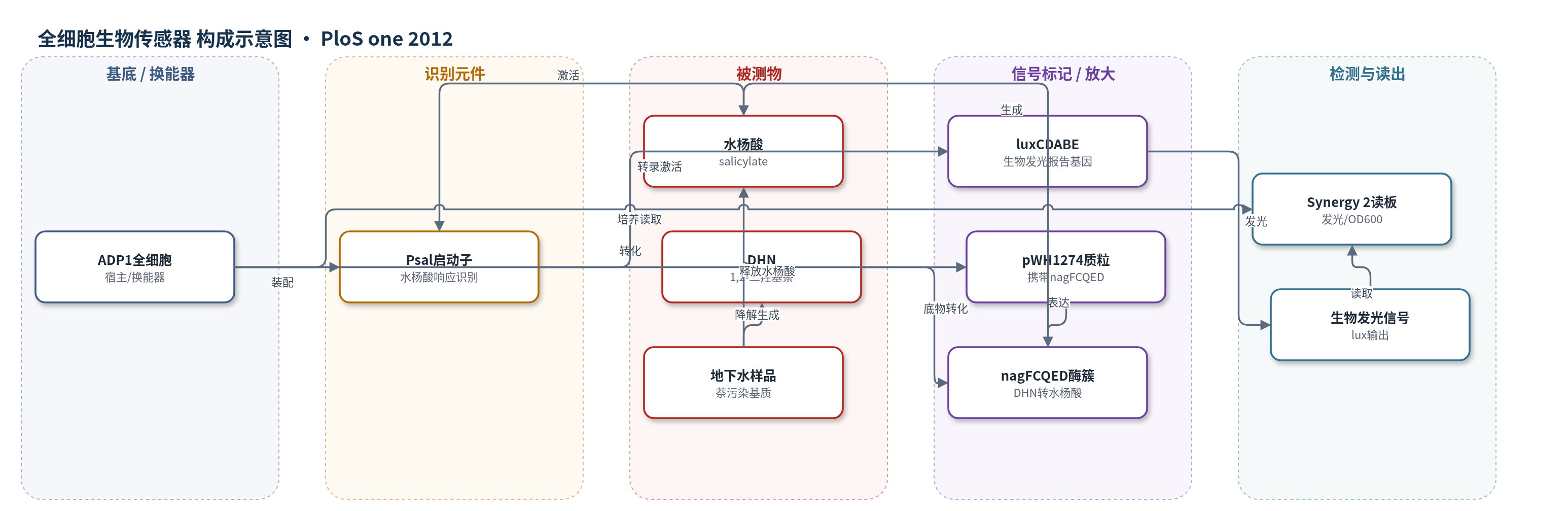
点击图片查看大图 · 依据论文自动绘制
传感器类型
全细胞生物传感器
检测对象
水杨酸(salicylate)、1,2-二羟基萘(DHN);样品基质:萘污染地下水、DHN 溶液、最小培养基(MMS)
检测原理
BGT 以 A. baylyi ADP1 全细胞为换能器。细胞染色体中 salA/salR 之间插入无启动子 luxCDABE,其上游为水杨酸响应启动子 Psal。当水杨酸进入细胞并激活 Psal 时,luxCDABE 转录翻译产生荧光素酶,催化荧光素氧化并发出光子,发光强度随水杨酸浓度增加而增强。若细胞携带 pWH1274-nagFCQED 或 pWH1274-nahFCQED,Ptet 组成型启动子驱动酶簇表达,将 DHN 转化为水杨酸;因此 DHN 浓度或基因簇活性越高,生成的水杨酸越多,发光越强。无 DHN 或空载质粒不产生水杨酸,故不发光。该策略通过全细胞基因表达和荧光素酶催化实现信号放大,可用于筛选功能基因簇并监测地下水萘降解产生的水杨酸。
检测灵敏度
原文未报告 LOD、线性范围、灵敏度斜率或相关系数。
效应效果
该全细胞生物传感器具有明确的选择性:阴性对照 ADPWH_1274 在 50 mM DHN 下不发光,ADPWH_Nag 与 ADPWH_Nah 在无 DHN 时保持沉默,加入 50 mM DHN 后 5 min 内即被诱导发光。SIP 13C-DNA 焦磷酸测序显示 Acidovorax sp. 占 16S-rRNA reads 的 55%,nag2 占 nag 相关 reads 的 64.3%,nag-CJ2 和 nag-U2 分别占 18.0% 和 17.7%;12C 与 13C 分部分别获得 269,001 和 797,526 reads。水杨酸在 120 h 达到峰值并于 144 h 回落至背景,表明原位萘降解发生。BGT 克隆序列与焦磷酸测序一致,排除组装假象。作者认为 SMB 工具箱可深入解析未培养微生物及其生态功能。
传感器的构成
- 宿主细胞层:A. baylyi ADP1 全细胞,作为生物传感器换能器,提供水杨酸响应调控系统。
- 识别元件:染色体 salA/salR 间插入的 Psal 水杨酸响应启动子,识别水杨酸并启动报告基因转录。
- 报告基因层:pSB417 来源的无启动子 luxCDABE 生物发光基因簇,受 Psal 控制,产生荧光素酶。
- 功能基因载体:pWH1274 E. coli-Acinetobacter 穿梭质粒,携带 nagFCQED 或 nahFCQED,受 Ptet 组成型启动子控制。
- 信号转化酶簇:nagFCQED/nahFCQED 编码酶,将 1,2-二羟基萘(DHN)转化为水杨酸。
- 信号底物:DHN 或水杨酸钠,作为诱导/检测底物,触发 Psal 启动子激活。
- 培养与读出介质:MM/MMS 最小培养基(含琥珀酸盐、氨苄西林等)支持细胞生长;Synergy 2 微孔板读板仪读取生物发光与 OD600。
中文摘要
自然界中绝大多数微生物尚未培养,功能未知。序列宏基因组只能回答“谁在那里”,不能回答“它们在做什么、谁在做以及如何做”。功能宏基因组可揭示基因功能,但受筛选特异性和灵敏度限制,尤其难以鉴定表达无可区分活性或表型的基因。本文报道基于生物传感器的基因转导器(BGT)技术,利用全细胞生物传感器定量检测插入基因编码的指定功能表达,以筛选未培养微生物中未知基因的功能。作者将 BGT 与稳定同位素探针(SIP)宏基因组整合为非培养 SMB 工具箱,并在萘污染地下水中验证。SIP 13C-DNA 测序显示未培养 Acidovorax sp. 是原位关键萘降解菌,尽管同地下水存在三种可培养 Pseudomonas sp. 降解菌。BGT 验证新 nag2 操纵子功能,其与两个 nag 和两个 nah 操纵子共存。焦磷酸测序表明 nag2 是原位萘降解关键操纵子,并与 Ralstonia sp. U2 和 Polaromonas naphthalenivorans CJ2 的 nag 操纵子同源。该工具箱有助于解析未培养微生物的生态作用。
英文摘要
Most microorganisms in nature are uncultured with unknown functionality. Sequence-based metagenomics alone answers 'who/what are there?' but not 'what are they doing and who is doing it and how?'. Function-based metagenomics reveals gene function but is usually limited by the specificity and sensitivity of screening strategies, especially the identification of clones whose functional gene expression has no distinguishable activity or phenotypes. A 'biosensor-based genetic transducer' (BGT) technique, which employs a whole-cell biosensor to quantitatively detect expression of inserted genes encoding designated functions, is able to screen for functionality of unknown genes from uncultured microorganisms. In this study, BGT was integrated with Stable isotope probing (SIP)-enabled Metagenomics to form a culture-independent SMB toolbox. The utility of this approach was demonstrated in the discovery of a novel functional gene cluster in naphthalene contaminated groundwater. Specifically, metagenomic sequencing of the (13)C-DNA fraction obtained by SIP indicated that an uncultured Acidovorax sp. was the dominant key naphthalene degrader in-situ, although three culturable Pseudomonas sp. degraders were also present in the same groundwater. BGT verified the functionality of a new nag2 operon which co-existed with two other nag and two nah operons for naphthalene biodegradation in the same microbial community. Pyrosequencing analysis showed that the nag2 operon was the key functional operon in naphthalene degradation in-situ, and shared homology with both nag operons in Ralstonia sp. U2 and Polaromonas naphthalenivorans CJ2. The SMB toolbox will be useful in providing deep insights into uncultured microorganisms and unravelling their ecological roles in natural environments.