组成图示
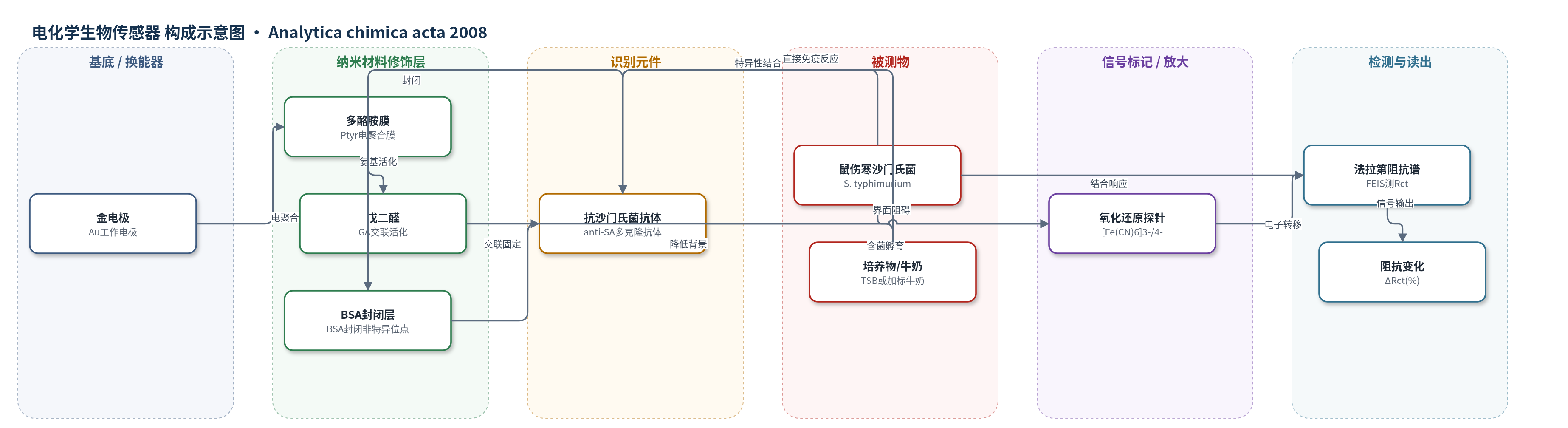
点击图片查看大图 · 依据论文自动绘制
传感器类型
电化学生物传感器
检测对象
鼠伤寒沙门氏菌(Salmonella typhimurium, S. typhimurium);样品基质为TSB纯培养物及加标牛奶
检测原理
传感器以Au/Ptyr/GA/anti-SA为识别界面,BSA封闭非特异位点。检测时,含S. typhimurium的培养物或牛奶直接孵育于电极表面,多克隆抗体与细菌抗原特异性结合。细菌结合及活菌在培养物中增殖使电极界面电荷分布、空间位阻和双电层结构改变,降低六氰合铁(II)/(III)氧化还原探针向金电极表面的电子转移速率。法拉第电化学阻抗谱在+0.200 V、10 mV rms下记录Nyquist/Bode谱,以0.1 Hz处实部阻抗Rct作为响应。被测菌浓度越高或孵育时间越长,界面阻碍越强,Rct相对变化ΔRct(%)越大,从而实现无标记定量检测。
检测灵敏度
LOD: 10 cfu mL−1(3 h孵育);动态范围: ∼10–10^7 cfu mL−1;3 h孵育信号变化: 10^4、10^5、10^6、10^7 cfu mL−1分别对应66%、90%、120%、190%;10 h孵育: 10 cfu mL−1对应88%、100 cfu mL−1对应130%
效应效果
该传感器在TSB标准培养物中3 h孵育可检出10 cfu mL−1 S. typhimurium,10 h信号变化达88%;10^4–10^7 cfu mL−1菌液3 h信号变化为66%–190%。以大肠杆菌为阴性对照,2 mg mL−1 BSA封闭使培养物背景可忽略,兼顾背景、选择性和灵敏度;牛奶中酪蛋白胶束、脂肪酸等产生背景,3 mg mL−1 BSA仅轻微降低背景且灵敏度下降,故2 mg mL−1最佳。加标牛奶(5×10^4 cfu mL−1)6 h可区分阳性与阴性;初始100 cfu mL−1需约10 h使信号高于背景。相比ELISA/PCR及电化学ELISA,该方法直接在培养物中反应,省去离心、洗涤和酶标抗体步骤,EIS测量约10 min,适合现场检测。
传感器的构成
- 基底/换能器电极:金电极(Au),作为工作电极提供法拉第阻抗换能
- 修饰层:电聚合多酪胺膜(Ptyr),提供末端氨基并稳定界面
- 交联活化层:戊二醛(GA),活化Ptyr氨基并交联固定抗体
- 识别元件:多克隆抗沙门氏菌抗体(anti-SA),特异性识别S. typhimurium
- 封闭层:牛血清白蛋白(BSA),封闭非特异性结合位点
- 氧化还原探针:六氰合铁(II)/(III)([Fe(CN)6]3-/4-),用于法拉第电化学阻抗谱读出
- 样品介质:磷酸盐缓冲液(PBS)、胰酪大豆胨肉汤(TSB)或牛奶,用于免疫反应与测量
中文摘要
本文首次报道了一种基于电聚合多酪胺(Ptyr)膜的法拉第阻抗免疫传感器,用于牛奶中鼠伤寒沙门氏菌(S. typhimurium)的检测。多克隆抗沙门氏菌抗体在戊二醛蒸气存在下交联固定于Ptyr修饰金电极上。通过电容测量评估Ptyr膜的介电行为,通过阻抗测量考察其中性水溶液中的稳定性,并研究成膜液中酪胺浓度对免疫传感器灵敏度和动态范围的影响。在六氰合铁(II)/(III)氧化还原电对存在下,用法拉第电化学阻抗谱测量不同修饰或识别步骤引起的电极界面特征变化。对于初始浓度为10 cfu mL−1的S. typhimurium样品(即传感器检出限),孵育3 h和10 h后分别获得33%和88%的信号变化。为实现生物传感器所需的操作简便性,免疫反应直接在培养物中进行,从而省去离心和洗涤等细菌分离步骤,使该免疫传感器有望用于现场检测。最后,该传感器成功用于实验加标牛奶样品中S. typhimurium的检测。
英文摘要
The development of a faradic impedimetric immunosensor based on electropolymerized polytyramine (Ptyr) films for the detection of S. typhimurium in milk is described for the first time. Polyclonal anti-Salmonella was cross-linked, in the presence of glutaraldehyde vapors, on Ptyr-modified gold electrodes. The dielectric behaviour of Ptyr films was evaluated with capacitance measurements, while their stability in neutral aqueous solutions was examined with impedimetric measurements. The effect of the concentration of tyramine in the forming solution on both the sensitivity and the dynamic range of the resulted immunosensors was also investigated. The alteration of the interfacial features of the electrodes due to different modification or recognition steps, was measured by faradic electrochemical impedance spectroscopy in the presence of a hexacyanoferrate(II)/(III) redox couple. At samples containing a low initial concentration of 10 cfu mL(-1)S. typhimurium, that actually defines the LOD of the immunosensors, signal changes of 33% and 88% were achieved after 3 and 10 h incubation, respectively. To achieve the working simplicity expected by a biosensor, immunoreaction was performed directly in cultures. This resulted in the elimination of various centrifugation and washing steps, which are used for the isolation of bacteria cells from the culture, thus making the proposed immunosensors promising candidates for on-site applications. Finally, the proposed immunosensors were successfully used for the detection of S. typhimurium in experimentally inoculated milk samples.